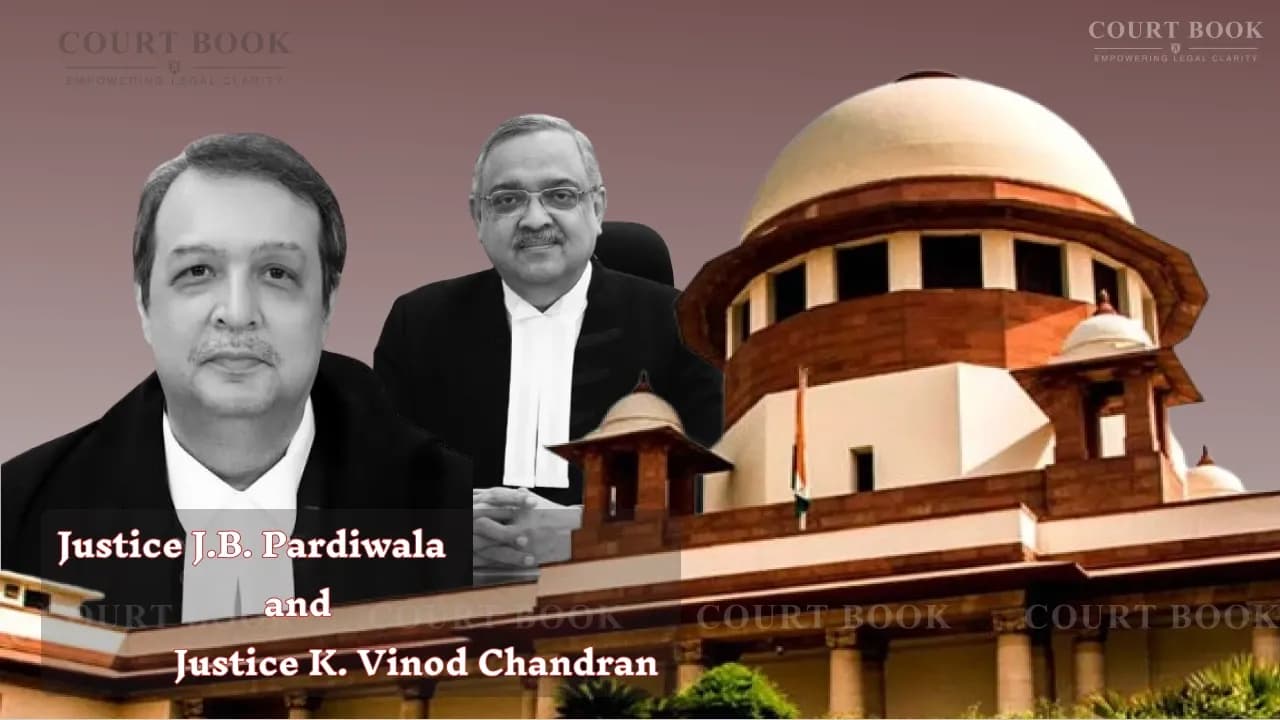
The judgment was delivered on September 3, 2026, by a Bench comprising Justice J.B. Pardiwala and Justice K. Vinod Chandran.
Background of the Case
The dispute arose from two housing projects of Granite Gate Properties Private Limited—‘Lotus Boulevard’ in Sector 100 and ‘Lotus Panache’ in Sector 110, Noida. The developer had taken the land from the New Okhla Industrial Development Authority (NOIDA) on perpetual lease for constructing high-rise residential complexes.
The developer subsequently entered insolvency proceedings and was declared a Corporate Debtor. A Committee of Creditors, consisting of homebuyers, was formed, and a resolution plan submitted by SMV Agencies Private Limited was approved.
The dispute before the Supreme Court concerned whether NOIDA’s time extension charges for delayed construction should be treated as CIRP costs, meaning expenses payable during the insolvency process.
The homebuyers argued that the delay was attributable to the erstwhile developer and that they should not be made liable for its default. NOIDA, however, maintained that payment of the charges was necessary for continuation of the projects.
Supreme Court’s Observation
The Court noted that the projects were originally intended to be completed in 2016, but the homebuyers were still waiting nearly a decade later. It also took note of the fact that the homebuyers had pooled their resources to keep the projects moving during the insolvency process.
The Court observed that the penalty was intended to deter a defaulting developer from delaying development. However, the original developer was no longer in control of the project, while the homebuyers and the successful resolution applicant were attempting to complete it.
“It is only proper that NOIDA waives the penalty charges”
The Bench further held that the homebuyers and the successful resolution applicant were being made to suffer for the past default of the Corporate Debtor, even though neither was responsible for the delay.
Decision
The Supreme Court held that, in the peculiar facts of the case, the delay penalty imposed by NOIDA could not validly be passed on to the homebuyers and the successful resolution applicant.
It set aside the directions requiring the time extension charges to be treated as CIRP costs. The Court also rejected NOIDA’s appeal seeking payment of time extension charges for the period extending beyond three years and up to ten years.
Accordingly, Civil Appeal No. 3132 of 2026 was allowed, while Civil Appeal No. 4207 of 2026 filed by NOIDA was dismissed.