

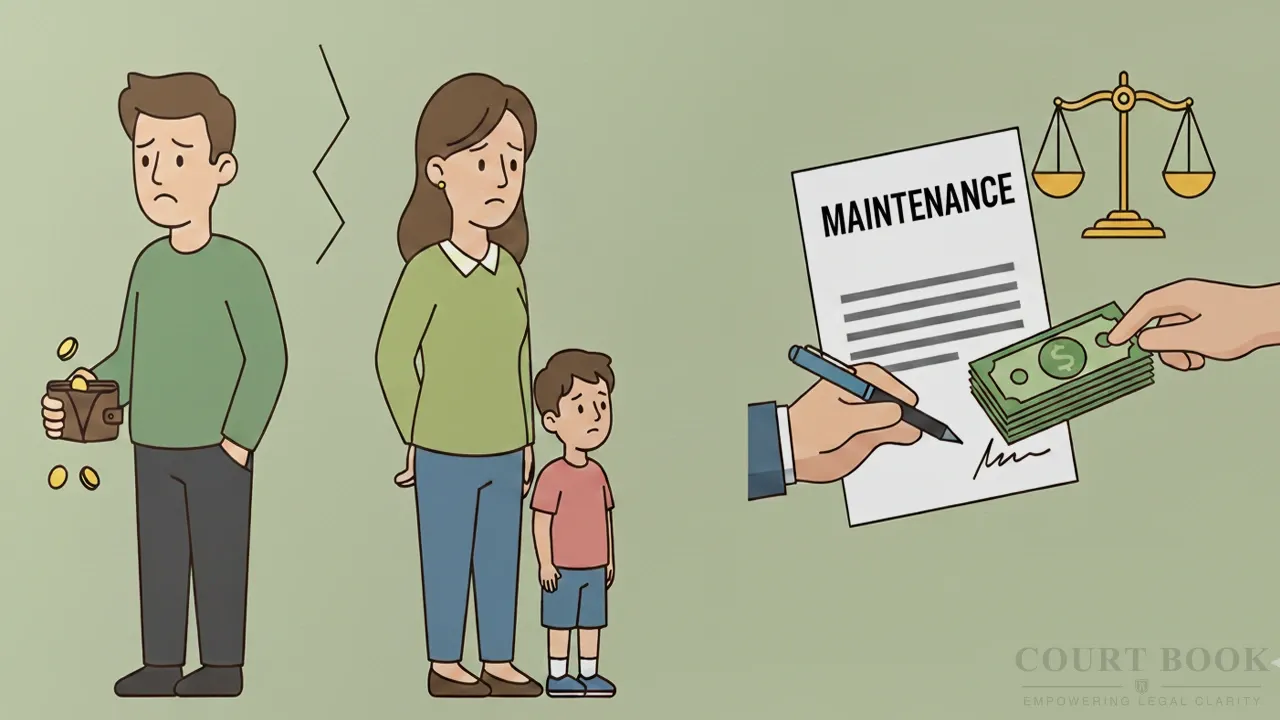
The Nagpur Bench of the Bombay High Court has refused to interfere with a Family Court order directing a husband to pay maintenance to his estranged wife, observing that “neglect” under Section 125 of the Criminal Procedure Code can be gathered from a husband’s conduct and need not always be expressed in words.
Justice Urmila Joshi-Phalke dismissed the husband’s criminal revision application challenging the maintenance granted by the Family Court at Nagpur.
Background of the Case
According to the wife, the marriage was solemnised on April 16, 2012. She alleged that soon after entering the matrimonial home, disputes began over dowry-related issues and she was subjected to physical and mental harassment.
She further claimed that on June 4, 2014, she was assaulted by the husband with a waist belt, after which she approached the police station and was referred to the Women Cell. Despite attempts by both families to resolve the dispute, reconciliation did not take place, and she eventually started living separately at her parental home.
The wife informed the court that the husband was employed in the Railway Department as a gangman and was earning around ₹25,000 per month, while she had no independent source of income.
The Family Court later directed the husband to pay maintenance of ₹5,000 per month from January 14, 2017 to December 31, 2020, ₹6,000 per month till August 31, 2024, and ₹7,000 per month thereafter.
The husband argued that the wife had left the matrimonial home on her own without sufficient reason and therefore was not entitled to maintenance. He also contended that the filing of a divorce petition by the wife showed that she was unwilling to cohabit with him.
His counsel submitted before the High Court that there was no proof of “refusal or neglect” on his part, which is a requirement under Section 125 CrPC for grant of maintenance.
The High Court examined the evidence placed on record and noted that the wife’s allegations regarding assault and harassment remained largely unshaken during cross-examination.
The bench also took note of the fact that the husband did not contest the divorce proceedings despite receiving notice.
“The burden that the wife is refusing to live with him is to be discharged by the husband,” the court observed while discussing the principles governing Section 125 CrPC.
Justice Joshi-Phalke further explained that refusal or neglect by a husband “may be proved not only by express words, but also by his conduct.”
The court noted that the husband had admitted during cross-examination that he had not taken steps to know how or where the wife was living after separation.
Referring to the Supreme Court’s ruling in Rajnesh vs Neha, the High Court reiterated that factors such as the financial condition of parties, reasonable needs of the claimant, and justification for living separately must be considered while fixing maintenance.
Holding that the Family Court’s order was “just and reasonable,” the Bombay High Court dismissed the husband’s revision application. The court also directed him to clear the arrears of maintenance within one month.
Case Details
Case Title: M J vs L M J
Case Number: Criminal Revision Application No. 183 of 2024
Judge: Justice Urmila Joshi-Phalke
Decision Date: April 10, 2026


