

The Supreme Court has reaffirmed that courts should be slow to reject documents during the evidence stage unless they are clearly irrelevant or legally inadmissible. While dismissing an appeal arising from a probate dispute, the Court held that merely exhibiting a document does not amount to proving its contents, and objections regarding admissibility can ordinarily be decided at the final stage of the trial.
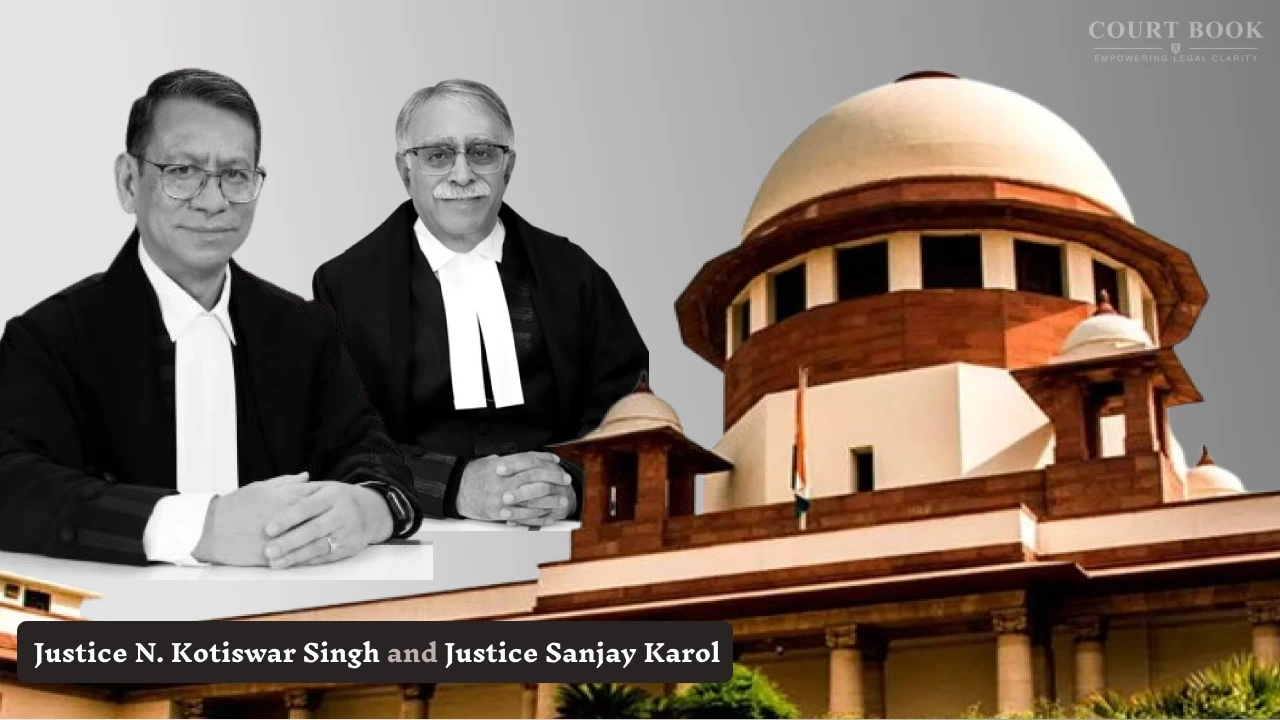
A Bench comprising Justice Sanjay Karol and Justice Nongmeikapam Kotiswar Singh delivered the judgment on August 7, 2026.
Background of the Case
The dispute arose from testamentary proceedings pending before the Madras High Court concerning the alleged will of late C. Shyamalavalli. Respondent Tmt. P. Ponni had filed proceedings seeking probate of the will. During the trial, the appellants challenged the respondent's proof affidavit, arguing that several averments and documents relied upon were irrelevant to the probate proceedings and should be excluded from the record.
The Single Judge rejected the application seeking exclusion of the affidavit. However, the court declined to mark certain xerox copies because the originals had not been produced and no explanation was offered for their absence. All other documents were permitted to remain on record for consideration during the trial.
The Division Bench later dismissed the appeal, observing that filing an affidavit by itself does not prove its contents and that excluding the material at such an early stage would prejudice the proceedings.
Court's Observations
Examining the matter, the Supreme Court found no reason to interfere with the concurrent findings of the Madras High Court. It observed that the trial court had correctly refused to mark photocopies for which no explanation regarding the absence of originals had been furnished. At the same time, the remaining documents could not be treated as prima facie inadmissible merely because objections had been raised against them.
The Bench referred to the landmark ruling in Bipin Shantilal Panchal v. State of Gujarat, reiterating that objections regarding admissibility of evidence except issues such as deficiency of stamp duty should ordinarily be noted during trial, with the documents tentatively marked and the objections decided while delivering the final judgment. This approach avoids unnecessary delays and repeated trials.
Quoting the earlier precedent, the Bench observed:
"Whenever an objection is raised during evidence-taking stage regarding the admissibility of any material... the trial court can make a note of such objection and mark the objected document tentatively as an exhibit... subject to such objections to be decided at the last stage in the final judgment."
The Court also clarified that simply marking a document as an exhibit does not establish the truth of its contents.
The Bench observed,
"Mere admission of a document in evidence does not amount to its proof... mere marking of exhibit on a document does not dispense with its proof, which is required to be done in accordance with law."
According to the Court, every document that has been exhibited must still be proved through legally admissible evidence before it can be relied upon.
Court's Decision
Dismissing the appeal, the Supreme Court upheld the Madras High Court's order dated August 21, 2024. It ruled that there was no justification to exclude the disputed documents at the threshold, except those photocopies already rejected by the Single Judge.
The Court further directed that the pending testamentary proceedings should continue independently and without being influenced by the observations made in the present judgment.
The interim stay granted earlier by the Supreme Court was also vacated.
Case Details
Case Title: S. Sangeetha & Ors. v. Tmt. P. Ponni
Case Number: Civil Appeal No. of 2026 (Arising out of SLP (C) No. 26326 of 2024)
Judge: Justice Sanjay Karol and Justice Nongmeikapam Kotiswar Singh
Decision Date: August 7, 2026


