

In a significant ruling on Hindu inheritance law, the Supreme Court has held that a widow who inherits property alongside her stepdaughters cannot claim the status of a family manager, or “karta,” to sell the entire property on grounds of legal necessity. The Court ruled that all heirs inherited distinct and equal shares in the property and held it as tenants-in-common, not as members of a joint Hindu family.
Background of the Case
The dispute concerned agricultural land and houses left behind by Dajiba, who died without leaving a will. His widow, Darubai, and his four daughters became heirs to the property.
The daughters filed a partition suit in 1972 seeking separate possession of their shares. They argued that each of them was entitled to a share in the estate. Darubai defended a sale transaction involving part of the property, claiming that she had sold it due to legal necessity, including expenses related to a daughter’s marriage.
The trial court ruled in favour of the daughters. An appellate court later upheld the sale transaction. However, the Bombay High Court restored the trial court’s decision, leading Darubai to approach the Supreme Court.
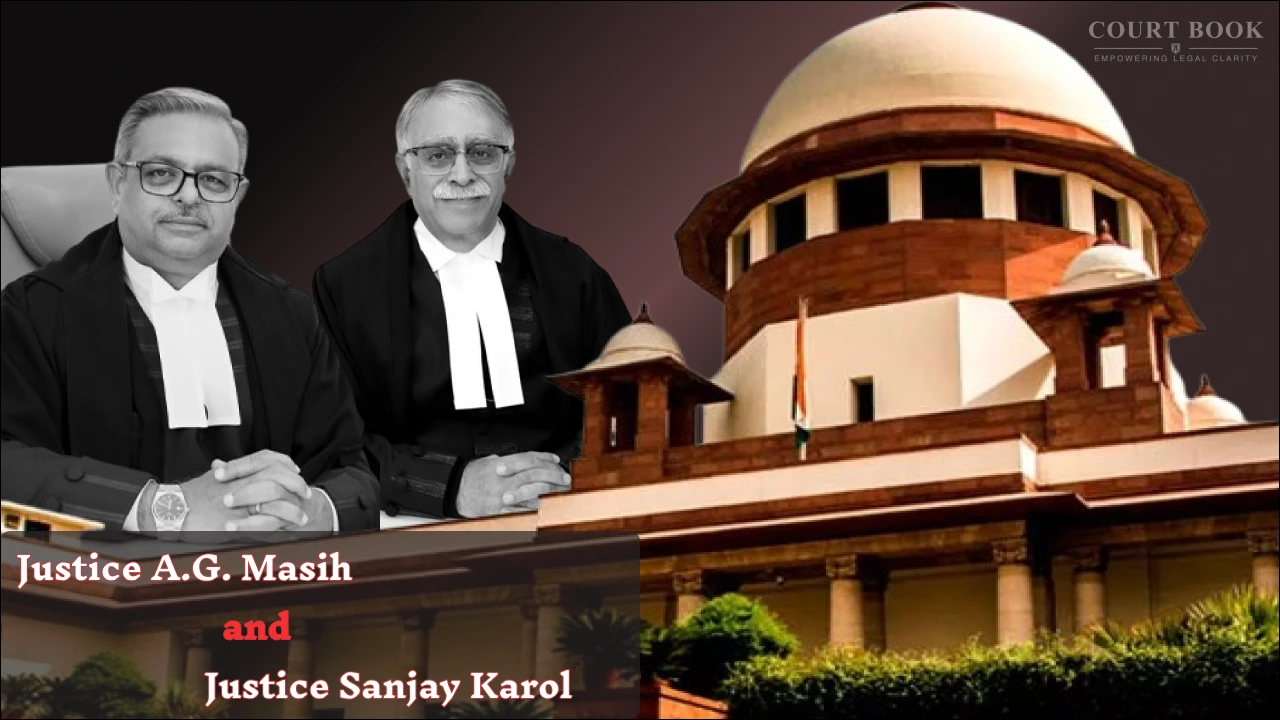
A bench of Justice Sanjay Karol and Justice Augustine George Masih examined whether Darubai could act as a karta of the family and whether the heirs inherited the property as joint tenants or tenants-in-common under the Hindu Succession Act, 1956.
Justice Sanjay Karol, writing for the Bench, explained that property inherited under Section 8 of the Hindu Succession Act devolves upon heirs as tenants-in-common. This means every heir receives a separate and identifiable share, unlike joint tenancy where ownership continues through the rule of survivorship.
The Court relied on earlier precedents, including CWT v. Chander Sen and Yudhishter v. Ashok Kumar, to reiterate that property inherited under Section 8 becomes the individual property of the heir and does not automatically become joint family property.
“The heirs succeed as tenants-in-common with definite and separate shares, and the property devolves by succession rather than by survivorship,” the Bench observed.
The Court found that after Dajiba’s death, Darubai and the four daughters each acquired a one-fifth share in the property.
Because each heir held a separate share, Darubai could not claim authority over the entire estate as karta. The Bench held that she was free to deal only with her own one-fifth share and had no legal power to sell the shares belonging to the other heirs.
The Court stated that once the shares were separate and identifiable, “there arises no question of the defendant acting as karta to sell off a part of the property on account of legal necessity.”
Dismissing the appeal, the Supreme Court upheld the High Court’s judgment and confirmed that the widow and the four daughters inherited equal one-fifth shares in the property as tenants-in-common. The Court ruled that Darubai could not justify the disputed sale by claiming to act as karta of the family.
The Bench expressed hope that the decades-long family dispute would finally come to an end and directed that there would be no order as to costs.
Case Title: Darubai & Anr. v. Kamalabai & Ors.


