

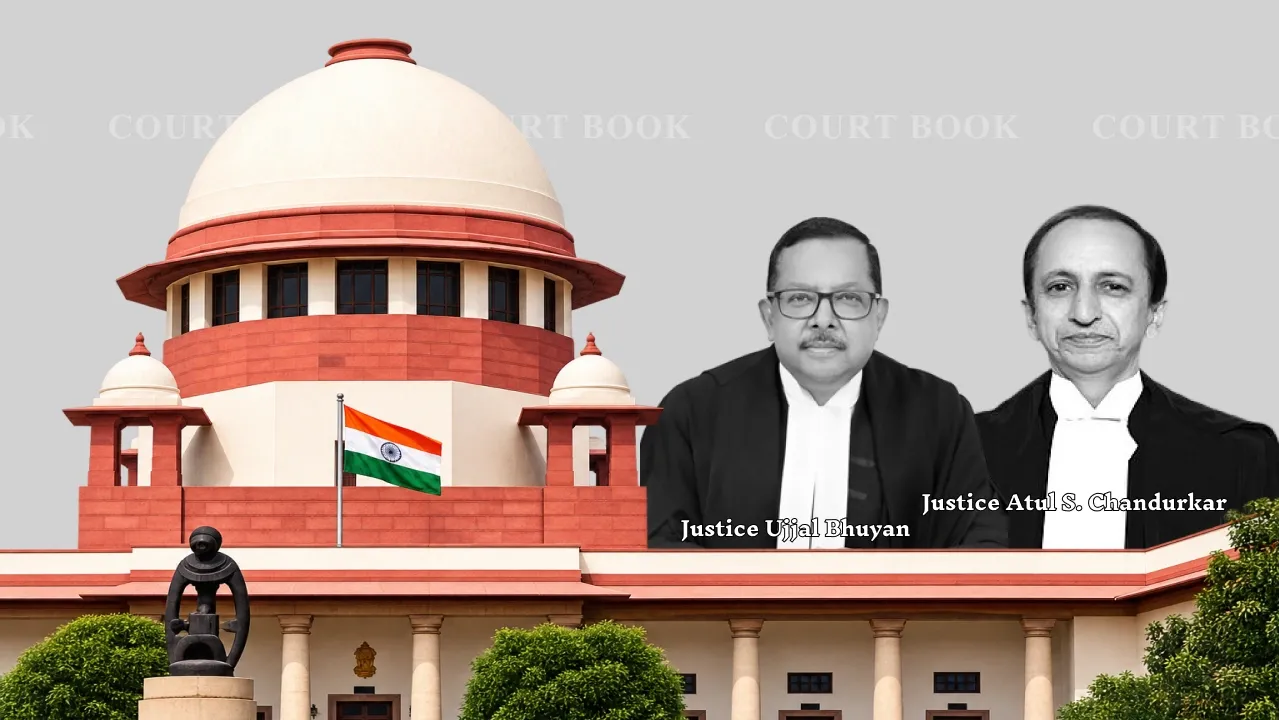
The Supreme Court has set aside the rape conviction of a man after finding that the testimony of the prosecutrix could not be rejected for the charge of abduction and then selectively relied upon to sustain a conviction for rape. The Court held that where the testimony is not of unimpeachable character, it cannot be divided according to the charge being considered.
A Bench of Justice Ujjal Bhuyan and Justice Atul S. Chandurkar delivered the judgment on September 25, 2026, in Paramjit Singh Bedi v. State of Punjab. The Court allowed Criminal Appeal No. 203 of 2015 and cleared the appellant of the charge under Section 376 of the Indian Penal Code.
Background
According to the prosecution case, the prosecutrix had left her home in Ludhiana on June 19, 2009, to purchase articles from a nearby shop. She alleged that the appellant took her first to an LIG flat in Ludhiana and later to an abandoned factory at Malerkotla, where she alleged that sexual intercourse took place against her will.
The appellant was initially tried under Sections 366 and 376 IPC. The Sessions Court, however, acquitted him of the Section 366 charge after finding that the prosecution had failed to establish that the prosecutrix was below 18 years of age or that she had been kidnapped or abducted. Despite this, the court convicted him under Section 376 IPC and sentenced him to 10 years of rigorous imprisonment and a fine of Rs. 5,000. The Punjab and Haryana High Court later upheld the conviction.
The Supreme Court closely examined the testimony of the prosecutrix and found several inconsistencies concerning her movements with the appellant.
The Court noted that, according to her own cross-examination, she travelled through crowded roads and brightly lit intersections while going from Ludhiana to Malerkotla on a scooter. She did not raise an alarm or attempt to get down from the scooter. Her account of the return journey also differed, as she stated in examination-in-chief that they returned by car, while in cross-examination she said they travelled by train.
The Court also considered the medical evidence. The doctor who examined the prosecutrix found no external injuries and no injury to her private parts. The Supreme Court further held that the presence of spermatozoa alone could not establish rape in the circumstances of the case.
The central issue before the Supreme Court was whether the same testimony could be treated as unreliable for one charge but accepted for another connected charge.
The Court held:
"There cannot be partial rejection of the evidence of the prosecutrix for the purpose of Section 366 IPC and partial acceptance of the very same statement for the purpose of proving the charge under Section 376 IPC. If the evidence of the prosecutrix is of unimpeachable character, it has to be accepted in its entirety. There cannot be part acceptance and part rejection of the statement of the prosecutrix."
The Court observed that the Sessions Court had already disbelieved the prosecution version concerning the Section 366 charge. Since the two charges were factually intertwined, the same prosecution version could not subsequently be relied upon to establish the Section 376 charge.
The Supreme Court also cautioned that a criminal conviction cannot be based merely on an assessment of whether the conduct attributed to an accused was immoral or unethical.
"While the conduct of the appellant may be immoral and unethical, that by itself would not justify a conviction under Section 376 IPC without any clinching evidence. Such a charge must be proved on the basis of hard evidence and not on the basis of the surmises and conjectures based on the value judgment of the presiding judge. Immorality of an act sans credible evidence cannot justify a conviction."
The Court further held that although a conviction for rape can, in an appropriate case, rest on the sole testimony of the prosecutrix, such testimony must inspire the confidence of the court.
The Supreme Court concluded that the conviction and sentence imposed by the Sessions Court and affirmed by the Punjab and Haryana High Court could not be sustained. It set aside both judgments and cleared the appellant of the charge under Section 376 IPC.
Criminal Appeal was accordingly allowed.
Case Details
Case Title: Paramjit Singh Bedi v. State of Punjab
Case Number: Criminal Appeal No. 203 of 2015
Judge: Justice Ujjal Bhuyan and Justice Atul S. Chandurkar
Decision Date: September 25, 2026


