

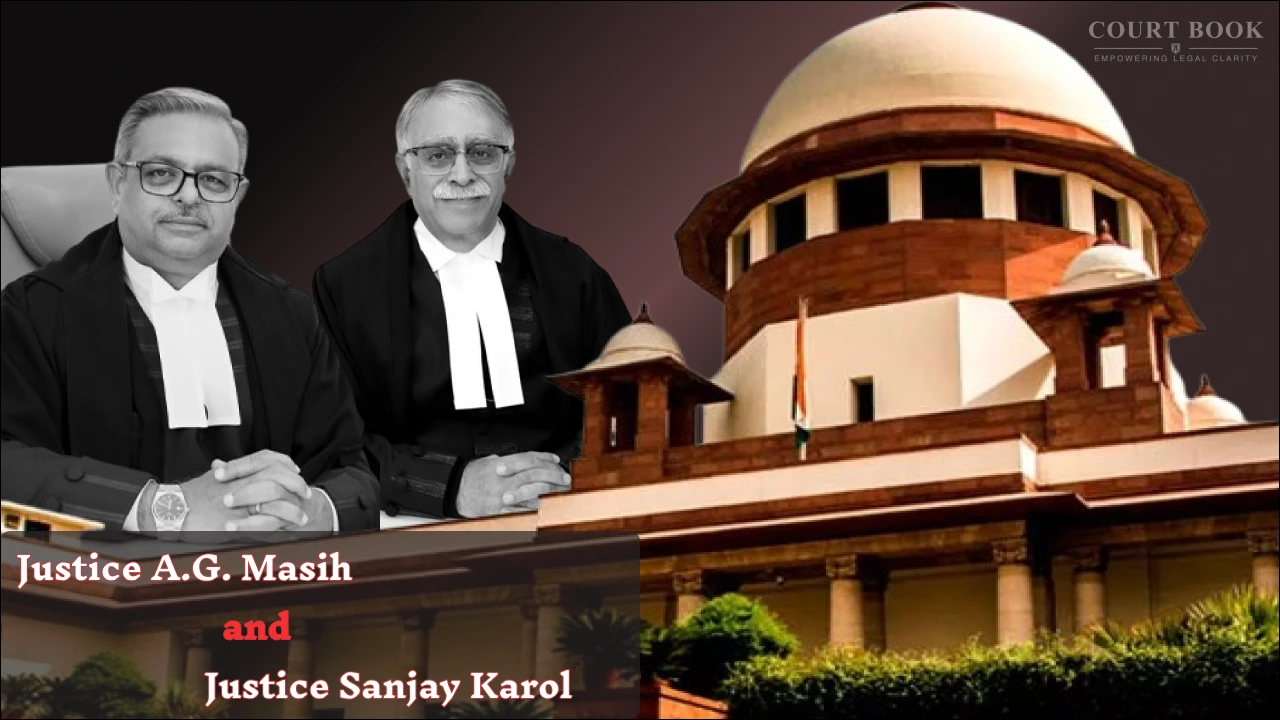
The Supreme Court has restored the promotion of a District Central Cooperative Bank officer in Chhattisgarh, holding that the Registrar of Cooperative Societies had the legal authority to amend the service rules governing promotions. Setting aside the judgments of the Chhattisgarh High Court, the Court ruled that the amendment removing restrictions on technical employees seeking administrative promotions was valid and that the appellant's promotion could not have been cancelled on that basis.
Background of the Case
The dispute arose from a promotion within the District Central Cooperative Bank, Raipur. The appellant, S. P. Chandrakar, was originally appointed to a technical post as an Assistant Engineer. In December 2010, he was promoted to the post of Additional Manager after a Departmental Promotion Committee recommended his elevation.
Another bank employee, Kishor Bagh, challenged the promotion, arguing that Rule 5(3)(a) of the Chhattisgarh District Cooperative Central Bank Employee Service Rules, 1982 prohibited employees appointed for technical work from being promoted to non-technical or administrative posts. The Single Judge accepted the challenge and quashed the promotion. The Division Bench later affirmed that decision, holding that there was no valid statutory amendment deleting the restriction.
Supreme Court Examines the Amendment
Before the Supreme Court, the central question was whether the Registrar of Cooperative Societies had lawfully amended the service rules by deleting Rule 5(3)(a), (b), and (c).
The Bench closely examined the statutory framework under the Chhattisgarh Cooperative Societies Act, 1960. It noted that Section 55 expressly empowers the Registrar to frame rules regulating service conditions of cooperative society employees.
The Court observed that this authority naturally includes the power to amend or delete existing rules.
As the Bench stated,
“A person authorised to frame rules also carries with him the requisite authorisation to amend, alter or delete.”
The Court relied on Section 21 of the General Clauses Act, 1897, which provides that the power to issue rules or notifications also includes the power to amend or rescind them.
Communication by Additional Registrar Was Valid
One of the objections before the High Court was that the communication announcing the amendment had been issued by the Additional Registrar rather than the Registrar himself.
The Supreme Court rejected this reasoning. It found that the communication specifically stated it had been issued "Ordered by Registrar." The State had also consistently maintained that the amendment was made under the Registrar's authority.
According to the Court, there was no legal bar preventing the Additional Registrar from communicating a decision taken by the Registrar.
The Bench observed that the form or description of the communication could not invalidate an otherwise lawful exercise of statutory power.
Requirement of Placing Rules Before the Legislature
The Court also dealt with the argument that the amended rules had not been laid before the Legislative Assembly as contemplated under Section 95(3) of the Act.
After examining earlier Constitution Bench decisions and precedents on statutory interpretation, the Supreme Court concluded that the requirement was directory rather than mandatory. Since the statute did not prescribe any consequence for non-compliance, failure to place the rules before the Legislature did not invalidate the amendment.
The Bench observed,
“In the absence of consequence, the laying procedure given in Section 95(3) is clearly directory. Non-compliance thereof cannot defeat the exercise of power by the Registrar.”
Court's Decision
Allowing the appeal, the Supreme Court held that the High Court had erred in treating the amendment as invalid. Since the Registrar had exercised statutory power to amend the service rules, the appellant's promotion could not have been set aside.
The Court further noted that the appellant had served on the promoted post for nearly thirteen years before the Single Judge delivered judgment because of prolonged judicial proceedings.
Accordingly, the Bench directed that S. P. Chandrakar be restored to the post and status from which he had been removed, his seniority be protected, and all consequential promotional benefits be granted in accordance with law. The Court also awarded him 50% back wages, directing payment within two months, failing which interest at 6% per annum would become payable.
The appeal was allowed and the judgments of the High Court were set aside.
Case Details
Case Title: S. P. Chandrakar v. State of Chhattisgarh & Ors.
Judge: Justice Sanjay Karol and Justice Augustine George Masih
Decision Date: July 30, 2026


