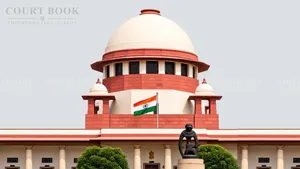
The Supreme Court has clarified that its earlier interim order regulating the use of audio and video recordings of court proceedings does not prevent recognised news organisations from reporting judicial hearings. The Court said the restriction applies only to the use and circulation of courtroom audio and video recordings, while fair reporting of proceedings can continue.
The clarification was issued by a Bench comprising Chief Justice of India Surya Kant, Justice Joymalya Bagchi and Justice V. Mohana on July 31, 2026.
Background of the Case
The matter arises from a public interest litigation filed by journalist Harshita Grover, seeking guidelines to regulate the unauthorised extraction, editing, circulation and monetisation of live-streamed court proceedings on social media and digital platforms.
On July 24, 2026, the Supreme Court had passed an interim order prohibiting the extraction, posting, reposting, uploading, transmission, storage or monetisation of audio and video recordings of judicial proceedings without prior permission from the Secretary General of the Supreme Court or the Registrar General of the concerned High Court.
Although that order had stated that recognised news outlets could continue reporting court proceedings, the Bench noted that uncertainty had remained regarding the scope of that clarification.
Court's Observation
Addressing the confusion, the Bench observed:
"The order is not to be construed as imposing a blanket prohibition on the reporting of court proceedings by recognised news outlets."
The Court further clarified:
"Such outlets may continue to report on the proceedings and inform the general public of legal developments and judicial pronouncements, save that audio or video clips of the court proceedings shall not be utilised in the course of such reportage."
The Bench emphasised that recognised media organisations remain free to publish accurate reports of hearings but must continue to comply with the restrictions on the use of courtroom recordings contained in the earlier interim order.
The Court also allowed intervention applications filed in the matter, permitting the applicants to assist during the proceedings.
Earlier Interim Directions
The July 24 interim order was issued after concerns were raised that edited or selective clips from live-streamed court proceedings were being circulated online, potentially presenting judicial proceedings out of context.
Along with imposing restrictions on the unauthorised use of courtroom recordings, the Supreme Court directed the Union Government to place before it a proposal, prepared in consultation with the relevant ministries, regarding the implementation of the reliefs sought in the petition. The High Courts were also asked to submit status reports on the adoption of the Model Rules for Live Streaming and Recording of Court Proceedings and explain the feasibility of uninterrupted live streaming.
Court's Decision
The Supreme Court clarified that recognised news organisations are permitted to continue reporting court proceedings and judicial developments. However, they cannot use audio or video clips of courtroom proceedings in their reports without the requisite permission.
The matter has been listed for further hearing on September 18, 2026.
Case Details
Case Title: Harshita Grover v. Union of India and Others
Case Number: W.P.(C) No. 751/2026
Judge: Chief Justice of India Surya Kant, Justice Joymalya Bagchi and Justice V. Mohana
Decision Date: July 31, 2026