

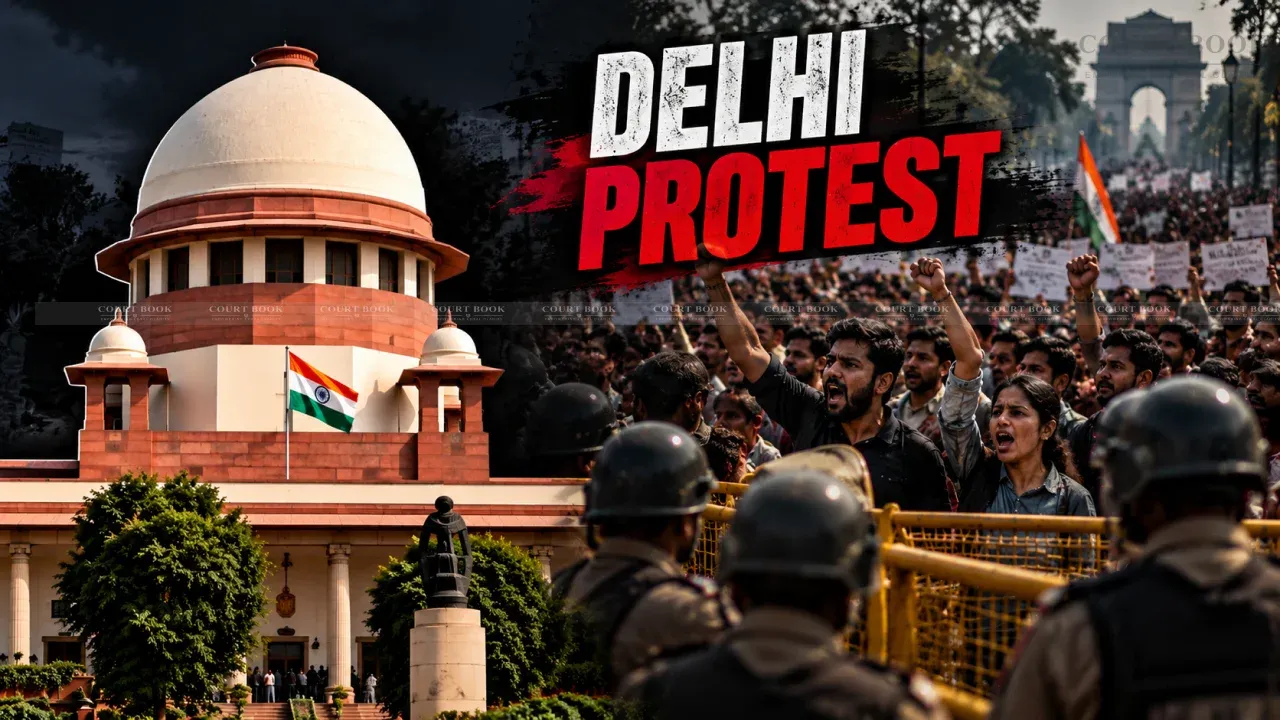
The Supreme Court on October 11, 2026, issued a series of directions concerning restrictions imposed in Delhi during protests against Chief Election Commissioner Gyanesh Kumar and the Special Intensive Revision (SIR) of electoral rolls. A Bench of Justice Joymalya Bagchi and Justice V. Mohana heard multiple petitions raising concerns over Metro station closures, alleged police excesses, preventive detentions and restrictions on peaceful assembly.
The Court also issued notice to authorities named in a contempt petition filed by advocate Shailendra Mani Tripathi, asking them to explain why contempt proceedings should not be initiated over the alleged violation of its earlier directions on public transport.
Background
The proceedings followed protests organised by the Cockroach Janta Party (CJP) at Jantar Mantar on October 10. Authorities had imposed security restrictions, including the closure or restricted access of Metro stations and measures to control movement in parts of the capital.
The earlier order dated October 9 had directed authorities to reconsider restrictions on Metro and railway services, making clear that public transport could be regulated but should not be stopped altogether.
Tripathi subsequently approached the Supreme Court, alleging that Metro stations remained closed despite the order. His petition named Union Home Secretary Govind Mohan, Delhi Police Commissioner Anurag Kumar and Delhi Metro Rail Corporation (DMRC) Chairperson D. Thara.
Other petitions raised concerns over the detention of political leaders, lawyers and protesters, as well as alleged excessive use of force and disruption of internet services.
Petitioners Raise Concerns Over Fundamental Rights
During Sunday's hearing, senior advocates argued that the restrictions had affected citizens' freedom of movement, access to legal assistance and right to peaceful protest.
Senior Advocate Shadan Farasat told the Bench that he had also been detained during the previous day's events. He said the issue extended beyond lawyers to the rights of ordinary citizens.
“The question we are raising is that we are part of a larger subset of citizens of this country. We don't have any separate special rights as lawyers. So all we are submitting is this. Yesterday, the situation in the city was, I can say, remarkably suppressive,” Farasat submitted.
Senior Advocate Menaka Guruswamy, appearing in connection with a petition challenging the detention of political leaders, also questioned the reported scale of the detentions and the restrictions imposed during the protests.
The allegations included claims that people were prevented from reaching the protest site, lawyers were detained while marching peacefully, and women protesters were mistreated. These claims were submissions before the Court and were not final judicial findings.
Centre Responds to Metro Closure Allegations
Solicitor General Tushar Mehta, appearing for the Central government, disputed the suggestion that Metro operations had been reduced across the network. He submitted that trains had operated according to their scheduled timetable, although several stations had been closed or access restricted.
The Bench sought further details, including the specific stations affected and their locations on the network. Justice Bagchi observed that the position of closed stations mattered because restrictions at intermediate points could affect access even when services continued elsewhere.
The Solicitor General informed the Court that all Metro stations were open and internet services had been restored.
Supreme Court's Observations and Directions
The Bench directed authorities to ensure that Metro and railway facilities function normally unless restrictions are necessary to address public-order concerns under Article 19(2) of the Constitution.
It also ordered that free movement within Delhi be permitted subject to traffic regulations and that existing barricades be reviewed promptly in light of law-and-order requirements and traffic conditions.
The Court further directed that internet facilities remain undisturbed in accordance with law, clarifying that the order did not remove the authorities' powers under the Information Technology Act.
On detention and public assembly, the Bench said that no person should be detained except in accordance with the procedure established by law. Peaceful assembly should be permitted in accordance with applicable legal requirements, including the restrictions operating under Section 163 of the Bharatiya Nagarik Suraksha Sanhita (BNSS).
The Court also ordered the removal, if not already done, of a board outside the Supreme Court indicating the imposition of Section 163 in the surrounding area. It said the measure was necessary to ensure that citizens and lawyers could access the courts.
Decision
The Supreme Court issued notice to the alleged contemnors, directing them to file affidavits explaining why contempt proceedings should not be initiated. It also required a compliance report addressing the earlier order and directed that the other petitions mentioned during the hearing be tagged with the contempt proceedings.
The Bench directed that Metro and railway services continue according to their normal schedules, subject to lawful public-order restrictions, and reiterated its directions concerning movement, internet access, barricades, detention and peaceful assembly.


