

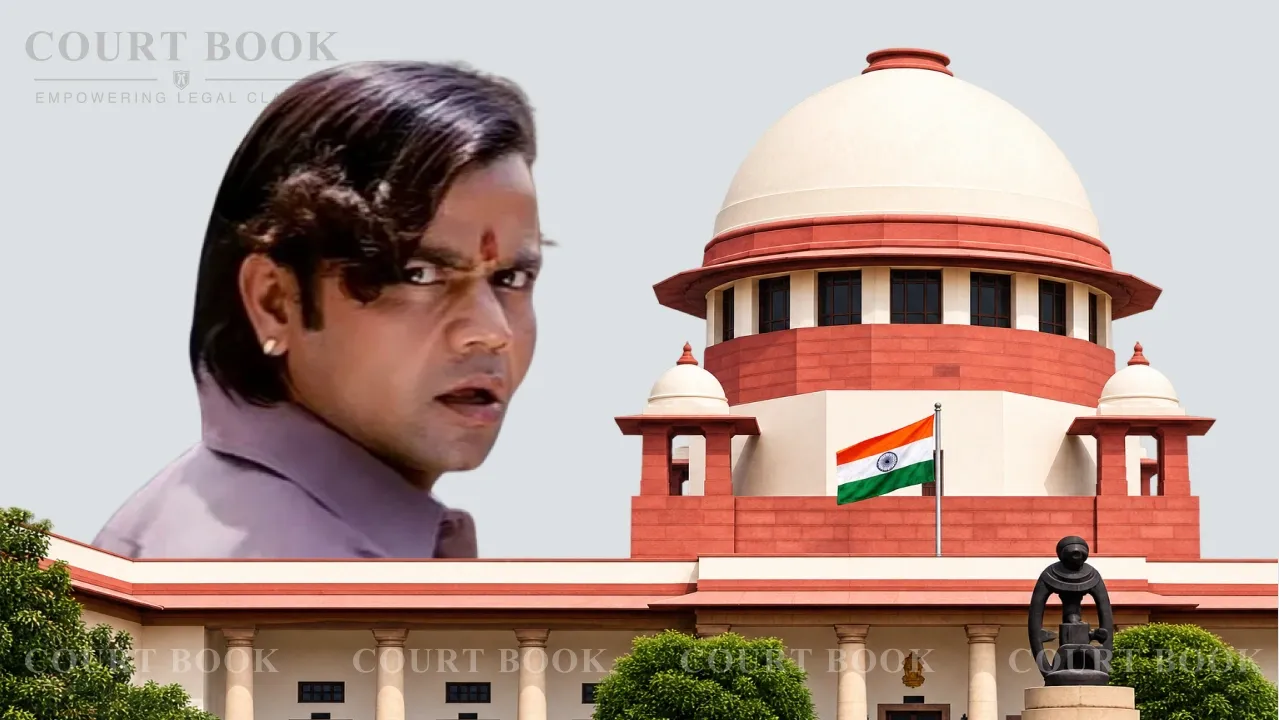
The Supreme Court on October 5, expressed strong displeasure with actor Rajpal Yadav for failing to comply with its direction to deposit ₹5 crore in connection with seven cheque-bounce cases involving M/s Murli Projects Pvt. Ltd. The Bench comprising Chief Justice of India Surya Kant and Justices Joymalya Bagchi and V. Mohana was informed that Yadav had produced a demand draft of only ₹50 lakh.
The Court questioned the genuineness of the payment document and criticised the failure to comply with the earlier undertaking. However, instead of dismissing Yadav’s challenge outright, the Bench chose to give him another opportunity to make the payment, keeping the complainant’s recovery in view.
Background
The dispute originates from financial assistance of ₹5 crore provided in 2010 in connection with Yadav’s film Ata Pata Laapata. According to the Delhi High Court judgment, the parties subsequently entered into several agreements as repayment was repeatedly extended and the amount payable was revised. Under the third supplementary agreement dated August 9, 2012, eight post-dated cheques were issued as security. Seven of those cheques later became the subject of proceedings under Section 138 of the Negotiable Instruments Act, which deals with cheque dishonour.
A consent agreement was subsequently executed on April 21, 2013, under which the parties agreed to a payment schedule. The Delhi High Court, in its July 10, 2026 judgment, ultimately upheld Yadav’s conviction in the seven cheque cases and maintained a three-month sentence, with the sentences directed to run concurrently.
The Supreme Court had earlier granted Yadav exemption from surrendering subject to a ₹5 crore deposit. On September 15, the Court granted him a final two-week opportunity and extended the protection until October 5.
When the matter came up on October 5, Yadav’s counsel informed the Bench that a ₹50 lakh demand draft had been prepared and was being processed by the bank. The explanation did not satisfy the Court.
The Bench questioned why the amount had not been deposited despite the time already granted. When counsel referred to bank holidays, the Court pointed out that Yadav had been given two weeks and could have approached the Court for an extension before the deadline expired.
During the hearing, the complainant’s counsel also criticised Yadav’s conduct, while Yadav’s counsel argued that the complainant was financially capable of waiting for the payment. The exchange prompted a sharp response from the Bench. The Court observed that it had so far refrained from dismissing the challenge because dismissal could affect the complainant’s prospects of recovering the money.
The Supreme Court directed that the payment be made by the following day and ordered the matter to be listed again as the first case after that. The Court therefore continued with the matter rather than dismissing Yadav’s challenge at this stage, while requiring compliance with the payment direction.
Case Title: Rajpal Naurang Yadav and another v. M/s Murli Projects Pvt Ltd
Case Number: SLP(Crl) 16923/2026


