

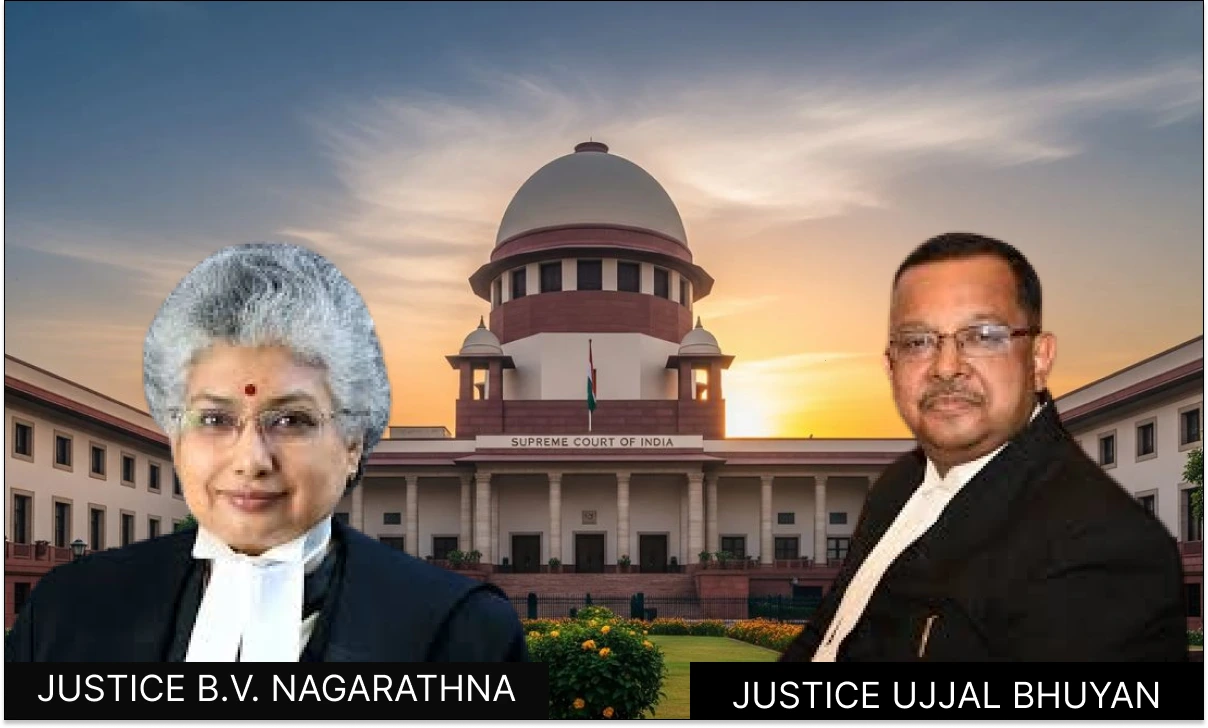
In a significant ruling on the distinction between civil and criminal disputes, the Supreme Court has quashed criminal proceedings initiated against two landowners accused of cheating and criminal breach of trust in connection with a failed joint development agreement. The Court held that the allegations arose from a contractual dispute and did not disclose the essential ingredients of criminal offences under Sections 406 and 420 of the Indian Penal Code.
A Bench of Justice B.V. Nagarathna and Justice Ujjal Bhuyan allowed the appeal and set aside the Madras High Court's order that had refused to quash the criminal case.
Background of the Case
The dispute stemmed from a Joint Development Agreement executed in May 2012 between landowners G. Saminathan and S. Radhika Malini and a construction company represented by its Joint Managing Director. Under the agreement, the developer paid a refundable security deposit of ₹3 crore, while the owners executed a General Power of Attorney to facilitate the proposed residential project.
However, the Chennai Metropolitan Development Authority later rejected the planning permission application after finding that the land formed part of an unapproved layout. Several years later, the landowners cancelled the power of attorney and sold the property to a third party, leading the developer to allege cheating, criminal breach of trust and dishonest conduct. An FIR was subsequently registered, followed by a chargesheet under Sections 406 and 420 read with Sections 109 and 34 of the IPC.
The Madras High Court declined to quash the proceedings, prompting the landowners to approach the Supreme Court.
Court's Observations
The Supreme Court closely examined whether the allegations disclosed the ingredients of criminal breach of trust or cheating.
The Bench observed that merely receiving a refundable security deposit under a commercial agreement did not amount to "entrustment" of property required for criminal breach of trust. It also noted that the record showed the landowners had offered to return the ₹3 crore deposit while seeking return of the original title documents, weakening the allegation that they intended to dishonestly retain the money.
The Court further emphasised that for the offence of cheating, dishonest intention must exist from the very beginning of the transaction. In the present case, both parties had initially acted to implement the development project, including execution of the power of attorney and submission of applications for planning permission. The project ultimately failed after statutory approval was refused. According to the Bench, these facts did not prima facie indicate fraudulent intent at the inception of the agreement.
Referring to earlier Supreme Court precedents, the Bench remarked:
"Mere breach of contract cannot give rise to criminal prosecution for cheating unless fraudulent or dishonest intention is shown right at the beginning of the transaction."
The Court also clarified that allegations of cheating and criminal breach of trust cannot ordinarily stand together on the same set of facts because the legal ingredients of the two offences are fundamentally different.
Court Warns Against Criminalising Civil Disputes
The Bench observed that the dispute essentially concerned contractual obligations arising from the development agreement and that the parties were already pursuing civil remedies, including arbitration proceedings and a challenge to the arbitral award.
It stated that allowing criminal prosecution to continue in such circumstances would amount to misuse of the criminal justice process. The Court relied on the principles laid down in State of Haryana v. Bhajan Lal and concluded that the case fell within recognised categories warranting quashing of criminal proceedings.
Decision
Allowing the appeal, the Supreme Court set aside the Madras High Court's judgment dated 28 March 2025. It quashed FIR No.181 of 2021, the chargesheet dated 23 March 2023, and all consequential criminal proceedings pending before the Metropolitan Magistrate, Special Court CCB, CBCID, Egmore, Chennai.
The Court clarified that its findings would not affect the parties' right to pursue appropriate civil remedies, which would be decided independently in accordance with law.
Case Details
Case Title: G. Saminathan & Another v. The State, represented by the Sub-Inspector of Police & Another
Case Number: Criminal Appeal No. of 2026 (Arising out of Special Leave Petition (Criminal) No. 10294 of 2025)
Judge: Justice B.V. Nagarathna and Justice Ujjal Bhuyan
Decision Date: 31 July 2026


