

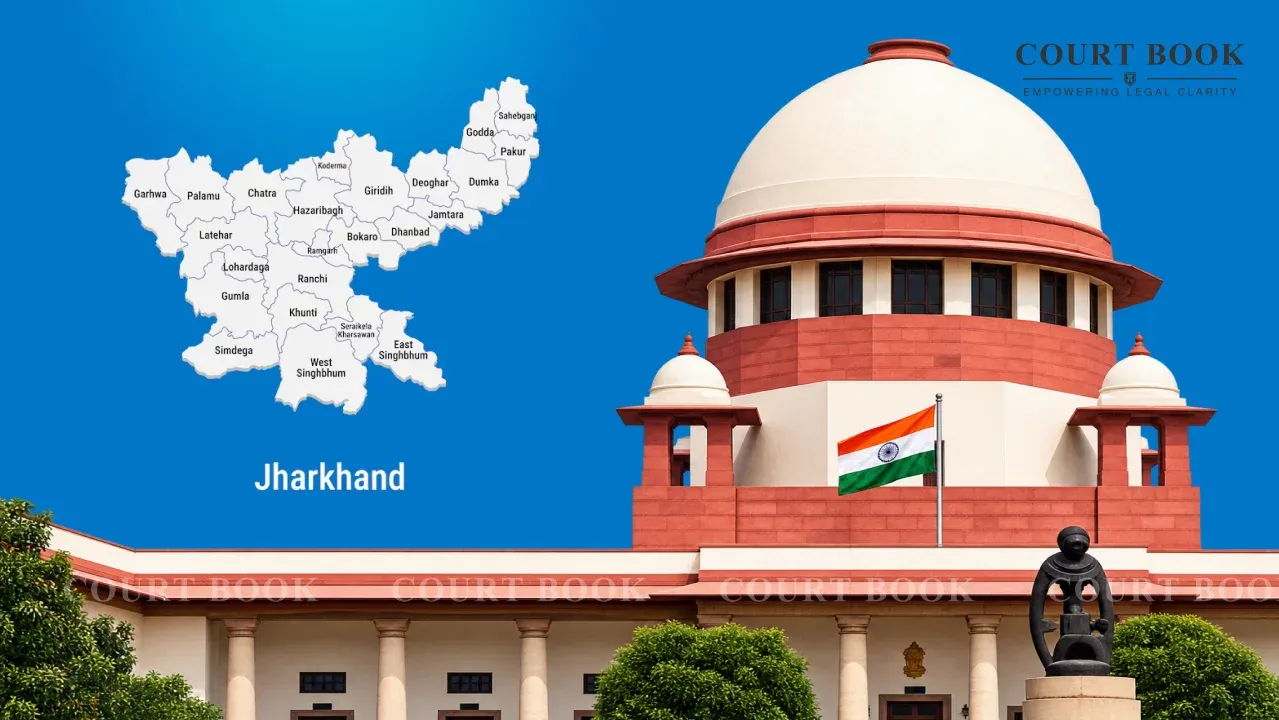
The Supreme Court on October 8 questioned the validity of a Jharkhand rule that permits an officer with less than six months of service remaining before retirement to be considered for appointment as the State’s Director General of Police (DGP).
A Bench comprising Chief Justice of India Surya Kant, Justice Joymalya Bagchi and Justice V. Mohana observed that the provision appeared, at the preliminary stage, to be inconsistent with the principles laid down by the Supreme Court in Prakash Singh v. Union of India, the long-running police reforms case.
The Court was hearing an application filed by the Union government challenging the Selection and Appointment of Director General and Inspector General of Police, Jharkhand (Head of the Police Force) Regulation, 2025, along with appointments made under the regulations.
Background
The dispute concerns the manner in which Jharkhand has framed its rules for appointing the head of its police force. The Centre has contended that the State’s regulations depart from the safeguards prescribed by the Supreme Court, including the requirement concerning residual service and the role of the Union Public Service Commission (UPSC).
The issue became particularly significant after IPS officer Tadasha Mishra was appointed Jharkhand DGP on December 30, 2025, a day before her scheduled retirement. The appointment gave rise to questions over whether an officer with such a short period of service remaining could be considered under the Supreme Court’s directions.
The Centre has also questioned the earlier appointment of IPS officer Anurag Gupta, arguing that the State’s approach to DGP appointments did not comply with the procedure laid down in Prakash Singh.
During Thursday’s hearing, the Bench noted that the Jharkhand provision appeared to depart from the six-month residual-service requirement.
The Court observed:
“An officer has been made eligible to be considered for appointment as Director General of Police of the State even where the residual service before superannuation is less than six months. Such a provision, prima facie, appears to be directly in conflict with the law laid down by this Court in Prakash Singh.”
The Bench also made it clear that its concern was about adherence to the law laid down by the Court and was not dependent on which political party was in power.
Justice Joymalya Bagchi said:
“Our concern is not who is in power at the Centre or State. Our bounden duty is to ensure that the law declared by this Court is not diluted.”
Senior Advocate Kapil Sibal, appearing for Jharkhand, questioned why the Union government had challenged the Jharkhand rules when, according to the State, similar questions could arise in other States.
Solicitor General Tushar Mehta, representing the Centre, maintained that the Union would have no objection to examining similar provisions elsewhere.
The Court consequently asked Amicus Curiae Senior Advocate Raju Ramachandran to examine the statutes, rules and regulations governing DGP appointments in other States as well and to assess their conformity with the principles laid down in Prakash Singh. The UPSC was also directed to assist the amicus in this exercise.
Since any decision affecting the challenged rule could have consequences for Tadasha Mishra’s appointment, the Supreme Court directed that she be given an opportunity to be heard.
The Bench gave the Jharkhand government one week to reconsider the provision. The State was also given the alternative of filing its response before the Court.
The Court ordered that the matter be listed after one week, while directing the amicus to assist it on the validity of the Jharkhand regulations and the corresponding rules and appointments in other States.


