

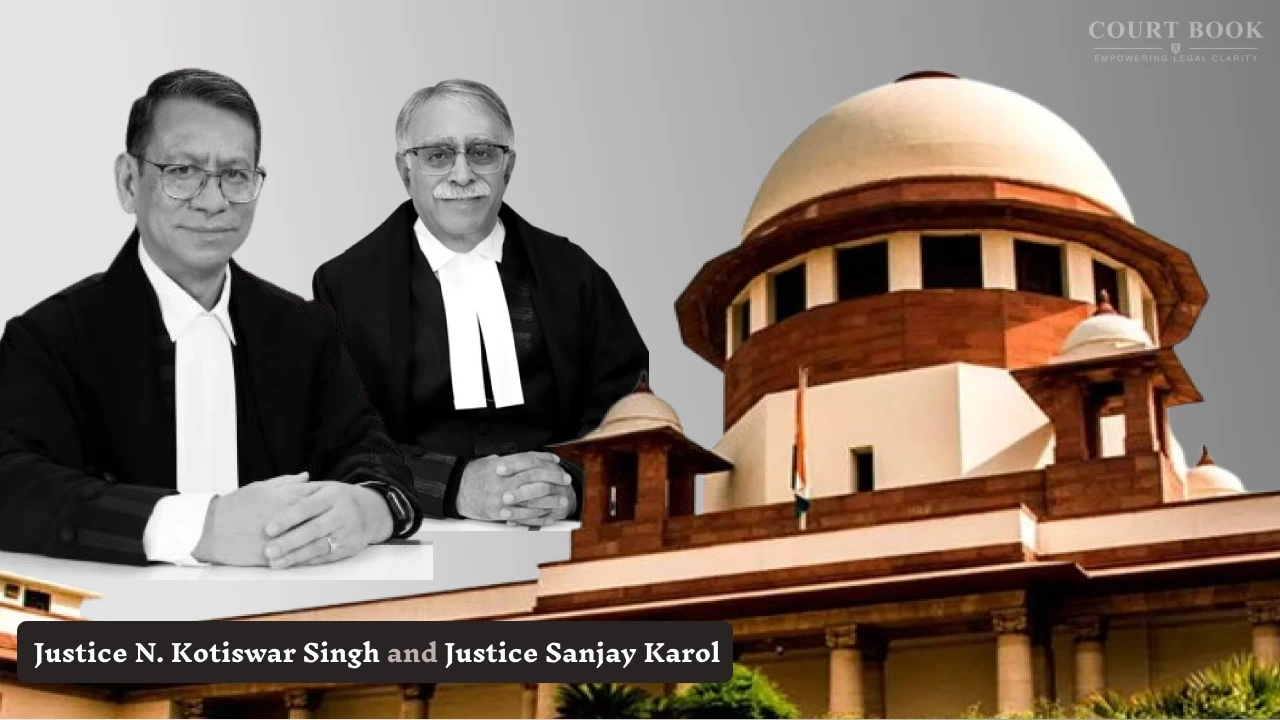
In a significant ruling on the scope of civil court jurisdiction in Scheduled Areas, the Supreme Court has held that disputes relating to succession and partition between exclusively non-tribal parties can be decided by ordinary civil courts even if the property is situated in a Scheduled Area. The Court ruled that the constitutional protections meant for Scheduled Tribes cannot be mechanically extended to disputes where no tribal interest is involved.
A Bench of Justice Sanjay Karol and Justice Nongmeikapam Kotiswar Singh delivered the judgment on August 6, 2026, allowing the appeal and restoring the second appeal before the Telangana High Court for consideration on merits.
Background of the Case
The dispute arose from a long-running family partition suit concerning agricultural land located in a Scheduled Area of present-day Telangana. The appellants claimed a share in the ancestral property, while the respondents contended that the family properties had already been partitioned decades earlier.
The trial court dismissed the partition suit, holding that the family branches had been enjoying separate possession for years. The first appellate court reversed that decision and treated the properties as joint family properties. However, the Telangana High Court later overturned the appellate judgment, holding that the civil court lacked jurisdiction because the land was situated in a Scheduled Area.
The matter eventually reached the Supreme Court.
Court's Observations
The Supreme Court undertook an extensive examination of the constitutional history behind Scheduled Areas, the protection granted to tribal communities, and the Andhra Pradesh Civil Courts Act, 1972.
The Bench noted that the purpose of excluding certain Scheduled Areas from the operation of the 1972 Act was to safeguard tribal communities, their customs, and their land rights. That objective, the Court said, does not automatically justify applying the same exclusion to disputes involving only non-tribal persons.
As the Bench observed,
"What is achieved by subjecting non-tribal people... to such special procedure? There is only one answer. Nothing."
The Court reasoned that such an interpretation would have no rational connection with the constitutional objective of protecting Scheduled Tribes.
The Court also examined the earlier decision in Nagarjuna Gramin Bank v. Medi Narayana and concluded that it did not lay down a binding legal principle on the jurisdictional issue because it was not based on a detailed interpretation of the governing statutory provisions.
"The High Court erroneously held the Civil Court not to have jurisdiction," the Bench observed, adding that applying the exclusion to parties who are not connected with the purpose of the legislation would amount to an incorrect use of the law.
Supreme Court's Decision
Allowing the appeal, the Supreme Court set aside the Telangana High Court's judgment and restored the second appeal for fresh consideration on merits.
The Court clarified that its ruling will apply only to pending and future cases involving exclusively non-tribal parties. It further held that if even one party to the dispute is a tribal residing in a Scheduled Area, the jurisdiction of the Agency Courts will continue to apply.
The Bench directed the parties to appear before the High Court on August 24, 2026, and requested that the matter be heard expeditiously.
Case Details
Case Title: Mukkera Venkata Ratnam & Ors. v. Vantasala China Venkateswarlu & Ors.
Case Number: Civil Appeal No. ...... of 2026 (Arising out of SLP (C) Diary No. 21610 of 2022)
Judge: Justice Sanjay Karol and Justice Nongmeikapam Kotiswar Singh
Decision Date: August 6, 2026


