

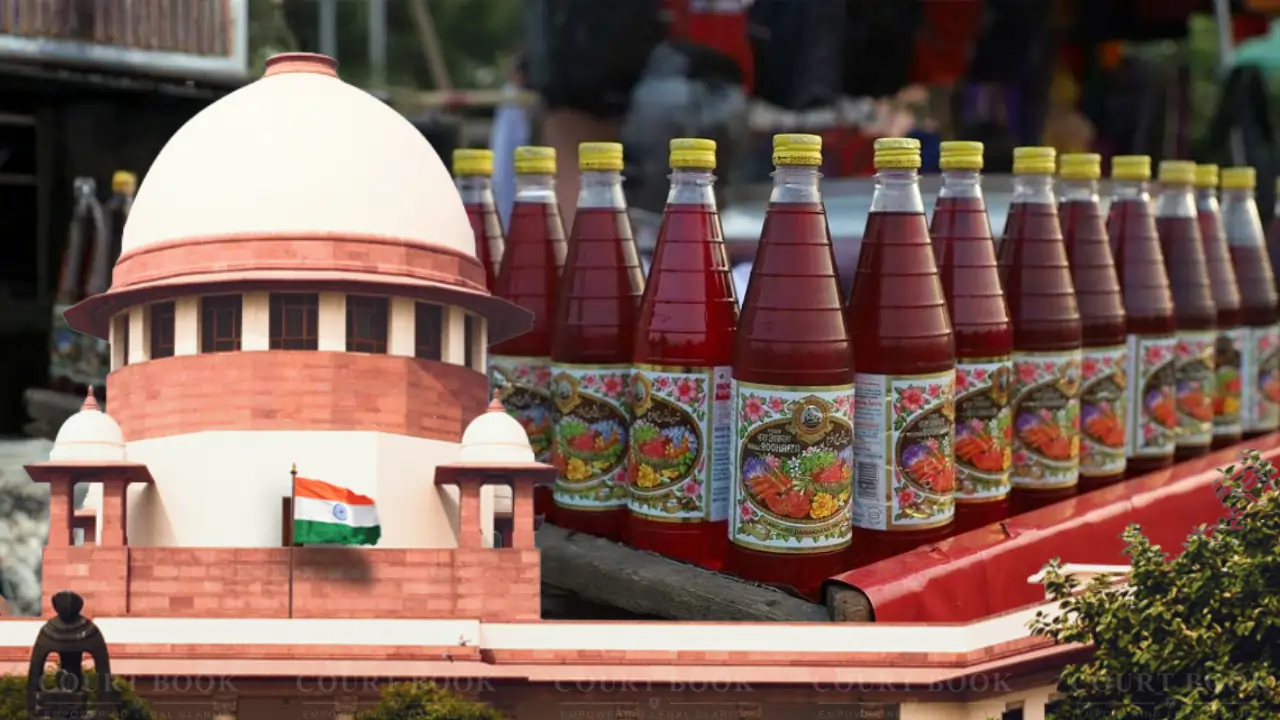
In a significant ruling for tax classification disputes, the Supreme Court of India has held that Sharbat Rooh Afza qualifies as a “fruit drink” under Uttar Pradesh VAT law and not as an unclassified item.
The verdict came in appeals filed by M/s Hamdard (Wakf) Laboratories, challenging a decision that had taxed the popular beverage at 12.5%. The Court ruled that the product should instead attract VAT at 4%, bringing relief to the manufacturer.
Read also:-Sikkim High Court Closes NHM Transfer Dispute After Amicable Settlement Between Employee
Background of the Case
The dispute related to the assessment period between January 1, 2008 and March 31, 2012.
Hamdard had classified Rooh Afza as a “fruit drink” under Entry 103 of Schedule II, Part A of the Uttar Pradesh Value Added Tax Act, 2008 (UPVAT Act). This entry covers processed or preserved fruits, including fruit drinks and fruit juices, and attracts a lower VAT rate of 4%.
However, tax authorities in Uttar Pradesh treated the product as an unclassified item under the residuary entry in Schedule V, levying VAT at 12.5%.
The Commercial Tax Tribunal and later the Allahabad High Court upheld the higher tax rate. Hamdard then approached the Supreme Court.
What Was the Core Issue?
The central question before the Court was simple but crucial:
Is Sharbat Rooh Afza a “fruit drink” under Entry 103, or does it fall under the residuary entry attracting higher tax?
Read also:-Patna High Court Dismisses Plea for Compensation Over Alleged Illegal Detention, Flags Lapses
The product contains about 10% fruit juice (8% pineapple and 2% orange), along with sugar syrup and herbal extracts. Authorities had relied heavily on food licensing norms that described it as a “non-fruit syrup” because it did not meet a 25% fruit juice threshold under food regulations.
Court’s Observations
The Bench of Justices B.V. Nagarathna and R. Mahadevan carefully examined the nature, composition, and commercial identity of the product.
1. Regulatory Labels Do Not Decide Tax Classification
The Court made it clear that food safety regulations cannot control how a product is classified under a tax law.
“The expression ‘fruit drink’ has not been defined under the UPVAT Act,” the Bench observed, adding that regulatory definitions under food laws operate in a different domain.
In tax matters, the statute must be interpreted in its own language.
2. Common Parlance Test Must Apply
Since the term “fruit drink” was not defined in the VAT Act, the Court applied the “common parlance test” - how the product is understood in the market by consumers and traders.
Read also:-Madras High Court Rules Grandparents Not ‘Family’ for Stamp Duty Concession in Settlement Deeds
The judges noted that classification must depend on how an average person perceives the product, not merely on technical or licensing descriptions.
Importantly, the Revenue had not produced any trade survey or evidence to show that Rooh Afza is not commercially understood as a fruit-based beverage.
“The Revenue has failed to discharge the burden cast upon it in law,” the Court said.
3. Essential Character of the Product
Though sugar syrup forms around 80% of the product by volume, the Court held that quantity alone is not decisive.
Applying the “essential character test”, the Bench observed that sugar acts as a carrier and preservative. The flavour and beverage identity come from the fruit juice and distillates.
Mechanical reliance on percentage composition, the Court cautioned, would be misplaced.
4. Inclusive Nature of Entry 103
Entry 103 uses the word “including”, which makes it broad and illustrative. It does not prescribe any minimum fruit percentage.
The Court held that it would be improper to read into the statute a 25% fruit content requirement when the Legislature itself did not provide one.
5. Residuary Entry Cannot Be Used Casually
The Bench reiterated that a residuary entry should be used only when a product clearly does not fit into any specific category.
“If a product reasonably answers the description of a specific entry, it cannot be consigned to the residuary clause,” the Court effectively emphasized.
Read also:-Gujarat HC Sends 17-Year-Old Girl to Mehsana Children Home After She Refuses to Return
Decision
Allowing the appeals, the Supreme Court held that Sharbat Rooh Afza is classifiable as a “fruit drink” under Entry 103 of Schedule II, Part A of the UPVAT Act.
It ruled that the product is liable to VAT at 4% and not 12.5%. The earlier judgments affirming classification under the residuary entry were set aside.
The Court directed authorities to grant consequential relief, including refund or adjustment of excess tax paid, in accordance with law.
Case Title: M/s Hamdard (Wakf) Laboratories v. Commissioner, Commercial Tax, U.P.
Case No.: Civil Appeal Nos. 2557–2578 of 2026
Decision Date: February 25, 2026
Download Judgment

