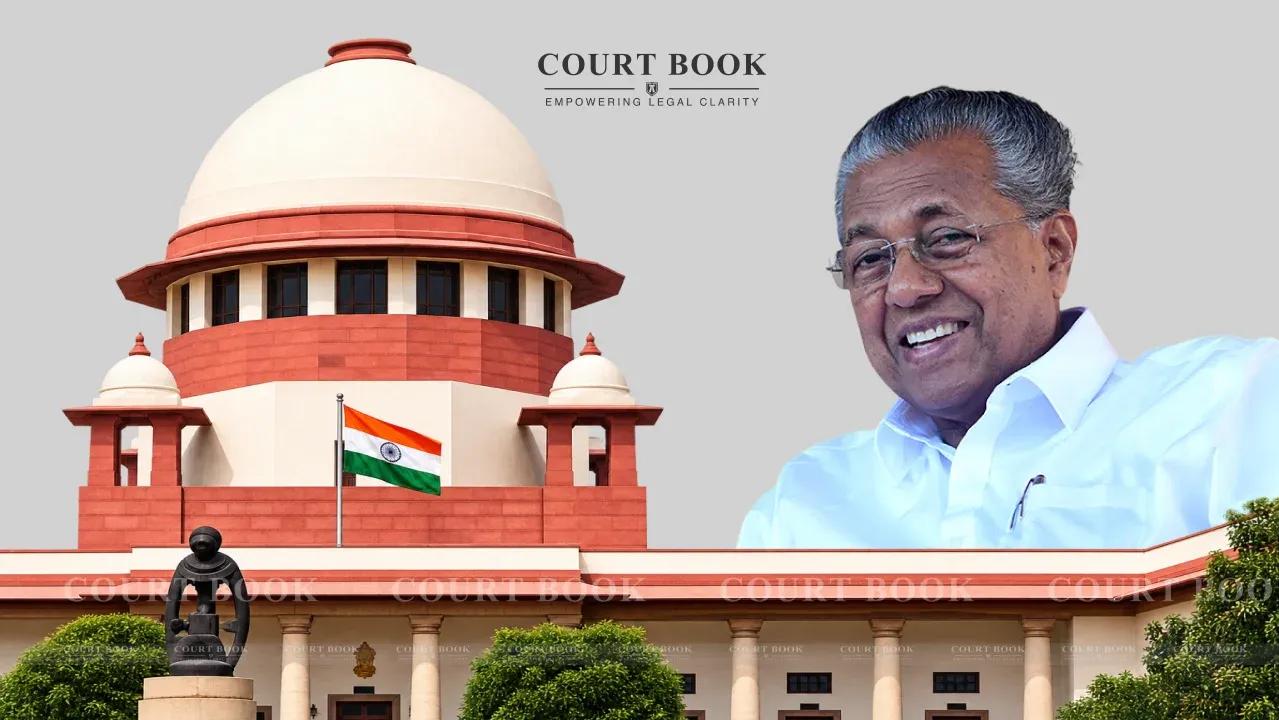
The Supreme Court on October 21 stayed the investigation in the CMRL-Exalogic case involving former Kerala Chief Minister Pinarayi Vijayan, his daughter Veena T, and son-in-law Mohammed Riyas for seven days. The Court set aside a Kerala High Court Division Bench order that had refused to allow them to pursue appeals against a single judge’s direction to register a First Information Report (FIR).
A vacation Bench of Justice Joymalya Bagchi and Justice V. Mohana held that the petitioners had made out a prima facie case to challenge the earlier order. It permitted them to pursue their appeals before the High Court’s Division Bench and seek interim relief in accordance with law.
The Supreme Court clarified that its observations concerned only their right to appeal and did not decide the merits of the allegations.
Background
The case concerns alleged irregularities in financial transactions between Cochin Minerals and Rutile Limited (CMRL) and Exalogic Solutions Private Limited, a company associated with Veena T.


According to the allegations, CMRL made payments totalling approximately ₹1.72 crore to Exalogic between 2017 and 2020 without corresponding services being provided. These allegations remain subject to legal proceedings.
The Enforcement Directorate (ED) forwarded information to the Kerala Police under Section 66(2) of the Prevention of Money Laundering Act (PMLA), requesting action under the Prevention of Corruption Act. The State government subsequently constituted a Special Investigation Team (SIT) to conduct a preliminary inquiry.
Lawyer KM Shajahan approached the Kerala High Court seeking registration of an FIR. On October 9, a single judge allowed his petition and directed the State Vigilance and Anti-Corruption Bureau to register the case. Vijayan and the other affected persons, who were not parties to the original writ proceedings, challenged that direction.
On October 15, the High Court’s Division Bench refused to permit them to pursue their appeals, prompting them to approach the Supreme Court.
During the hearing, the Bench examined whether the petitioners could be denied an opportunity to challenge a judicial direction that had resulted in an FIR against them.
The Court noted that the FIR had followed a High Court order rather than an independent decision by the State investigating agency. It also considered the significance of the State’s decision to conduct a preliminary inquiry before registering a case.
The Bench observed that the petitioners could be treated as aggrieved parties because the single judge had found that the material disclosed a cognizable offence and had directed further criminal proceedings.
The Court remarked,
“If the petitioners are not permitted to assail such finding of fact, the same shall stare at them in an independent proceeding challenging the FIR.”
The Bench also referred to Section 175(4) of the Bharatiya Nagarik Suraksha Sanhita (BNSS), which provides for additional procedural requirements in certain applications seeking investigation against public servants. It clarified that this reference was intended to explain the scope of a potential accused person’s right to challenge judicial intervention, not to decide the merits of the case.
Another issue concerned whether information supplied by the ED under Section 66(2) of the PMLA automatically requires a State agency to register an FIR.
The Bench questioned whether the Supreme Court’s earlier ruling in Vijay Madanlal Choudhary could be interpreted as imposing an unconditional obligation on State agencies to act on every such communication.
Justice Bagchi cautioned against allowing one agency’s statutory powers to intrude into the jurisdiction of another investigating authority.
“We will maintain the FIR, but no investigation until and unless these issues are decided by the appellate court,” the Bench observed.
The Court did not rule on whether the material forwarded by the ED ultimately justified an investigation under the Prevention of Corruption Act.
The Supreme Court set aside the Kerala High Court Division Bench’s order refusing permission to pursue the appeals. It allowed Vijayan, Veena T and Riyas to approach the Division Bench on the merits and seek interim relief in accordance with law.
The Bench directed that the investigation under the FIR remain stayed for seven days to enable the petitioners to pursue those remedies.
It expressly clarified that its observations were limited to the question of their right to appeal and did not constitute an opinion on the merits of the allegations.
The matter was thus left for consideration by the Kerala High Court’s Division Bench.
Case Title: Pinarayi Vijayan v Adv KM Shajahan
Case Number: SLP(Crl) No. 20437/2026