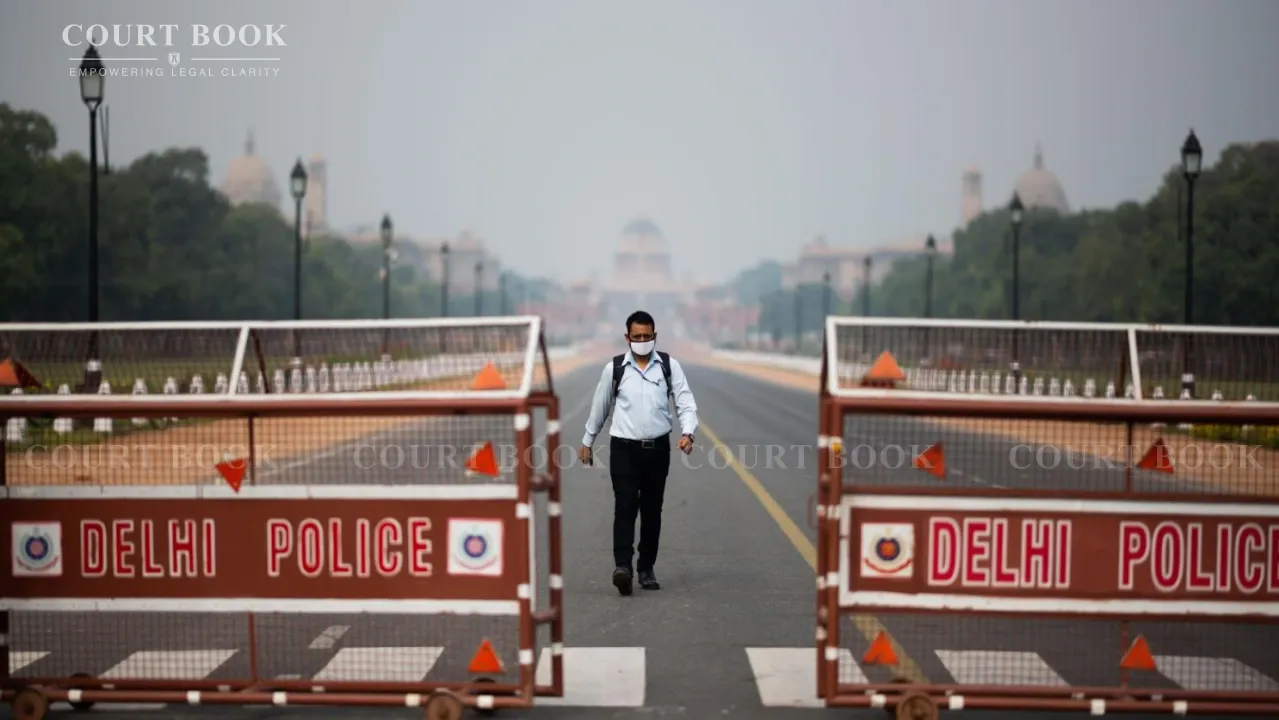
The Delhi High Court has quashed an FIR registered against a Delhi resident during the first nationwide COVID-19 lockdown, holding that merely walking on a public road, without proof of violation of essential legal requirements, does not amount to a criminal offence. The Court found that the prosecution had failed to establish the basic ingredients required for offences invoked under the Indian Penal Code (IPC).
Background of the Case
The case arose from FIR No. 105/2020 registered at Police Station Kishangarh on 28 March 2020. According to the police, Anupam Sahu was stopped while walking during the COVID-19 lockdown. He allegedly told the officers that he had stepped out because he was unable to remain indoors. Based on this, the police booked him under Sections 188, 269, 270 and 336 of the IPC and later filed a chargesheet.
Before the High Court, the petitioner argued that he had gone out for a medical follow-up due to severe back pain and relied on a medical certificate issued a week before the incident. During the proceedings, the State verified that this medical certificate was genuine.
Court's Observations
Justice Madhu Jain examined whether the material collected by the police disclosed the commission of any offence even if accepted at face value.
Regarding Section 188 IPC, the Court noted that the prosecution failed to show that the lockdown order had been properly made known to the petitioner or that he had knowledge of it.
The bench observed,
"Knowledge is the hinge on which the offence turns."
Without proof that the accused knew about the order and deliberately disobeyed it, the offence could not be made out.
The Court also found that the prosecution had not demonstrated any actual consequence flowing from the petitioner's conduct.
As the judgment records,
"Mere presence on a public road, unaccompanied by any circumstance capable of attracting the consequences envisaged under Section 188 IPC, does not constitute an offence."
It further noted that the lockdown rules themselves permitted movement for essential purposes, including medical needs, and the petitioner's explanation was supported by a verified medical certificate.
Findings on Other IPC Sections
The High Court similarly found no basis for the offences under Sections 269 and 270 IPC, which relate to acts likely to spread an infectious disease.
The Court pointed out that the petitioner was never tested for COVID-19 and there was no allegation that he was infected, suspected to be infected, or showing symptoms. In these circumstances, the essential ingredients of those offences were absent.
On Section 336 IPC, the Court observed that the prosecution had not identified any individual whose life or personal safety had allegedly been endangered. Therefore, that provision was also found to be inapplicable.
Court's Decision
Allowing the petition, Justice Madhu Jain held that the allegations in the FIR and the evidence collected during the investigation did not disclose the commission of any of the alleged offences. The Court held that continuing the prosecution more than six years after the incident would amount to an abuse of the judicial process.
Accordingly, the Delhi High Court quashed FIR No. 105/2020 and all consequential proceedings, including the pending trial against Anupam Sahu.
Case Details
Case Title: Anupam Sahu v. The State
Case Number: CRL.M.C. 3629/2023
Judge: Hon'ble Ms. Justice Madhu Jain
Decision Date: 21 July 2026