

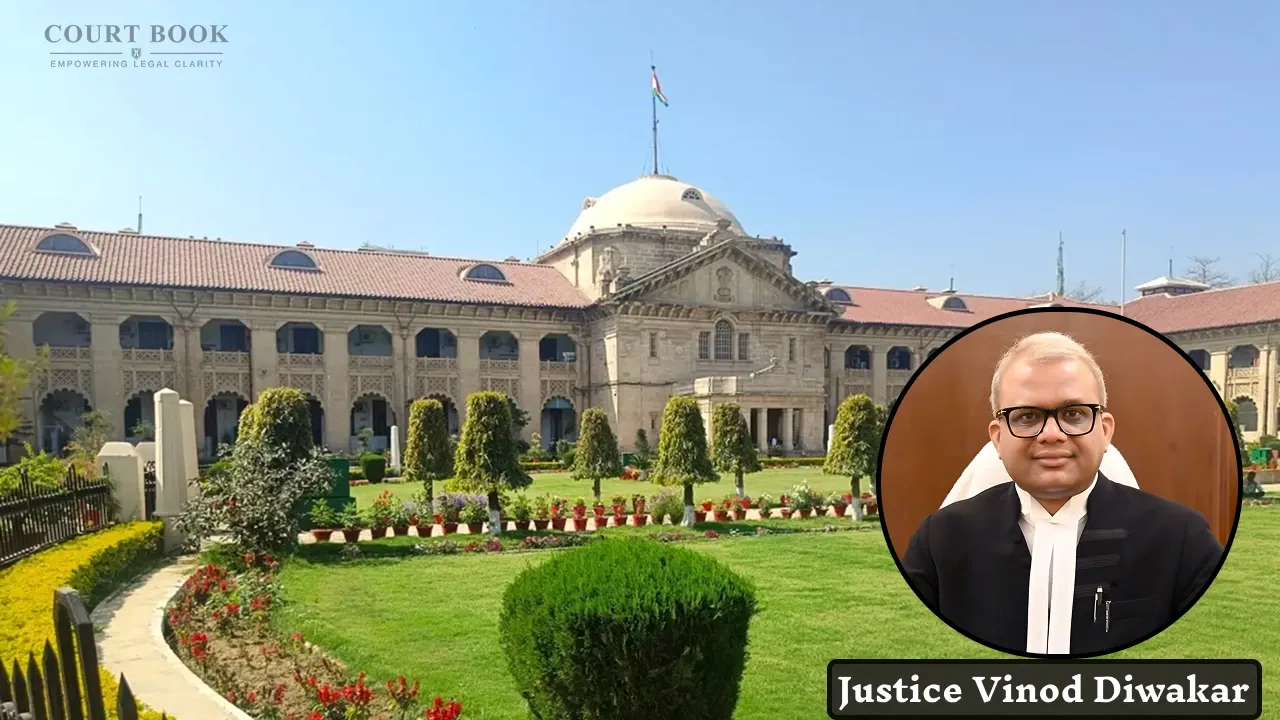
The Allahabad High Court has dismissed a writ petition seeking re-examination of a B.A. LL.B. student’s answer book after the student was awarded zero marks in all attempted questions in the subject “Bio-Diversity Protection Law.”
Justice Vinod Diwakar examined the original question paper and answer book produced before the Court and found no ground to interfere with the academic evaluation.
Background of the Case
The petitioner, a student of the five-year B.A. LL.B. course at Prayag Vidhi Mahavidyalaya, Naini, Prayagraj, had appeared in the ninth-semester examination for 2025–26.
The result was declared on March 18, 2026. The petitioner received zero marks in the concerned subject despite claiming to have attempted all the questions. After obtaining a copy of the answer book under the Right to Information Act, the petitioner approached the University for re-evaluation, but no action followed.
The High Court subsequently directed the University to produce the original question paper and answer book.
Court Examination of the Answer Book
The Court examined the material placed before it and specifically considered the answer written to Question 3-C, which asked the student to describe national laws in India relating to biodiversity conservation.
During the hearing, the Court directed Standing Counsel Vaibhav Tripathi to read the answer aloud. After doing so, he stated that he was unable to understand its meaning or identify any coherent legal reasoning connected with the question.
The Court agreed with this assessment.
“The answer to Question No. 3-C does not disclose any legal understanding of the subject,” the Court observed, adding that similar problems were found in the remaining answers. It therefore held that no fault could be found with the examiner awarding zero marks.
Court’s Observation on Legal Education
Justice Diwakar also raised concerns about the quality of legal education reflected in the answer book. The Court noted that legal education forms the foundation of the justice delivery system and that declining academic standards can affect the legal profession and administration of justice.
At the same time, the Court clarified that the observations should not be treated as a finding against the institution, teachers or examiner.
Decision
The High Court held that judicial review of academic evaluation is extremely limited unless arbitrariness, mala fides, statutory violation or a patent error is established.
Finding no such ground, the Court dismissed the writ petition under Article 226 of the Constitution.
The Court also directed that copies of the question paper and the redacted answer book be sent to the Bar Council of India and the Law Commission of India for consideration of broader issues concerning standards of legal education.
Case Details
Case Title: A v. State of U.P. & 3 Ors.
Case Number: Writ – C No. 26475 of 2026
Court: High Court of Judicature at Allahabad
Judge: Hon’ble Vinod Diwakar, J.
Decision Date: July 17, 2026


