

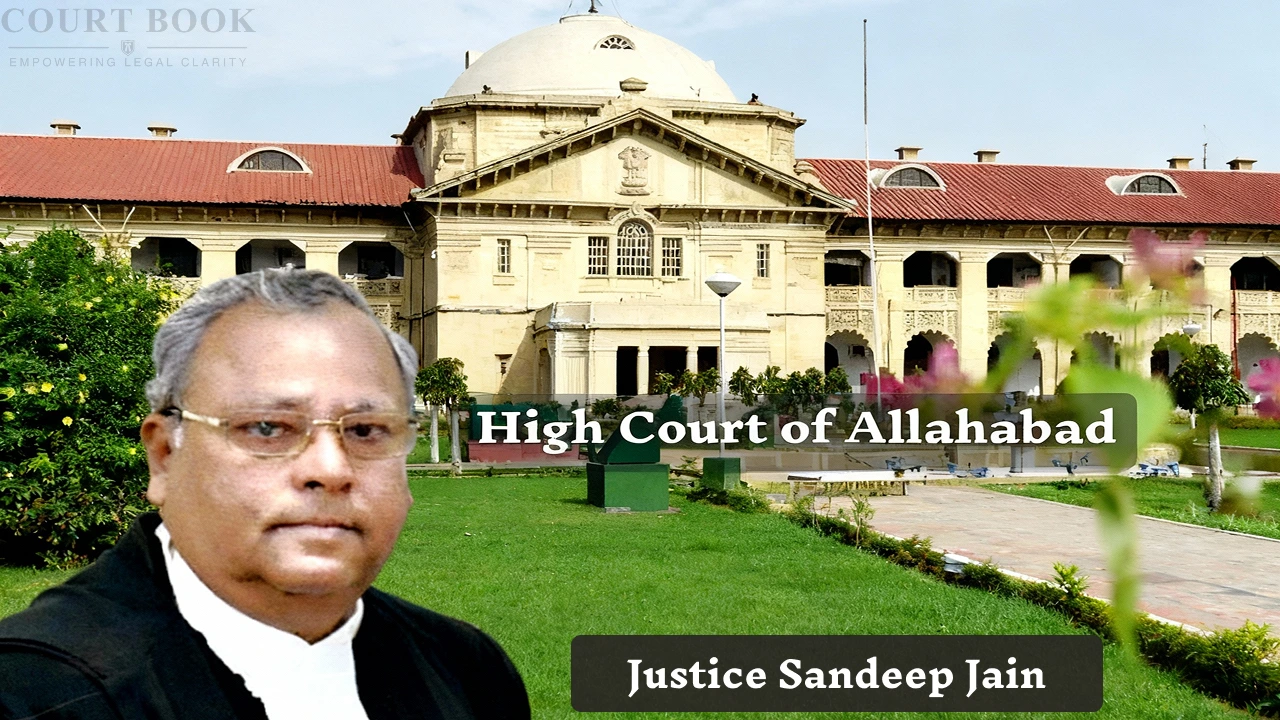
The Allahabad High Court has clarified that, under the law applicable in Uttar Pradesh, the physical presence of both the buyer and the seller is not mandatory at the time of execution and registration of a sale deed. While deciding a first appeal arising from a property dispute in Kanpur, the Court held that Section 32A of the Registration Act, as amended for Uttar Pradesh, differs significantly from the Central law and does not require the buyer's and seller's photographs and fingerprints to be affixed during registration.
Justice Sandeep Jain dismissed the appeal filed by the legal heirs of the original property owner and upheld the trial court's decree directing specific performance of a registered agreement to sell.
Background of the Case
The dispute concerned a residential property in Sarvodaya Nagar, Kanpur. Shivani Hospital Private Limited entered into a registered agreement to sell with Dharam Prakash Nangia on October 22, 2012, for ₹5.25 crore. The hospital paid ₹2 crore as earnest money and later paid another ₹41 lakh towards expenses for converting the leasehold property into freehold, leaving a balance consideration of ₹2.84 crore.
Under the agreement, Nangia was required to obtain freehold conversion from the Kanpur Development Authority (KDA) and inform the purchaser in writing before the sale deed could be executed. However, although he applied for conversion in August 2014, he passed away on July 4, 2015, before the process was completed.
After his death, his daughters issued a legal notice seeking cancellation of the agreement and refund of the advance amount. In response, the hospital repeatedly called upon them to execute the sale deed and fixed three dates before the Sub-Registrar. According to the hospital, its representatives remained present with the draft sale deed and cheques, but the daughters did not appear.
The Trial Court decreed the hospital's suit for specific performance on March 21, 2025. Challenging that decision, the daughters approached the High Court under Section 96 of the Code of Civil Procedure.
Appellants' Arguments
The appellants argued that the hospital had failed to establish continuous readiness and willingness to perform its contractual obligations as required under Section 16(c) of the Specific Relief Act, 1963.
They contended that a cheque for ₹38 lakh had earlier been dishonoured, showing the hospital lacked financial capacity. They also alleged that a notarised document extending the time for performance, dated December 21, 2014, had been fraudulently created and therefore the hospital was not entitled to the equitable relief of specific performance.
Another key submission was that the hospital's authorised representative was not present before the Sub-Registrar, demonstrating that it was not genuinely ready to complete the transaction.
Court's Observations
Rejecting these arguments, the High Court held that obtaining freehold permission was a condition precedent under the agreement. Since Dharam Prakash Nangia neither secured the conversion during his lifetime nor informed the purchaser in writing that the condition had been fulfilled, the purchaser could not be blamed for the delay.
The Court observed:
“From the above evidence on record it is evident that the plaintiff was always willing to get the sale deed executed in its favour by paying the balance sale consideration, but Dharam Prakash Nangia till his death... and after his death, his daughters... neither obtained the permission... nor intimated in writing to the plaintiff.”
The Court found that the hospital had consistently responded to legal notices, repeatedly called upon the legal heirs to appear before the Sub-Registrar and had attended the scheduled dates with the required documents and payment instruments. Bank statements and financial records also established that the balance consideration had been deposited before the Trial Court on May 29, 2025.
Presence Before the Sub-Registrar Not Mandatory in Uttar Pradesh
One of the significant legal questions before the Court was whether the purchaser's presence before the Sub-Registrar was mandatory under Section 32A of the Registration Act.
Relying on the Supreme Court's decision in Asset Reconstruction Company (India) Ltd. v. S.P. Velayutham, Justice Sandeep Jain held that the Registration Act must be interpreted in light of State-specific amendments.
The Court observed:
“It is apparent that there is a vast difference between Section 32A of the Registration Act as prevailing in the State of Uttar Pradesh and as prevalent in the Central Act. Under the Central Act... the presence of both the buyer and seller is mandatory... but in the Act prevailing in the State, it is not mandatory.”
The Court explained that while the Central Act requires photographs and fingerprints of both parties, the Uttar Pradesh amendment only requires prescribed true copies to accompany the document presented for registration. Therefore, the appellants' argument based on the Central provision could not be accepted.
Fraud Allegation and Limitation Rejected
The High Court also rejected the allegation that the hospital had fabricated the notarised time-extension document. It noted that the Trial Court had merely held that the document was not proved, not that it had been forged.
The Court remarked:
“Merely because the plaintiff failed to prove the above document, it cannot be inferred that the plaintiff has fraudulently fabricated that document.”
It further relied on the Supreme Court's rulings in Aloka Bose v. Parmatma Devi and Rattan Singh v. Nirmal Gill to reiterate that an agreement to sell signed only by the vendor remains legally enforceable and that the purchaser's signature on a sale deed is not indispensable.
On limitation, the Court held that the last date fixed before the Sub-Registrar for execution of the sale deed would be treated as the date fixed for performance under Article 54 of the Limitation Act, making the suit filed in January 2017 well within the prescribed limitation period.
Decision
Finding no error in the Trial Court's conclusions, the Allahabad High Court dismissed the first appeal with costs and affirmed the decree directing specific performance of the agreement to sell. The Court held that the hospital had consistently demonstrated its readiness and willingness to complete the transaction, while the contractual obligation of obtaining freehold conversion had never been fulfilled by the seller or his legal heirs.
Case Details:
Case Title: Mimansa Nangia and 2 Others v. Shivani Hospital Private Ltd.
Case Number: First Appeal No. 485 of 2025
Judge: Justice Sandeep Jain
Decision Date: 06 May 2026


