

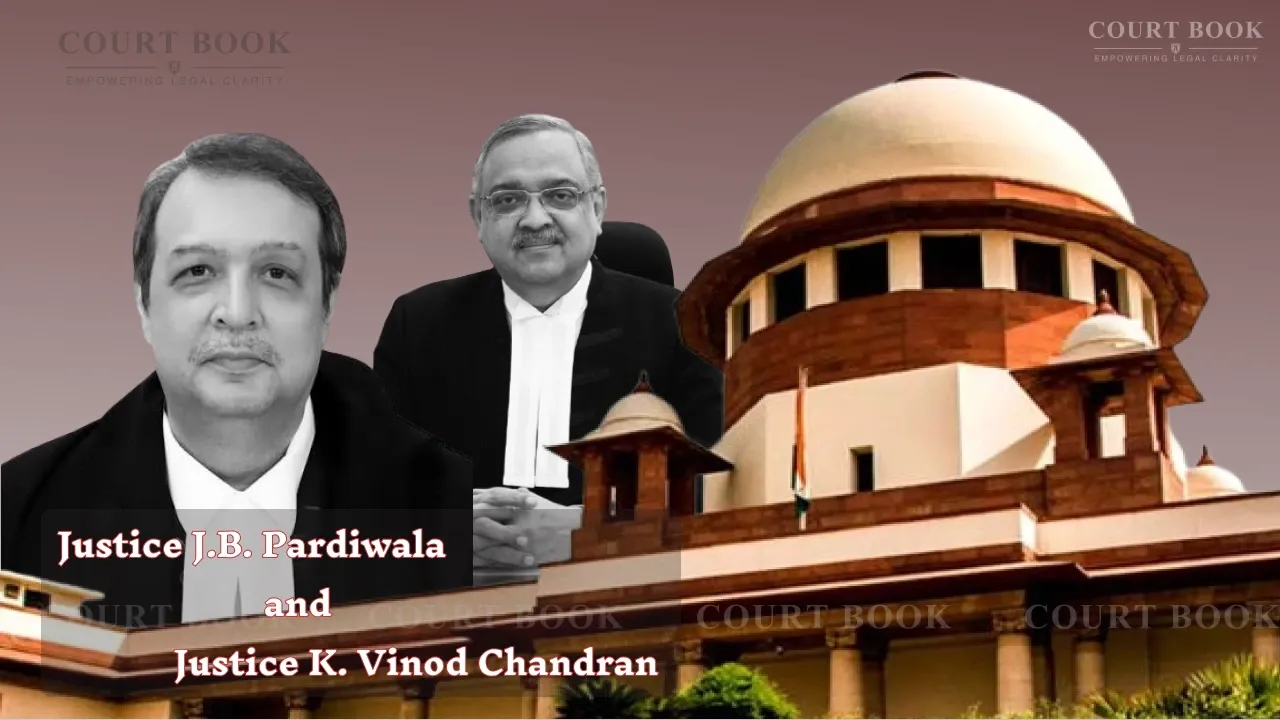
The Supreme Court on September 28, 2026, dismissed an appeal filed by M/s ASJ Finsolutions Pvt. Ltd. and upheld the forfeiture of the earnest money deposit (EMD) and other amounts paid by a successful auction bidder after the bidder failed to pay the remaining sale consideration within the period prescribed in the e-auction notice.
The judgment was delivered by Justice J.B. Pardiwala and Justice K. Vinod Chandran in Civil Appeal No. 13023 of 2025. The dispute arose from an auction conducted during liquidation proceedings under the Insolvency and Bankruptcy Code, 2016.
The case concerned Lot No. 5 at Village Nangal Khurd, Sonepat, Haryana, which had a reserve price of Rs. 25.56 crore. The e-auction notice disclosed a pending dispute concerning the sale deed of part of the land and stated that the property was being sold on an “as is where is” basis. M/s ASJ Finsolutions Pvt. Ltd. successfully bid for the property at the reserve price of Rs. 25.56 crore on November 15, 2021.
Under the auction terms, the balance amount had to be paid within 30 days, or within 90 days with 12% annual interest. The 90-day deadline was February 14, 2022. The EMD for Lot No. 5 was Rs. 2.55 crore, representing 10% of the reserve price. The Liquidator required the successful bidder to deposit 25% of the bid amount, or Rs. 6.39 crore, comprising the Rs. 2.55 crore EMD and Rs. 3.84 crore towards the sale consideration. The appellant deposited this amount and subsequently informed the Resolution Professional on December 15, 2021, that it intended to pay the balance of Rs. 19.17 crore with 12% interest by February 14, 2022.
Meanwhile, M/s Agarwal Trading Company approached the Punjab and Haryana High Court over the same property. The High Court rejected the writ petition but directed Agarwal Trading Company to approach the NCLT for appropriate relief. It also directed the Liquidator not to execute the sale deed during the period granted to the company, which extended up to February 14, 2022. Agarwal Trading Company subsequently filed an application before the NCLT on February 11, 2022, which it withdrew on September 22, 2022.
The appellant did not pay the balance consideration and instead sought the prior sale deeds before the NCLT through Company Application No. 85 of 2022. The application was rejected on March 31, 2023, and the subsequent appeal was dismissed on April 21, 2023. The Punjab and Haryana High Court later rejected the appellant’s plea for the prior deeds while reserving liberty to pursue remedies available in law.
While the writ petition was pending, the property was sold in a fresh auction for Rs. 31.10 crore, which was Rs. 5.54 crore higher than the appellant’s bid.
The Supreme Court noted that the auction notice expressly contained a forfeiture condition. The Court also found that the bidder had participated in the auction with knowledge of the disclosed circumstances and had deposited the required amounts without protest.
The Court observed:
“Having deposited 10% of the reserve price, along with a portion of the balance sale consideration, which itself is an undertaking to pay the balance amounts within a period of 30 days or 90 days with interest, brings in the consequences of forfeiture, on failure; which is automatic.”
The Court further rejected the argument that the absence of an express forfeiture provision in the liquidation regulations prevented forfeiture under the auction terms. It noted that the auction notice itself clearly provided for forfeiture if the successful bidder failed to pay the balance consideration.
The Court also examined the Triple Test considered by the NCLT—whether the bidder had acted with a hidden agenda to rig the auction, whether the bidder was not a genuine bidder with adequate financial capacity, and whether extraneous circumstances had prevented it from making the full payment. The Supreme Court agreed with the NCLAT that the Triple Test did not absolve the appellant from forfeiture. It noted that the appellant’s repeated expressions of willingness to pay did not by themselves establish its financial capacity, and that the circumstances relied upon by the appellant did not justify its failure to make the balance payment.
The Supreme Court ultimately held that the forfeiture clause in the e-auction notice was applicable. Since the appellant had failed to pay the balance sale consideration within the stipulated period, the Court found no basis to direct refund of the Rs. 6.39 crore deposited by the appellant, which included the Rs. 2.55 crore EMD and Rs. 3.84 crore towards the sale consideration.
The Court concluded:
“The appellant having paid the money voluntarily and the terms and conditions stipulated in the e-auction notice having provided for the entire amount paid by a successful bidder, including EMD to be forfeited, if he fails to pay the balance sale consideration as per the terms of the sale, there is no reason to order refund. We find no reason to interfere with the impugned order.”
The appeal was accordingly dismissed.
Case Title: M/s ASJ Finsolutions Pvt. Ltd. v. Vikram Bajaj
Case Number: Civil Appeal No. 13023 of 2025


