.webp)
The Supreme Court on September 17, 2026, allowed appeals filed by Bharat Sanchar Nigam Limited (BSNL), holding that employees working as Rajbhasha Adhikari only on an officiating basis could not claim consideration for promotion under the recruitment rules that existed before the 2005 Rules.
The judgment examined whether the employees’ cases were covered by the Supreme Court’s earlier decision in Medini C. v. Bharat Sanchar Nigam Limited or by CMD/Chairman, BSNL v. Mishri Lal.
Background
The respondents were working as Assistant Director (Official Language), later renamed Rajbhasha Adhikari, on an officiating basis. Earlier administrative instructions had provided for promotion of Hindi Translators to the post of Hindi Officer after completing specified periods of service.
Subsequently, the Department of Telecommunications framed the Assistant Director (Official Language) Recruitment Rules, 2002. These Rules contemplated filling existing vacancies through eligible Hindi Translators. However, the 2002 Rules were never brought into operation.
In 2005, fresh Recruitment Rules were introduced. The post was renamed Rajbhasha Adhikari, and a written test was prescribed for promotion. The respondents challenged the requirement and sought consideration under the earlier regime. The High Court accepted their claim, leading BSNL to approach the Supreme Court.
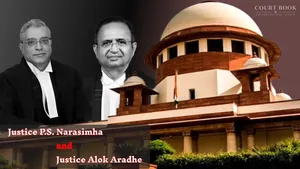
The Bench of Justice Prashant Kumar Mishra and Justice Ujjal Bhuyan noted an important factual distinction between the present matter and Medini C. The employees in the present case had never been regularly or even ad hoc promoted to the post of Rajbhasha Adhikari. They were merely working there on an officiating basis.
The Court referred to its earlier ruling in Mishri Lal, where it had held that employees appointed purely on an officiating basis did not acquire a vested right to promotion under rules that had not been implemented.
The Court also examined Medini C., where the concerned employees had been provisionally promoted before the relevant rules came into force. That factual circumstance was considered significant in distinguishing that decision from the present case.
The Bench observed:
“The conspicuous discerning factors in Mishri Lal (supra) and Medini C. (supra) are that in Mishri Lal (supra) the writ petitioners were working as ‘Rajbhasha Adhikari’ on officiating basis like in the present case; whereas in the matter of Medini C. (supra), the writ petitioners were provisionally promoted.”
The Supreme Court further relied on its decision in State of Himachal Pradesh v. Raj Kumar, holding that vacancies do not necessarily have to be filled according to the rules existing when those vacancies arose. The right of an eligible candidate is to be considered under the rules applicable when consideration actually takes place.
Applying that principle, the Court held that the High Court could not have directed consideration of the respondents’ promotions under the rules preceding the 2005 Rules.
It therefore set aside the common judgments of the High Court and allowed BSNL’s appeals.



-300x169.webp)



-300x169.webp)

-300x169.webp)