

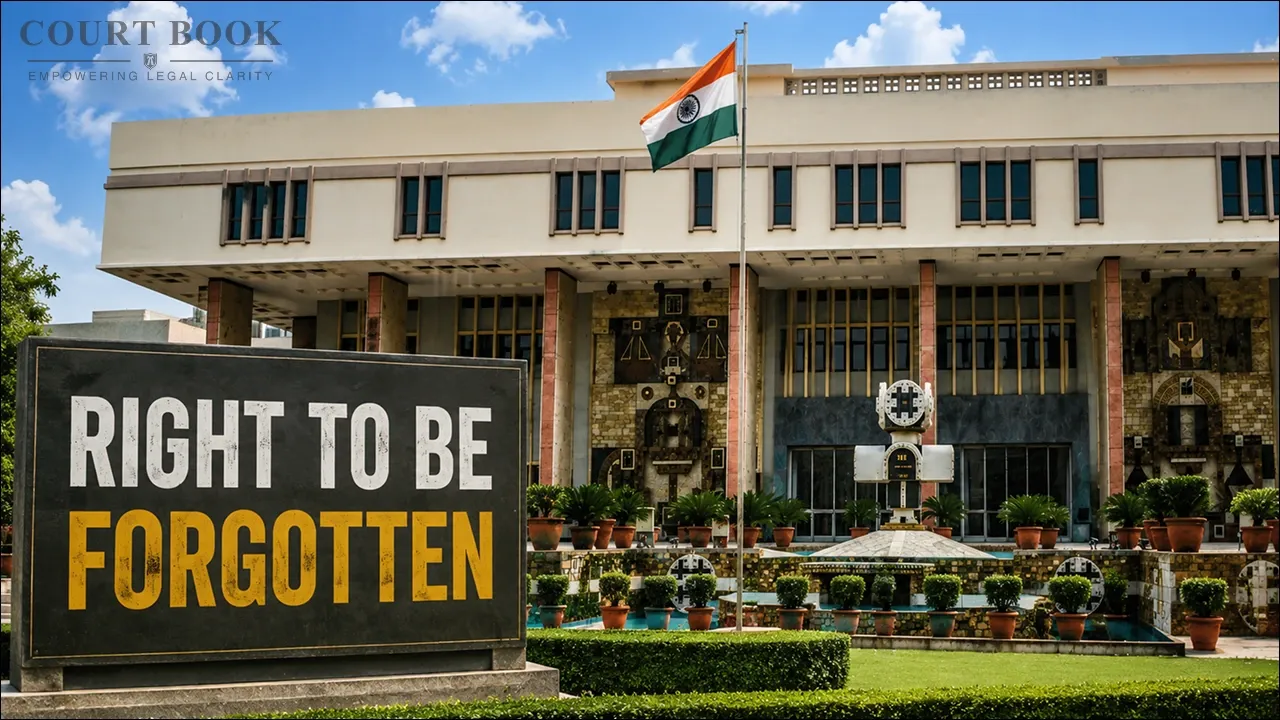
In a significant ruling on privacy rights in the digital age, the Delhi High Court has held that the “Right to Be Forgotten” is a facet of the constitutional right to privacy under Article 21 of the Constitution. The court ruled that individuals may seek de-indexing of judicial records from name-based internet searches and, in suitable cases, masking of personal identifiers from publicly accessible digital records.
The judgment was delivered by Justice Sachin Datta while deciding a large batch of petitions filed by individuals who claimed that old judicial records, criminal proceedings, matrimonial disputes, and other personal matters continued to appear in online searches, causing lasting harm to their reputation and personal lives.
Background of the Case
The petitions before the court arose from diverse situations. Some petitioners had been acquitted of criminal charges, some had been discharged or had FIRs quashed, while others were involved in settled matrimonial disputes. Several petitioners argued that despite favorable outcomes in court, internet searches continued to prominently display old allegations, arrests, or disputes.
According to the petitioners, this unrestricted digital accessibility created social stigma, affected employment opportunities, damaged personal relationships, and undermined their dignity long after the legal proceedings had ended.
Court’s Observations
Justice Datta observed that privacy is a constitutionally protected right and includes informational privacy. The court noted that the internet preserves information indefinitely, making it difficult for individuals to move beyond past events.
“The right to be forgotten, understood as the right to seek removal or restriction of personal information from public digital accessibility where it no longer serves a legitimate purpose, flows naturally from informational privacy under Article 21,” the court observed.
At the same time, the court clarified that the right is not absolute. It must be balanced against competing interests such as freedom of expression, public interest, transparency, and the principle of open justice.
The court emphasized that judicial records cannot ordinarily be erased or removed altogether. However, unrestricted name-based searchability may, in certain circumstances, disproportionately affect an individual's privacy and dignity.
De-Indexing and Masking Explained
The judgment drew a distinction between complete removal of a judgment and de-indexing.
The court explained that de-indexing does not delete a judicial record. Instead, it prevents the record from appearing in search engine results when a person's name is searched. The record itself remains available through lawful and purposeful access.
Similarly, masking involves replacing names and other personal identifiers with neutral references such as “ABC” or “XYZ” in publicly accessible digital versions of judicial records, while preserving the original records within the court system.
Justice Datta noted that such measures are intended to protect privacy without compromising transparency or the institutional value of judicial decisions.
Categories Identified by the Court
The High Court laid down legal principles for determining when de-indexing or masking may be granted. The court indicated that relief may be appropriate in matters involving acquittals, discharge orders, quashing of criminal proceedings, certain settled disputes, and purely private matrimonial or family matters.
However, the court cautioned that relief may not be available in every case, particularly where continuing public interest outweighs privacy concerns.
Decision
Concluding a batch of petitions concerning online accessibility of judicial records, the Delhi High Court held that the Right to Be Forgotten is a facet of informational privacy protected under Article 21 of the Constitution.
Justice Sachin Datta laid down a detailed legal framework governing requests for de-indexing and masking of personal information in judicial records available online. The Court held that such relief may be granted in appropriate cases after balancing an individual's right to privacy, dignity and reputation against competing considerations such as open justice, freedom of expression and public interest.
The Court further clarified that de-indexing does not amount to deletion of judicial records, and that masking of personal identifiers does not erase judgments from the public domain. Applying the principles laid down in the judgment, the Court proceeded to consider the relief sought in the individual petitions before it.
Case Details:
Case Title: Laksh Vir Singh Yadav v. Union of India & Ors. & Connected Matters
Case Number: W.P.(C) 1021/2016 and connected matters
Judge: Justice Sachin Datta
Decision Date: 29 May 2026


