

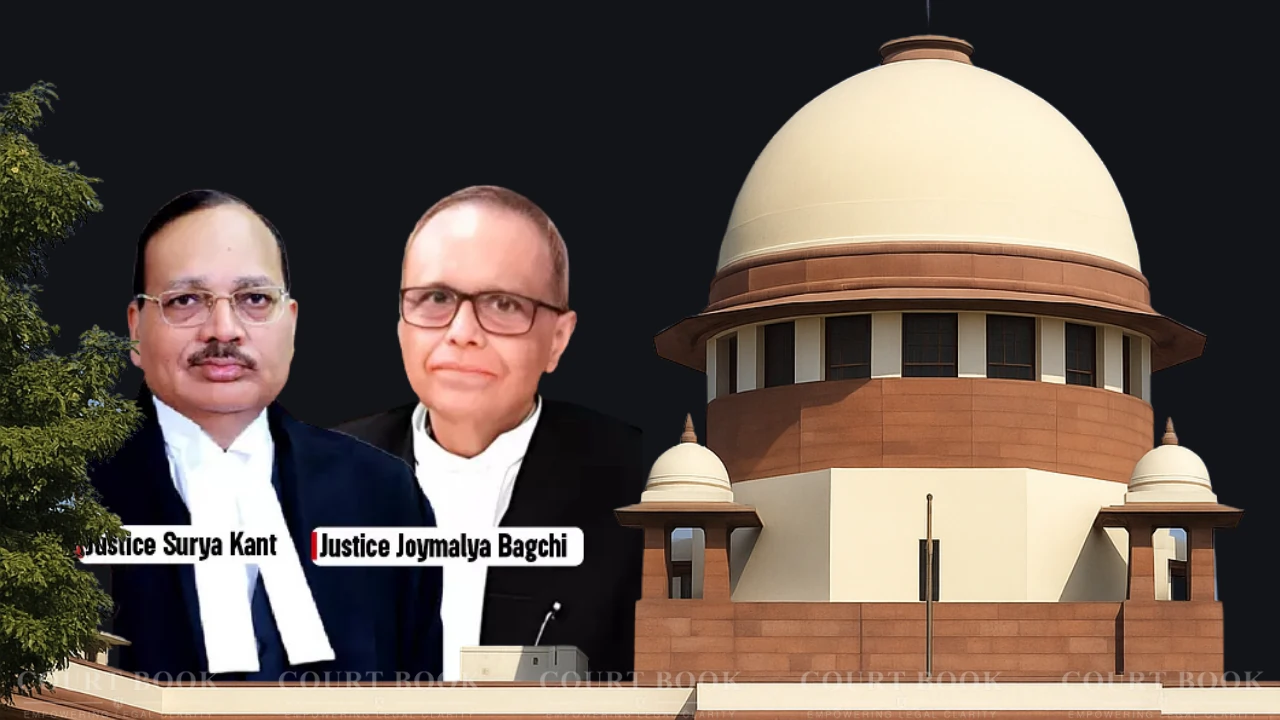
In a significant move aimed at tackling judicial delays, the Supreme Court has laid down a uniform framework for High Courts across India to ensure that reserved judgments are delivered within a reasonable time. The Court expressed concern over cases where judgments remained pending for months and, in some instances, even years after hearings had concluded.
A Bench comprising Chief Justice Surya Kant and Justice Joymalya Bagchi issued comprehensive directions that will apply to all High Courts in the country. The ruling came while deciding a batch of petitions that highlighted long-pending reserved judgments.
Background of the Case
The lead petition was filed by several convicts from Jharkhand whose criminal appeals had been heard by the High Court, but judgments had remained reserved for extended periods. Some of the appeals had been awaiting pronouncement since 2022.
During the proceedings, the Supreme Court sought reports from High Courts across the country regarding pending reserved judgments. The data revealed a broader institutional issue extending beyond any one court.
The Court subsequently expanded the scope of the matter to examine delays in pronouncing judgments and uploading reasoned orders on court websites.
Court's Observations
The Bench observed that delayed judgments directly affect litigants whose rights remain uncertain even after their cases have been fully heard.
The Court noted that every delayed judgment represents a person waiting for closure. It emphasized that the constitutional guarantee of life and personal liberty under Article 21 extends beyond the trial stage and includes timely delivery of judicial decisions.
“The right to life and personal liberty guaranteed under Article 21... is as much violated by such delay in pronouncing a reserved judgement as by a denial of the right to be heard,” the Bench observed.
The Court also highlighted the impact on prisoners awaiting decisions in appeals and bail matters, stating that prolonged silence from courts can result in continued incarceration without final adjudication.
At the same time, the Bench acknowledged the heavy workload carried by High Court judges and clarified that the directions were intended to assist judicial administration rather than criticize any individual judge.
Nationwide Guidelines Issued
The Supreme Court directed that High Courts should endeavour to pronounce reserved judgments within a maximum period of three months from the date they are reserved.
For matters involving personal liberty-such as bail applications, criminal appeals where the convict is in custody, and death reference cases-the Court stressed the need for greater urgency.
Among the key directions:
Bail orders should preferably be pronounced and uploaded on the same day, or the next day if reserved.
Judgments granting bail, suspending sentences, or acquitting prisoners must be communicated immediately to jail authorities.
Reasoned judgments should ordinarily be uploaded within 24 hours of pronouncement.
If a reserved judgment is not delivered within three months, parties may seek early pronouncement.
If the delay continues beyond the prescribed period, parties may request reassignment of the matter to another Bench.
The Court also ordered High Courts to improve transparency by displaying relevant information on their websites, including dates of reservation, pronouncement, and uploading of judgments.
Decision
Invoking its powers under Article 142 of the Constitution, the Supreme Court issued the guidelines as binding directions applicable to all High Courts in India. The Registrars General of all High Courts have been directed to place the guidelines before their respective Chief Justices and take steps to incorporate necessary changes in court rules and website systems.
The batch of writ petitions was disposed of in terms of the directions issued by the Court.
Case Details:
Case Title: Pila Pahan @ Peela Pahan & Ors. v. State of Jharkhand & Anr. (with connected matters)
Case Number: Writ Petition (Crl.) No. 169 of 2025 and connected petitions
Judge: Chief Justice Surya Kant and Justice Joymalya Bagchi
Decision Date: May 29, 2026


