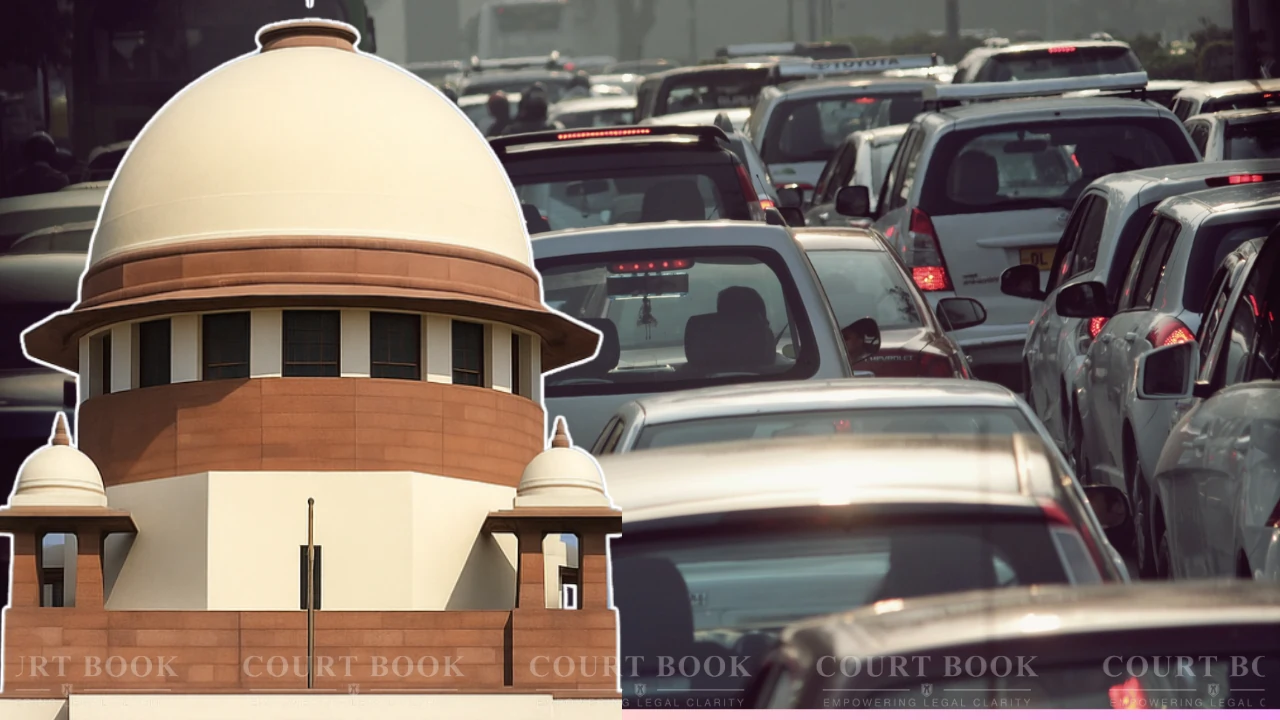
The Supreme Court has issued a series of nationwide directions to improve compliance with mandatory motor vehicle insurance laws. The Court expressed concern over the growing number of uninsured vehicles on Indian roads and directed authorities to adopt technology-driven enforcement while introducing a more transparent insurance policy structure. The ruling came while deciding an appeal filed by National Insurance Company Ltd. arising out of a motor accident compensation dispute.
Background of the Case
The appeal originated from a motor accident that occurred in July 1996, when the owner of a Maruti 800 car died after his vehicle was hit from behind by an unidentified lorry. His legal representatives sought compensation before the Motor Accident Claims Tribunal (MACT).
The Tribunal rejected the claim against the insurer, holding that no additional premium had been paid to cover the owner's personal risk. However, the Telangana High Court later reversed that decision and awarded compensation of ₹10,00,500 with interest, holding that the comprehensive insurance policy extended coverage to the owner travelling in the vehicle. National Insurance Company challenged that decision before the Supreme Court.
Court Examines Larger Public Interest Issues
While hearing the appeal, the Supreme Court expanded the scope of the matter to examine two broader issues affecting motor insurance across the country. These included the widespread non-compliance with mandatory third-party insurance under the Motor Vehicles Act and the absence of a uniform policy structure explaining different insurance covers to consumers.
To address these concerns, the Court sought responses from the Ministry of Road Transport and Highways (MoRTH), the Insurance Regulatory and Development Authority of India (IRDAI), the General Insurance Council and insurance companies operating in India before framing comprehensive directions.
Court Observations
The Bench observed that the failure to maintain valid insurance leaves accident victims and their families struggling for compensation despite statutory protection.
Referring to official data, the Court noted that nearly 56% of vehicles on Indian roads remain uninsured, defeating the objective of compulsory third-party insurance under Section 146 of the Motor Vehicles Act.
Emphasising the need for technological enforcement, the Bench observed:
“The integration of the enforcement system with technology is the need of the hour.”
The Court further remarked that the purpose of compulsory insurance is not merely to provide compensation but also to ensure that victims are not forced into prolonged litigation after road accidents.
Key Directions Issued by the Supreme Court
To improve enforcement and consumer awareness, the Court issued several directions in the public interest.
It directed that Automatic Number Plate Recognition (ANPR) cameras installed on highways and roads should be integrated with the Insurance Information Bureau and VAHAN database to automatically detect uninsured vehicles and issue electronic challans.
The Court also ordered that State Police should be equipped with handheld devices or mobile applications linked to these databases so that insurance status can be verified instantly during vehicle checks.
The Bench approved a four-layer insurance policy structure consisting of:
- Mandatory third-party insurance.
- Optional legal liability cover for occupants or pillion riders.
- Optional personal accident cover.
- Optional own damage cover.
It further directed that every customer purchasing motor insurance, whether online or offline, must receive a customer option form and a simplified information sheet clearly explaining mandatory and optional covers before making a choice.
Another important direction extends the mandatory third-party insurance period for new vehicles. The Court ordered that new cars must now be covered by four years of third-party insurance instead of three, while new two-wheelers must carry six years of mandatory third-party insurance instead of five. IRDAI was directed to issue the necessary instructions immediately.
The judgment also directs insurance companies to display the benefits of comprehensive motor insurance in an easy-to-understand format on their websites. Additionally, pilot projects have been proposed to allow citizens to verify the insurance status of vehicles and to explore linking fuel supply with valid insurance records to improve compliance.
Decision
On the dispute before it, the Supreme Court upheld the Telangana High Court's ruling. It agreed that a comprehensive insurance policy covered the owner travelling in the insured vehicle and found no reason to interfere with the compensation awarded to the deceased's legal representatives.
The civil appeal filed by National Insurance Company Ltd. was dismissed. At the same time, the Court directed all stakeholders to comply with its nationwide directions on motor insurance and file compliance responses before the specified date.
Case Details
Case Title: National Insurance Co. Ltd. v. Smt. Thungala Dhana Laxmi & Ors.
Case Number: Civil Appeal No. 14369 of 2025
Judge: Justice Sanjay Karol and Justice Prashant Kumar Mishra
Decision Date: August 4, 2026



-300x169.webp)
-300x169.webp)
-300x169.webp)