The Supreme Court has clarified when interest stops running on an amount deposited in court during proceedings challenging an arbitral award. The Court held that merely depositing money with the court does not automatically amount to payment or satisfaction of the award.
The ruling came in National Seeds Corporation Ltd. v. National Agro Seed Corporation (India), where the Court examined whether interest remained payable on money deposited by the award-debtor while challenging enforcement of an arbitral award.
Background of the Case
An arbitral award dated June 13, 2019 directed the appellant to pay Rs.1,46,40,005.02 along with interest. The total amount, including interest up to the date of the award, was Rs.1,77,97,434.
The appellant challenged the award under Section 34 of the Arbitration and Conciliation Act, 1996. The Delhi High Court stayed enforcement subject to a condition that 50% of the principal amount be deposited.
Accordingly, Rs.73,20,003 was deposited with the High Court Registry on November 25, 2019. The Section 34 challenge was later dismissed, followed by dismissal of the appellant's Section 37 appeal and its Special Leave Petition before the Supreme Court.
During execution proceedings, the appellant deposited a further Rs.1,53,17,792. The respondent sought withdrawal of the deposited amounts. However, the release remained subject to conditions for some time. On September 8, 2022, the executing court finally directed release of the deposited amount without the earlier restriction, and the appellant did not oppose the release.
The dispute before the Supreme Court was therefore limited to whether interest remained payable for the period between June 13, 2019 and September 8, 2022.
Supreme Court's Observations
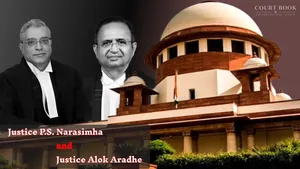
The Bench of Justice Pamidighantam Sri Narasimha and Justice Alok Aradhe examined Order XXI Rule 1 of the Code of Civil Procedure, which deals with the manner in which money payable under a decree can be paid.
The Court explained that an arbitral award is enforced like a court decree under Section 36 of the 1996 Act. Therefore, the relevant provisions of the CPC apply for the limited purpose of enforcement.
The Court relied upon earlier decisions, including the Constitution Bench judgment in Gurpreet Singh v. Union of India, and explained that interest can stop running on a court deposit when the deposit satisfies the requirements of Order XXI Rule 1 and the award-holder is properly notified.
" A deposit made in court has to be unconditional and the same must be available to the decree-holder for withdrawal, in order to make the deposit in consonance with Order XXI Rule 1 of the Code. If the decree-holder is permitted to withdraw the amount only on furnishing security, it amounts to payment not made in the satisfaction of the decree."
The Supreme Court further stated that where a decree-holder fails to take steps to withdraw an amount that has been made available unconditionally, such inaction can amount to deemed refusal of the tender.
Applying these principles, the Court found that the first deposit of Rs.73,20,003 was made to obtain a stay of enforcement and was not accompanied by the notice contemplated under Order XXI Rule 1(2) CPC.
The appellant also resisted the respondent's attempts to withdraw the deposited amount. Even when the executing court permitted withdrawal of Rs.1 crore subject to furnishing title deeds as security, the respondent could not utilise the money without satisfying that condition.
The Supreme Court therefore held that the deposits were not made in accordance with Order XXI Rule 1 and the respondent was not free to withdraw the money unconditionally.
The Court also addressed a wider issue concerning the handling of money deposited before courts and tribunals. It noted that there is no uniform system governing how such deposits are invested, administered and credited with interest.
The Supreme Court observed that different courts follow different practices and said that a common framework could provide greater certainty regarding the investment and interest earned on deposited amounts. It requested the Law Commission of India to examine the issue, including practices followed in other countries, and to consult the Reserve Bank of India and the Ministries of Finance and Law and Justice.
Decision
The Supreme Court held that where an award-debtor makes a deposit in accordance with Order XXI Rule 1 CPC and the amount is unconditionally available to the award-holder, interest liability on that deposited amount ceases.
However, in the present case, the deposits did not satisfy those requirements. The Court therefore found no ground to interfere with the impugned order directing payment of interest at 12% per annum and affirmed the High Court's order.
The appeal was accordingly disposed of. The Registry was also directed to send a copy of the judgment to the Law Commission of India, RBI and the Ministries of Finance and Law and Justice.




-300x169.webp)
-300x169.webp)