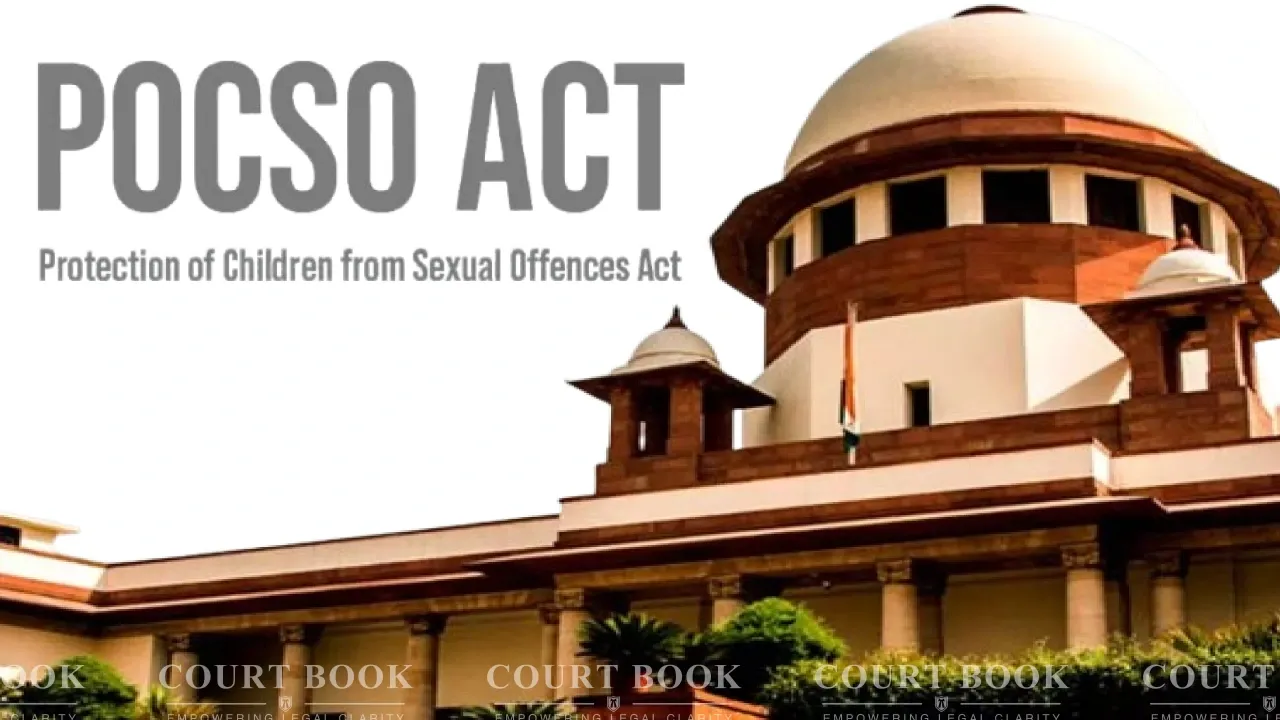
The Supreme Court has acquitted a man who had spent years behind bars after being convicted under the POCSO Act, ruling that the prosecution's own medical evidence undercut the case built against him. A bench of Justice Prashant Kumar Mishra and Justice N.V. Anjaria set aside the concurrent findings of the trial court and the Delhi High Court, holding that the mother's testimony could not be trusted once weighed against the forensic report and the statements of the examining doctors.
Background Of The Case
The case dates back to December 2015, when a complaint was lodged at Kalkaji Police Station by the mother of a two-and-a-half-year-old girl. She alleged that her daughter had gone missing from outside their jhuggi and was later found with a neighbour, the appellant, who had reportedly taken the child to a nearby park. On returning home, the child is said to have cried and shown signs of distress, following which the mother noticed what she believed was blood on the child's clothing and took her to a private doctor that night.
An FIR was registered two days later, on 11 December 2015, and a chargesheet followed in March 2016 under Sections 363 and 506 of the IPC and provisions of the POCSO Act. In August 2023, the trial court convicted the appellant under Section 363 IPC and Section 6 of the POCSO Act, sentencing him to ten years of rigorous imprisonment. The Delhi High Court upheld this conviction in July 2025, leading the appellant to approach the Supreme Court.
Court's Observations
Going through the record, the bench found that the mother's account did not match the version given by the private doctor she said she consulted first. The doctor placed the visit at around 4-5 pm, while the mother insisted it was 9.30 pm at night, and each gave a different account of who had accompanied the child. The Court also noted that the medical examination at AIIMS found no injury and an intact hymen, while the forensic laboratory detected neither semen nor blood on the clothing said to have carried bloodstains.
Referring to the standard expected of a witness whose word alone can sustain a conviction, the Court recalled the principle laid down in earlier rulings:
"The 'sterling witness' should be of a very high quality and calibre whose version should, therefore, be unassailable. The court considering the version of such witness should be in a position to accept it for its face value without any hesitation... It should be natural and consistent with the case of the prosecution qua the accused."
The bench also examined the presumption of guilt under Sections 29 and 30 of the POCSO Act, which shifts the burden onto the accused once the prosecution establishes the foundational facts. It clarified that this presumption is not absolute and does not lower the standard of proof required from the prosecution. The judgment observed:
"The court should not mechanically accept the ipse dixit of the prosecution riding on the provisions regarding presumption of guilt to give a stamp of approval to every prosecution even if they are absurd or improbable in its story."
The Court further took note of the defence's version - that the complaint stemmed from a dispute between the two families over a shared water connection in their jhuggi cluster, an aspect that surfaced during the mother's own cross-examination and which the Court found lent credibility to the claim of enmity behind the complaint.
Decision
Holding that the prosecution had failed to establish its case beyond reasonable doubt, and that the appellant had successfully rebutted the presumption against him through the contradictions and medical evidence on record, the Supreme Court set aside the High Court's judgment dated 3 July 2025.
The appellant was acquitted of the charges under Section 363 IPC and Section 6 of the POCSO Act, with directions for his release if he was not required in any other case.
Case Details:
Case Title: Deepak in JC v. State Govt. of NCT Delhi
Case Number: Criminal Appeals @ SLP (Crl.) Nos. 21271-72 of 2025
Judges: Justice Prashant Kumar Mishra and Justice N.V. Anjaria
Decision Date: September 17, 2026



-300x169.webp)
-300x169.webp)