

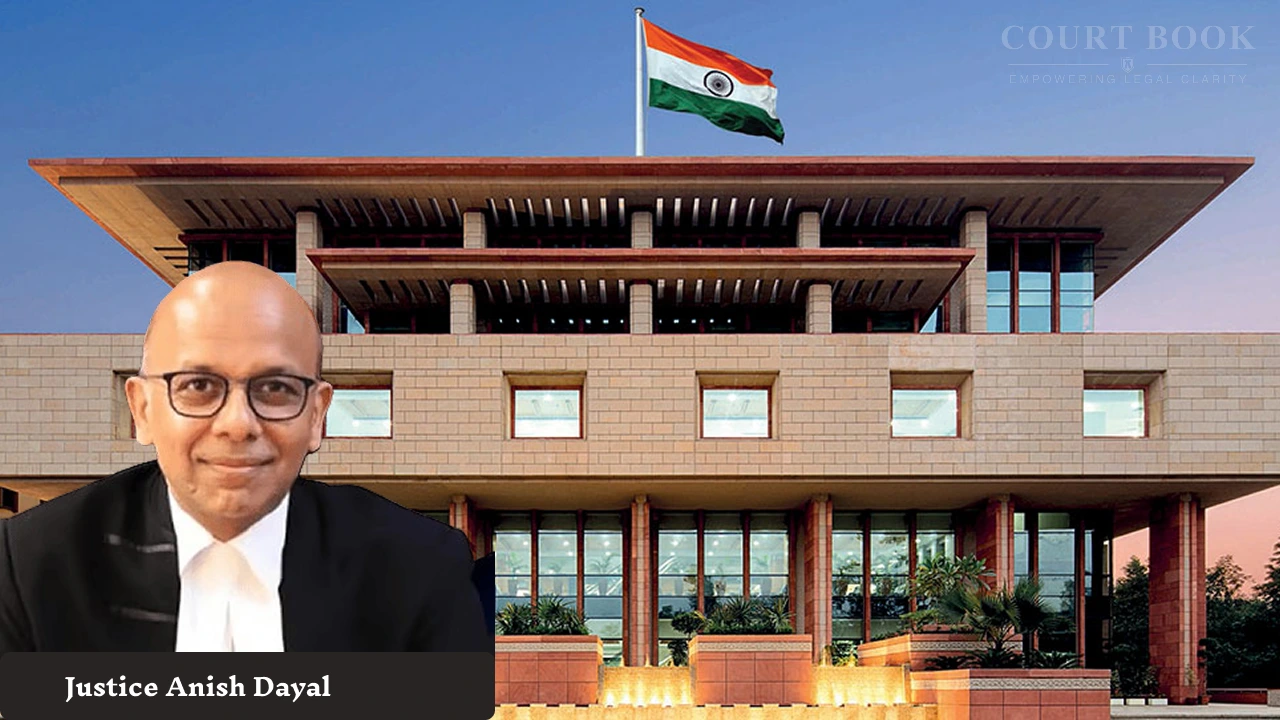
The Delhi High Court has dismissed an appeal filed by Oriental Insurance Company Ltd., holding that an earning husband can claim compensation under the head of "loss of dependency" following the death of his earning wife in a motor accident. The Court ruled that dependency cannot be assessed through outdated assumptions that an employed husband is automatically financially independent of his spouse.
Delivering the judgment, Justice Anish Dayal upheld the Motor Accident Claims Tribunal (MACT) award of ₹57.54 lakh in favour of Vinay Jain, whose wife Nidhi Jain died in a road accident in January 2022.
Background of the Case
The case arose from a tragic road accident on the night of 26 January 2022 on National Highway-58. Nidhi Jain was travelling with her husband Vinay Jain, their daughter, mother-in-law and niece when a truck allegedly driven rashly collided with their car.
The accident claimed the lives of Nidhi Jain, the couple's daughter, the mother-in-law and the niece, while Vinay Jain survived. An FIR was registered and a charge sheet was subsequently filed against the truck driver.
Before the MACT, Vinay Jain stated that his wife was a postgraduate (M.Phil.) working as a Salaried Director with Grepix Infotech Pvt. Ltd. Her income significantly contributed towards household expenses, home loan repayments and office rent.
Relying on her Income Tax Returns, the Tribunal assessed her annual income at ₹5,06,230, added 40% towards future prospects, applied a multiplier of 16 and awarded a total compensation of ₹57,54,476, along with 9% annual interest.
Oriental Insurance challenged only the quantum of compensation.
The insurer argued that since Vinay Jain himself was earning, he could not be treated as financially dependent on his deceased wife. According to the insurer, compensation should have been calculated under the head of "loss of estate" rather than "loss of dependency", which would have substantially reduced the award. The company relied on earlier Delhi High Court decisions including Keith Rowe, Pawan Kumar Sharma and Ashok Kumar Kochhar.
Court's Observations
Justice Anish Dayal rejected the insurer's argument, observing that compensation claims under the Motor Vehicles Act cannot be decided on stereotypes regarding family finances.
The Court observed:
"The issue of compensation resulting from an accident cannot be seen through a prism of whether society is a patriarchal setup, or otherwise. Such considerations ought to be anathema to the application of legal principles."
The Court further explained that an earning spouse's income forms part of the household corpus, and merely because the surviving spouse also earns does not mean there is no financial dependency.
It noted that tribunals should not speculate about private financial arrangements within families or assume that one spouse's contribution was unnecessary because the other spouse also had an income.
The judgment also referred to several Supreme Court decisions, including Arun Kumar Agarwal v. National Insurance Co. Ltd. and Malakappa v. IFFCO Tokio General Insurance Co. Ltd., which recognise the economic value of both financial contributions and domestic services rendered by a spouse.
The Court held:
"Where there is a joint income sustaining the household, the dependency of the surviving spouse extends to the extent of the loss occasioned by the contribution of the deceased spouse to the corpus of the household, whether through pecuniary earnings or through non-pecuniary contributions."
The High Court found no error in the MACT's calculation.
It noted that the Tribunal had adopted a conservative approach by deducting 50% of the deceased's income towards her personal expenses, considering that both spouses were earning members of the family.
The Court also observed that although another method of calculation could theoretically have been adopted, the Tribunal's assessment was consistent with the principles laid down by the Supreme Court in Pranay Sethi and Sarla Verma and therefore required no interference.
Decision
Dismissing the appeal, the Delhi High Court upheld the MACT's award of ₹57,54,476, together with interest at 9% per annum. The Court reaffirmed that an earning husband is not automatically excluded from claiming compensation under the head of loss of dependency merely because he has an independent source of income. It held that dependency must be assessed in the context of the deceased spouse's overall contribution to the family's financial and domestic life.
Case Details:
Case Title: Oriental Insurance Co. Ltd. v. Vinay Jain & Ors.
Case Number: MAC.APP. 509/2024
Judge: Justice Anish Dayal
Decision Date: 01 July 2026


