

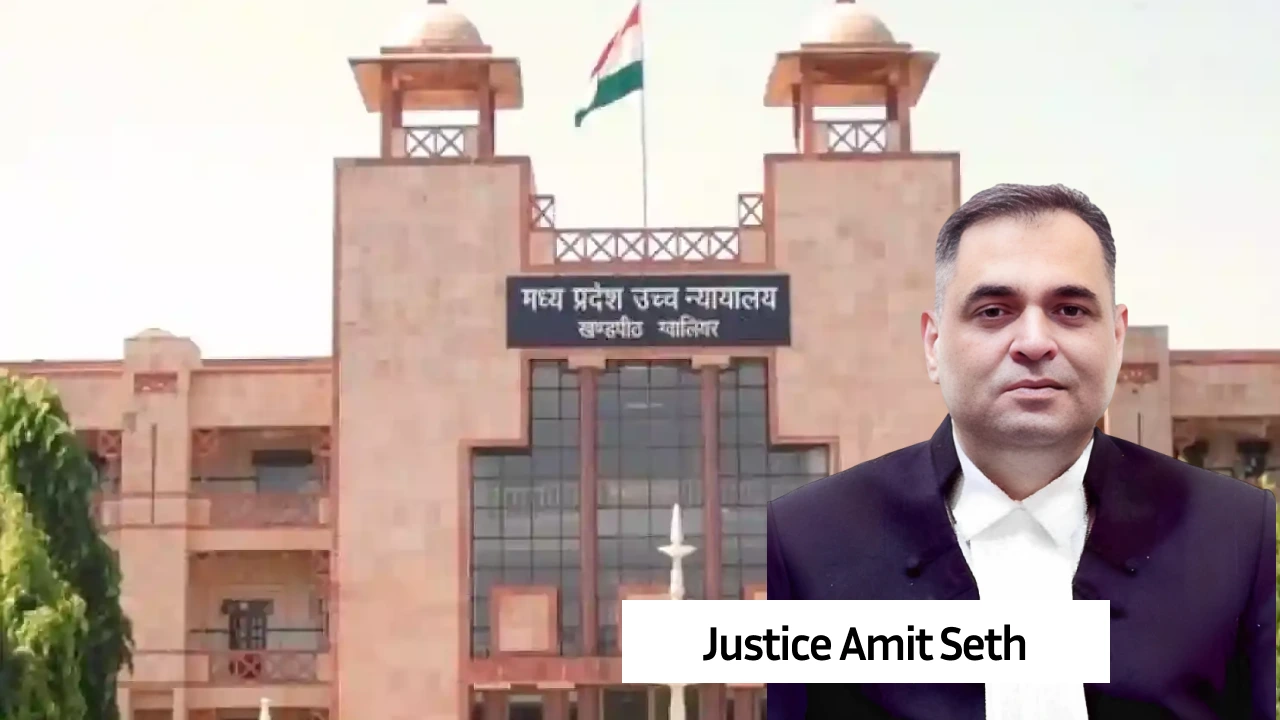
The Madhya Pradesh High Court at Gwalior has dismissed a miscellaneous petition seeking quashing of proceedings filed under Section 9 of the Hindu Marriage Act, 1955, before the Family Court, Gwalior.
Justice Amit Seth held that the supervisory jurisdiction under Article 227 could not be invoked to quash the Section 9 proceedings before the Family Court or to supplant the court’s original jurisdiction.
The petitioner-husband approached the High Court under Article 227 of the Constitution, which confers supervisory jurisdiction over subordinate courts. He sought quashing of Case No. 848A/2023, filed by the respondent under Section 9 of the Hindu Marriage Act, 1955, before the Family Court, Gwalior.
The husband argued that he had earlier approached the Family Court under the same provision in 2018, where, according to him, the wife had declined to reside with him. He contended that the subsequent proceedings initiated by the wife were a counter-blast to his divorce proceedings and were intended to cause harassment.
The respondent opposed the petition on maintainability grounds. It was also pointed out that an earlier order allowing the petition had already been recalled in review in August 2025, and that decision had attained finality between the parties.
The High Court examined whether Article 227 could be invoked to directly quash proceedings under Section 9 of the Hindu Marriage Act. It noted that proceedings before a Family Court under Section 9 are civil proceedings and that the statutory framework provides remedies concerning orders and decrees passed by the Family Court.
Relying on the Supreme Court decisions in Jacky v. Tiny Alias Antony and K. Valarmathi and Others v. Kumaresan, the Court held that the supervisory jurisdiction under Article 227 cannot be converted into a means of taking over the original jurisdiction of a subordinate court.
The Court further observed:
"Procedural law provides the necessary legal infrastructure on which edifice of rule of law is built. Short-circuiting of procedure to reach hasty outcomes is an undesirable propensity of an overburdened judiciary. Such impulses rendering procedural safeguards and substantive rights otiose, subvert certainty and consistency in law and need to be discouraged."
The High Court also held that the husband’s allegations concerning the earlier proceedings, the parties’ separation and the alleged counter-blast were factual matters requiring evidence. They could not be examined on merits in the present Article 227 proceedings.
Justice Amit Seth held that the miscellaneous petition was not maintainable and dismissed it. The Court, however, reserved liberty for the petitioner to pursue any remedy permissible in law. Pending applications, if any, were also closed.
Case Title: Petitioner/Husband v. Respondent/Wife
Case Number: Misc. Petition No. 2816 of 2024


