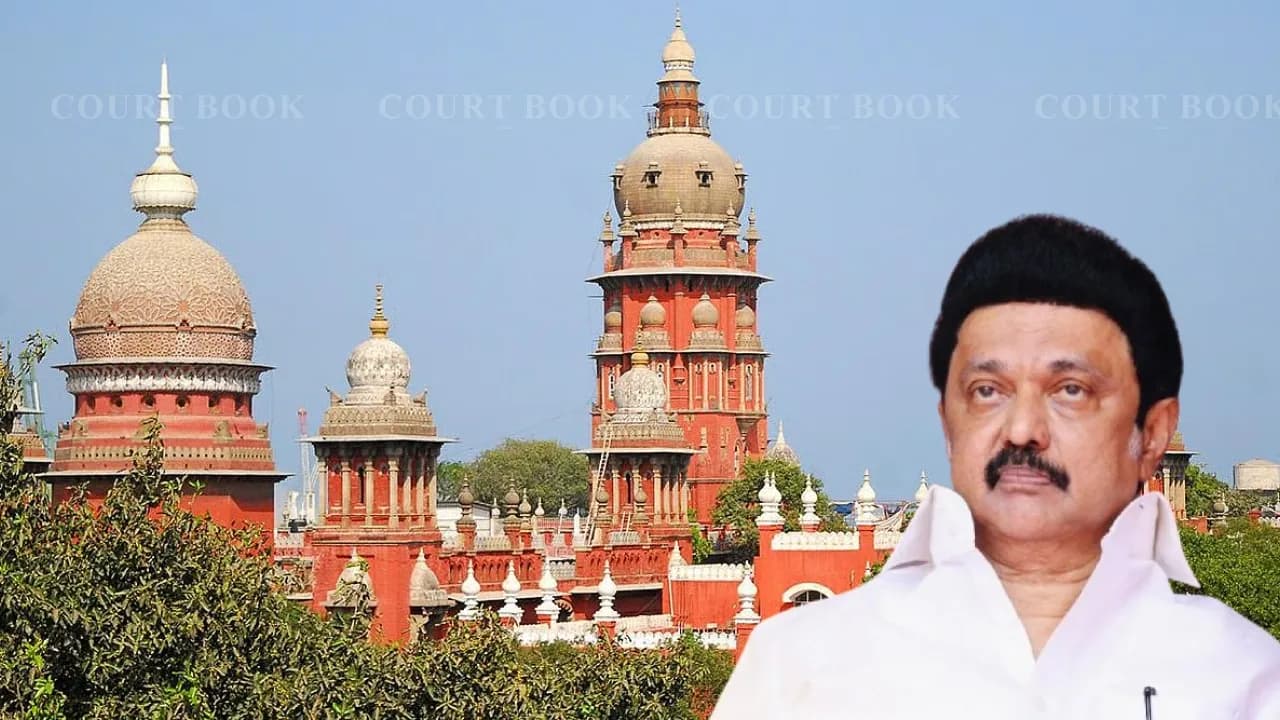
A Division Bench comprising Chief Justice Sushrut Arvind Dharmadhikari and Justice G. Arul Murugan held that the petition, despite being framed around the verification process, effectively challenged the election result itself. Such a challenge, the Court held, cannot be brought through a writ petition because of the constitutional bar under Article 329(b).
Background of the Case
Stalin had contested the 2026 Tamil Nadu Assembly election from No.13, Kolathur Assembly Constituency as the DMK candidate. Polling was held on April 23, 2026, while counting took place on May 4. V.S. Babu, the fourth respondent, was declared elected, with Stalin securing the second-highest number of votes.
Following the Supreme Court’s directions in Association for Democratic Reforms v. Election Commission of India, Stalin sought verification of the burnt memory of EVM and VVPAT units used at 14 polling stations, representing 5% of the 286 polling stations in the constituency. The verification was conducted between July 29 and August 5.
His authorised representative raised objections concerning alleged VVPAT malfunctions, irregularities in machine seals and address tags, mismatch involving ballot units, and the failure of a Control Unit to detect a Ballot Unit. The petition sought, among other reliefs, 100% counting of VVPAT slips and verification of all 286 machines.
Court’s Observation
The Election Commission opposed the writ petition, arguing that the reliefs effectively amounted to a challenge to the election and therefore had to be pursued through an election petition under the Representation of the People Act, 1951.
The Bench observed:
“The petitioner does not merely seek a fresh or more thorough verification, he seeks a declaration that the election of the fourth respondent, the returned candidate, is void, and a further declaration that he himself be declared the duly elected candidate for No.13, Kolathur Assembly Constituency.”
The Court further held that the alleged irregularities relied upon by Stalin, if established, would have to be examined under Section 100 of the Representation of the People Act. That process would require evidence and, potentially, expert evidence concerning the technical functioning of EVM and VVPAT units, which could not be undertaken in writ proceedings based merely on affidavits.
The Bench also rejected the argument that the expiry of the 45-day period for filing an election petition could expand the High Court’s writ jurisdiction. It left that issue open for consideration by the appropriate election forum.
Decision
The Madras High Court held that the writ petition was barred by Article 329(b) of the Constitution read with Section 80 of the Representation of the People Act.
The Court dismissed the petition as not maintainable, while granting liberty to Stalin to pursue any remedy available to him in law. It also left all allegations concerning the verification process and alleged technical or procedural irregularities open for consideration before the appropriate forum.
No order as to costs was made.