

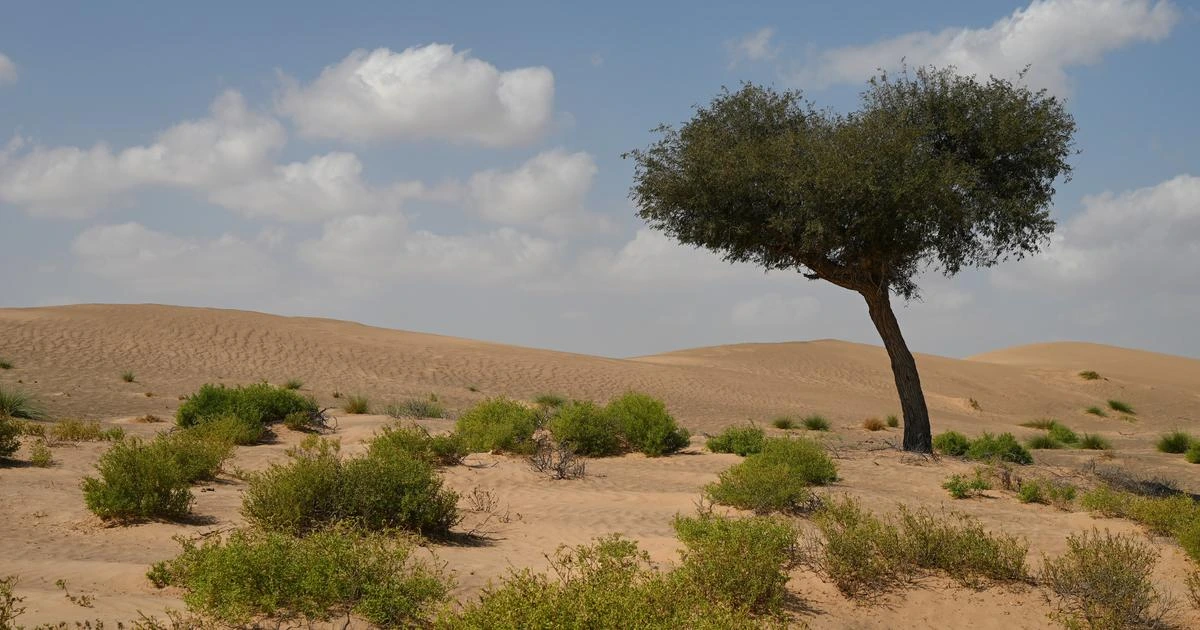
The Rajasthan High Court has raised serious concerns over the cutting of Khejri trees for solar power projects in desert regions of the state, observing that technological progress should not come at the cost of ecological destruction. While disposing of a public interest litigation, the court directed that no tree should be felled without prior approval under law and that the state-appointed committee must be informed before any such action is taken.
Background of the Case
The petition was filed by Shri Jambeshwar Paryavaran and Jeev Raksha Pradesh Sanstha before the Rajasthan High Court at Jodhpur. The organisation sought directions to stop illegal cutting of Khejri trees and requested the framing of a separate tree protection law or guidelines for their conservation.
The petitioner argued that under the State’s solar energy policy, large stretches of land were being cleared, leading to indiscriminate felling of Khejri trees, scientifically known as Prosopis cineraria. According to the plea, these trees are uniquely suited to survive Rajasthan’s harsh desert climate and hold cultural and religious importance for local communities.
During the hearing, counsel for the petitioner referred to the historic Khejarli sacrifice of 1730, where members of the Bishnoi community gave their lives while protecting Khejri trees from being cut.
The division bench of Justice Arun Monga and Justice Sandeep Shah acknowledged the environmental concerns raised in the petition and noted that the State Government had already taken steps on the issue by constituting a special committee to examine protective measures and possible legislation.
The court reproduced the government order dated March 9, 2026, under which a committee comprising ministers, government officials and legal experts was formed to study tree protection laws in other states and prepare a draft legislation for Rajasthan.
In a strongly worded observation, the bench remarked,
“The Khejri, a rare desert tree of ecological significance, grows in sparse isolation… Yet it is slated for felling. The reason? To make way for solar power generation.”
The judges further observed that society must confront the “uncomfortable truth” that environmental destruction is increasingly taking place in the name of technological development.
The bench also expressed hope that the committee would explore alternatives to prevent the loss of even a single tree and preserve ecological balance.
Disposing of the writ petition, the High Court held that no further judicial intervention was necessary at this stage because the State Government had already initiated the process of examining legal protection for Khejri trees.
However, the court directed that no trees shall be cut without prior approval in accordance with law and with due intimation to the committee constituted by the State Government.
The petitioner organisation was also granted liberty to assist the committee during its deliberations and approach the court again if any grievance survives.
Case Details:
Case Title: Shri Jambeshwar Paryavaran And Jeev Raksha Pradesh Sanstha vs State of Rajasthan & Ors.
Case Number: D.B. Civil Writ Petition No. 18852/2025
Judges: Justice Arun Monga and Justice Sandeep Shah
Decision Date: May 8, 2026
Download Order

