

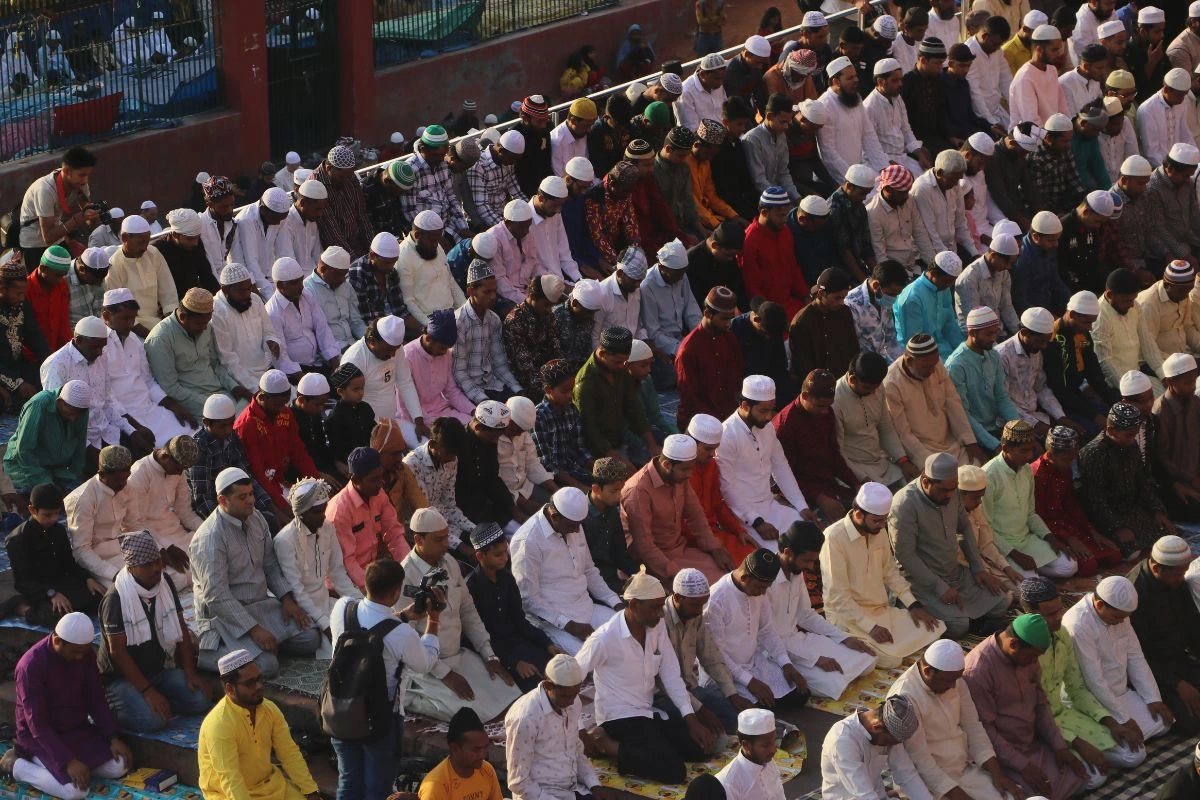
The Allahabad High Court has dismissed a writ petition seeking protection and permission to offer Namaz on a disputed piece of land in Sambhal district. The Court underscored that while the Constitution protects religious practices, such rights are not absolute and remain subject to reasonable restrictions.
Background of the Case
The case, Aseen vs State of U.P. and Others (Writ-C No. 10803 of 2026), was heard by a Division Bench comprising Justice Saral Srivastava and Justice Garima Prashad. The judgment was delivered on April 6, 2026.
The petitioner approached the Court seeking directions to authorities to allow and provide security for offering Namaz on a piece of land measuring 82.80 square meters in Village Ikona, Sambhal. He claimed ownership based on a registered gift deed dated June 16, 2023, and argued that interference by authorities violated his fundamental rights under Articles 19 and 25-28 of the Constitution.
The petitioner also sought a direction to the District Magistrate to decide his long-pending representation.
Opposing the plea, the State argued that the land in question is recorded as Abadi land meant for public use. It contended that the petitioner’s claim of ownership was unsupported, as the gift deed lacked essential details such as Khata and Gata numbers.
The State further submitted that Namaz had traditionally been offered at the site only on the occasion of Eid. According to official reports, the petitioner was attempting to introduce regular large-scale congregational prayers, which could disturb the existing social balance in the village.
The Court framed a key question: to what extent do constitutional rights under Articles 25 and 26 permit religious gatherings on public or private land?
Addressing this, the Bench observed,
“Freedom in a constitutional society is always accompanied by responsibility towards others.”
It clarified that religious rights are subject to public order, morality, and health.
On public land, the Court held that no individual or group can claim a right to use it as a recurring religious space. Such use must remain regulated to ensure equal access and civic order.
Read also:- Supreme Court Grants Anticipatory Bail to Pawan Khera, Flags ‘Political Rivalry’ Angle in Assam Case
On private property, the Court drew a distinction. It noted that private prayer and limited family worship are protected. However, once such activities become organized, frequent, or involve large gatherings, they acquire a public character.
The Bench explained,
“It does not extend to transforming any private premises into a de facto public religious venue.”
The Court also referred to past Supreme Court rulings, emphasizing that offering Namaz is not tied to any specific location as a matter of right.
Examining the case facts, the Court found the petitioner’s claims lacking in substance. It noted that the pleadings were vague and unsupported by concrete details or evidence of interference by authorities.
On ownership, the Court held that the gift deed relied upon by the petitioner did not establish legal title, especially in the absence of identifiable land particulars.
Further, even assuming the land to be private, the Court found that the petitioner was attempting to expand religious activity beyond its traditional scope. The record showed that Namaz had been offered only on specific occasions like Eid, and not as a regular practice.
In conclusion, the Court held that no enforceable legal right had been established by the petitioner.
Dismissing the petition, the Bench stated that expanding religious use in a manner that may affect public order or alter existing practicesdoes not fall within the protected scope of constitutional guarantees in the facts of the present case..
“Accordingly, the writ petition is dismissed. No order as to costs.”
Case Details
Case Title: Aseen vs State of U.P. and Others
Case Number: Writ - C No. 10803 of 2026
Judges: Justice Saral Srivastava and Justice Garima Prashad
Decision Date: April 6, 2026
Download Order

