

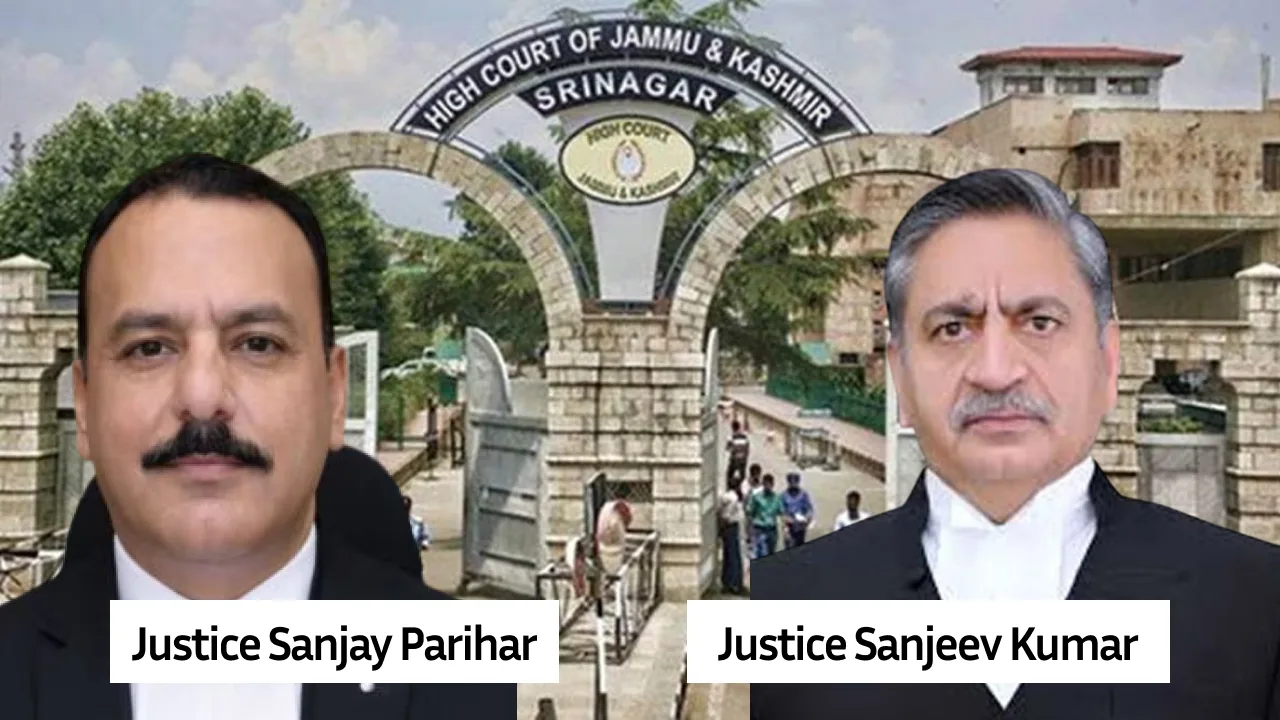
The High Court of Jammu & Kashmir and Ladakh has dismissed a Letters Patent Appeal filed by legal heirs seeking to stop the release of land acquisition compensation to another claimant, holding that revenue authorities were justified in relying on existing revenue records during acquisition proceedings. At the same time, the court protected the interests of the appellants by directing that half of the compensation amount be secured through a bank guarantee until the pending civil dispute is decided.
Background of the Case
The dispute arose over agricultural land measuring more than 40 kanals in Baramulla that originally belonged to Abdul Ahad Ganie. After his death, Mutation No. 1066 was sanctioned in favour of respondent No. 5, who was recorded as the Khananashin daughter and shown as the owner in the revenue records.
Years later, the appellants challenged the mutation, claiming that the property should have devolved upon multiple legal heirs and that the mutation had been wrongly sanctioned. They also questioned an unregistered Will allegedly relied upon in the mutation proceedings.
Meanwhile, nearly six kanals of the land were acquired for the National Highway Bypass project. When compensation proceedings commenced, the Collector treated respondent No. 5 as the sole interested person because her name alone appeared in the revenue records. The appellants sought a reference to the civil court under the National Highways Act, but their request was rejected. They then approached the High Court after their writ petitions were dismissed.
Court's Observations
The Division Bench of Justice Sanjeev Kumar and Justice Sanjay Parihar examined whether the Collector was legally required to withhold compensation merely because a title dispute had been raised by the appellants.
The court observed that a Land Acquisition Collector is responsible for determining compensation and identifying persons entitled to receive it for administrative purposes. However, the Collector is not empowered to decide disputed questions of ownership or title, which fall within the jurisdiction of civil courts.
Referring to several Supreme Court decisions, the Bench reiterated that revenue entries are maintained mainly for fiscal purposes and do not by themselves establish ownership. At the same time, acquisition authorities are expected to proceed on the basis of the official revenue records available when compensation is assessed.
“The Collector conducting acquisition proceedings is bound to proceed on the basis of the official records available at the relevant point of time for the purpose of assessment and disbursement of compensation,” the Bench observed.
The judges noted that the appellants were never shown as owners or persons in possession in the revenue records. They had separately challenged the mutation before revenue authorities and had also filed a civil suit seeking declaration of co-ownership. These proceedings themselves indicated that their claimed rights were yet to be established before a competent civil court.
Why the Court Declined to Interfere
The Bench found that the Collector had correctly declined to make a reference under Section 3H of the National Highways Act because the appellants had not established any legally recognised interest in the acquired property during the acquisition proceedings.
“The Collector had no jurisdiction to adjudicate disputed questions of title or to determine pre-existing proprietary rights,” the court said while explaining that such disputes must be decided by the competent civil court.
The court further held that the pendency of a civil suit, by itself, did not create a legal obligation on the Collector to stop disbursing compensation when only one person was recognised in the revenue records as the interested party.
Court's Decision
Dismissing the appeal, the High Court upheld the earlier judgment of the writ court and found no illegality or jurisdictional error requiring interference.
However, recognising that the civil suit over ownership remains pending, the Bench directed that respondent No. 5 may receive the compensation determined by the Collector only after furnishing a bank guarantee equivalent to one-half of the compensation amount before the competent civil court.
The security will remain in place pending the final outcome of the civil proceedings.
Case Details
Case Title: Atiqa Begum and Others v. UT of J&K and Others
Case Number: LPA No. 50/2026 in WP(C) No. 601/2025
Judges: Justice Sanjeev Kumar and Justice Sanjay Parihar
Decision Date: 05 June 2026


