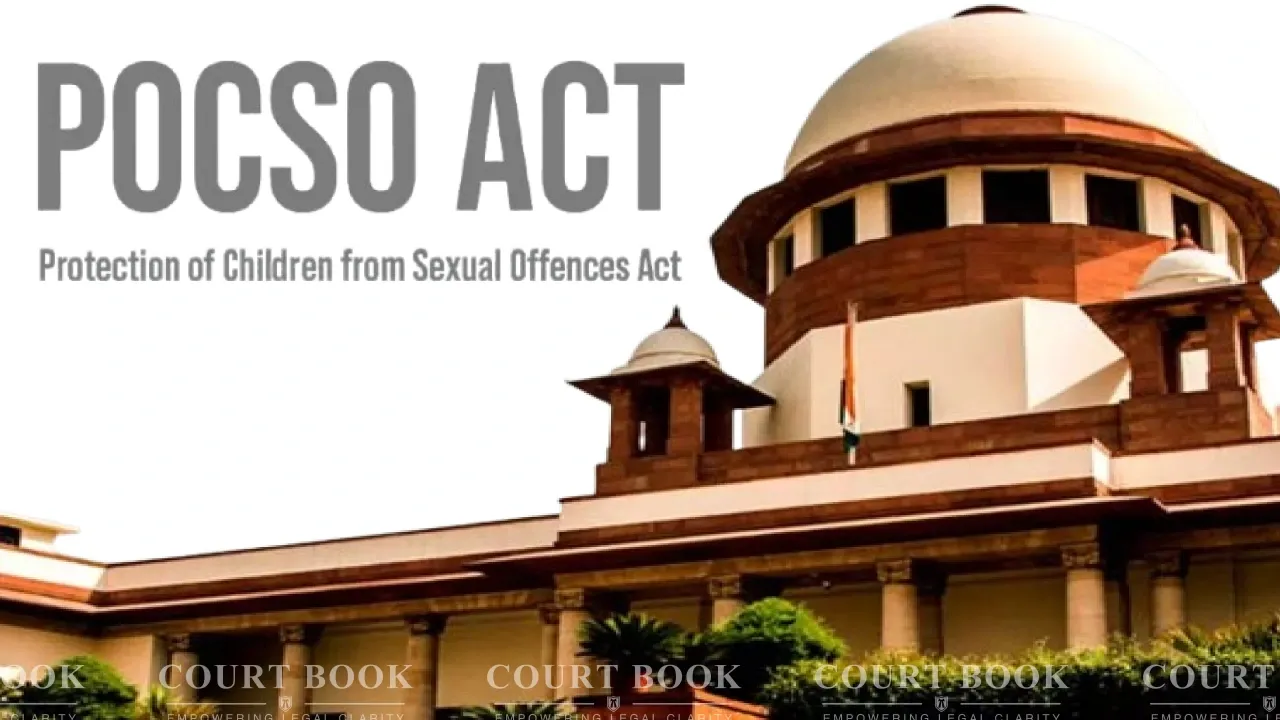
The Supreme Court has partly allowed an appeal in a case arising from Meghalaya, holding that the prosecution failed to establish the victim’s age in the manner required under the Juvenile Justice Act for sustaining a conviction under the Protection of Children from Sexual Offences (POCSO) Act.
However, the Court found that the prosecution had sufficiently established the commission of rape through the medical, forensic and oral evidence on record. It therefore converted the conviction from the aggravated POCSO provision to Section 376 of the Indian Penal Code (IPC) and awarded 10 years of rigorous imprisonment.
The judgment was delivered on September 10, 2026, by a bench comprising Justice Prashant Kumar Mishra and Justice N.V. Anjaria.
Background of the Case
The case arose from an incident reported in November 2019 involving a 13-year-old girl, according to the prosecution. The Trial Court had convicted the appellant under Section 506 IPC and Sections 3 and 4 of the POCSO Act and sentenced him to 20 years’ rigorous imprisonment with a fine of Rs. 5,000.
The Meghalaya High Court upheld the conviction and sentence in July 2024. The appellant then approached the Supreme Court, principally challenging the manner in which the victim’s age had been established.
The prosecution relied mainly on a Baptismal Certificate recording the victim’s date of birth as March 5, 2006. However, the investigating officer had not obtained a school birth certificate, matriculation certificate or birth certificate issued by a municipal or panchayat authority. No age determination test was conducted either.
Supreme Court on Proof of Age Under POCSO
The Supreme Court examined Section 94 of the Juvenile Justice (Care and Protection of Children) Act, 2015. The provision lays down a sequence for determining age: first, the school or matriculation record; failing that, a birth certificate issued by a municipal authority, corporation or panchayat; and only thereafter, an ossification or other latest medical age determination test.
The Court found that none of the prescribed documents had been produced in the present case and no age determination test had been conducted.
"Although the date of birth in the Baptismal Certificate finds corroboration in the deposition of P.W.-2, the mother of the victim girl, stating the girl was born on 05.03.2006, yet since the document itself is not the one prescribed under Section 94 of the JJ Act, we are of the considered view that the prosecution has failed to prove the age of the victim in the manner required under Section 94 of the JJ Act."
The Court also rejected the State's reliance on an earlier decision concerning baptism records, noting that the earlier case involved a birth certificate in addition to the baptismal record and did not concern the statutory procedure for proving the age of a POCSO victim.
Rape Conviction Still Sustained
The Court, however, made a distinction between proving the victim's minority and proving the act of rape. It held that the absence of legally sufficient evidence regarding age did not erase the evidence establishing sexual assault.
The Court noted the victim's identification of the appellant, the injuries found on him, the medical findings and the forensic evidence. The record also showed blood belonging to the appellant on articles belonging to the victim and other medical findings supporting the prosecution case.
The Court further held that failure to frame a separate charge under Section 376 IPC did not prevent conviction under that provision where the accused had a fair opportunity to defend himself against the substantially similar allegation under Section 3 of the POCSO Act.
Decision
The Supreme Court confirmed the conviction under Section 506 IPC. It held that the POCSO conviction could not be sustained because the victim's minority had not been proved according to the statutory procedure.
The Court instead convicted the appellant under Section 376 IPC and sentenced him to 10 years' rigorous imprisonment with a fine of Rs. 10,000. In default of payment of the fine, he would undergo an additional six months of rigorous imprisonment.
The earlier judgments of the Meghalaya High Court and the Special Judge were modified to this extent, and the appeal was partly allowed.




-300x169.webp)

-300x169.webp)