

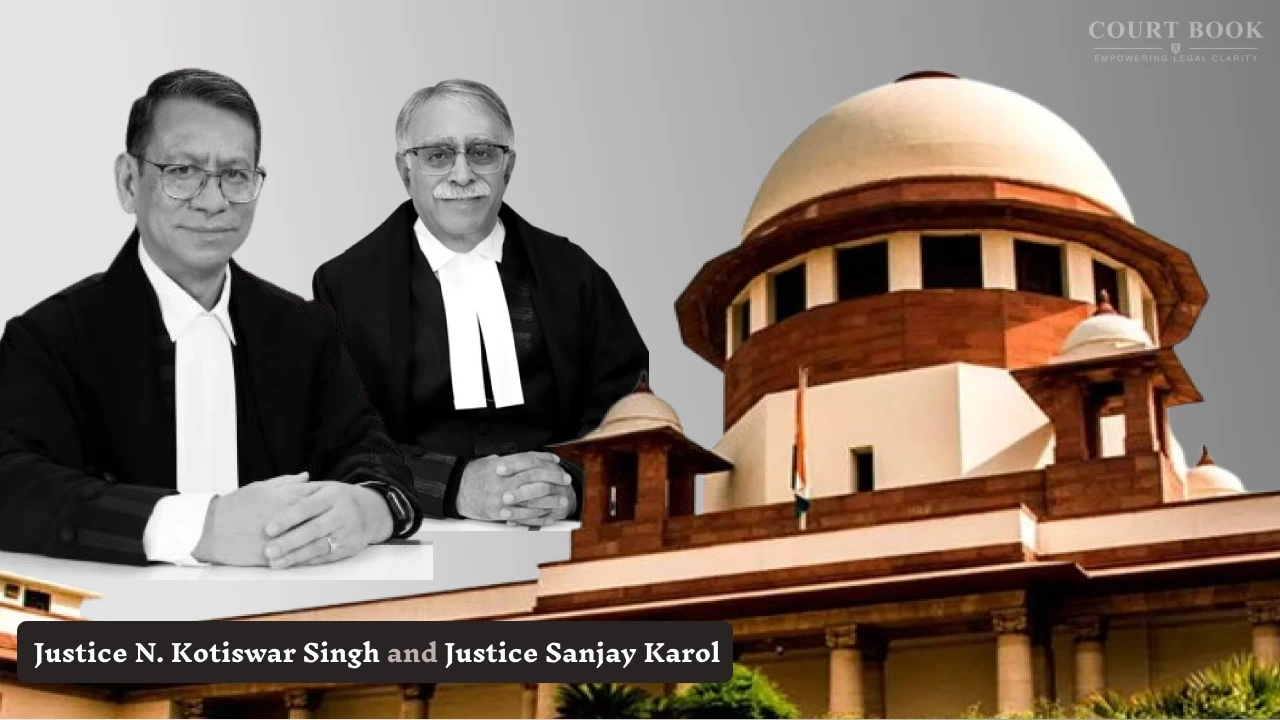
The Supreme Court has ruled in favour of Makardhwaj Ram in a long-running family property dispute that traces its roots back more than six decades. The Court set aside a Chhattisgarh High Court judgment that had dismissed his suit on the ground of constructive res judicata, a legal principle that prevents parties from raising claims that could and should have been raised in earlier litigation.
Delivering the judgment, Justice Sanjay Karol, speaking for the Bench also comprising Justice N. Kotiswar Singh, held that the High Court had incorrectly applied the doctrine to the facts of the case.
Background of the Case
The dispute concerns agricultural land originally connected to Mahabir Rai, a descendant of Gokul Rai. In 1960, Mahabir Rai transferred a substantial portion of his property, measuring about 95.80 acres, in favour of his mother Raj Mohani and his son Makardhwaj Ram.
Two years later, a General Power of Attorney was executed in favour of a relative, Rambhajan. Acting under that authority, Rambhajan sold portions of the land through two separate transactions in 1969. These transactions later became the subject of multiple rounds of litigation.
Over the years, several suits challenging the sale deeds were filed but ultimately failed. The present proceedings arose after an attempt was made to mutate ownership records, prompting Makardhwaj Ram to seek a declaration of title and possession over the remaining land. The trial court partly decreed the suit and the first appellate court upheld that decision. However, the High Court reversed those findings in 2009, holding that the claim was barred by constructive res judicata.
The Supreme Court undertook a detailed examination of the doctrine of constructive res judicata under Section 11 of the Code of Civil Procedure.
The Bench explained that the principle is intended to prevent repeated litigation over matters that should have been raised earlier. However, its application depends on the specific facts of each case and cannot be applied mechanically.
Referring to earlier precedents, the Court noted that parties are expected to exercise reasonable diligence and bring forward all relevant claims in appropriate proceedings. At the same time, courts must carefully assess whether a particular issue genuinely ought to have been raised in earlier litigation.
The Court found that the earlier suits were primarily aimed at challenging specific sale deeds executed through the power of attorney holder. In contrast, the present suit sought recognition of Makardhwaj Ram's title over land that, according to him, remained unaffected by those transactions.
Rejecting the High Court's reasoning, the Bench observed:
“Where and how does the question of asserting his right over the larger parcel of land emerge when the same already rests undisputedly in his favour by virtue of the 1960 deed?”
The Court further noted that the need to assert ownership over the larger property arose only when Rambhajan sought mutation of his name in respect of land beyond the portions covered by the disputed sales.
The Bench concluded that the High Court had overlooked a crucial aspect of the dispute and had wrongly applied the principle of constructive res judicata.
The Court stated that accepting the High Court's approach would effectively deprive the appellant of property that had stood in his name for decades. Such a result, the Court held, would be both harsh and unjust in the circumstances of the case.
Observing that law and equity must operate together, especially in family property disputes, the Bench held that Makardhwaj Ram had already taken steps through his guardians to protect his rights whenever they were threatened.
Setting aside the High Court's judgment, the Supreme Court allowed the appeal and restored the appellant's position.
The Court directed that the parties may pursue such remedies as are available to them in accordance with law and ordered that each side bear its own costs.
Case Details
Case Title: Makardhwaj Ram v. Jagdish Rai (Dead) Through LRs & Anr.
Case Number: Civil Appeal No. 2950 of 2011
Judges: Justice Sanjay Karol and Justice N. Kotiswar Singh
Decision Date: June 11, 2026


