

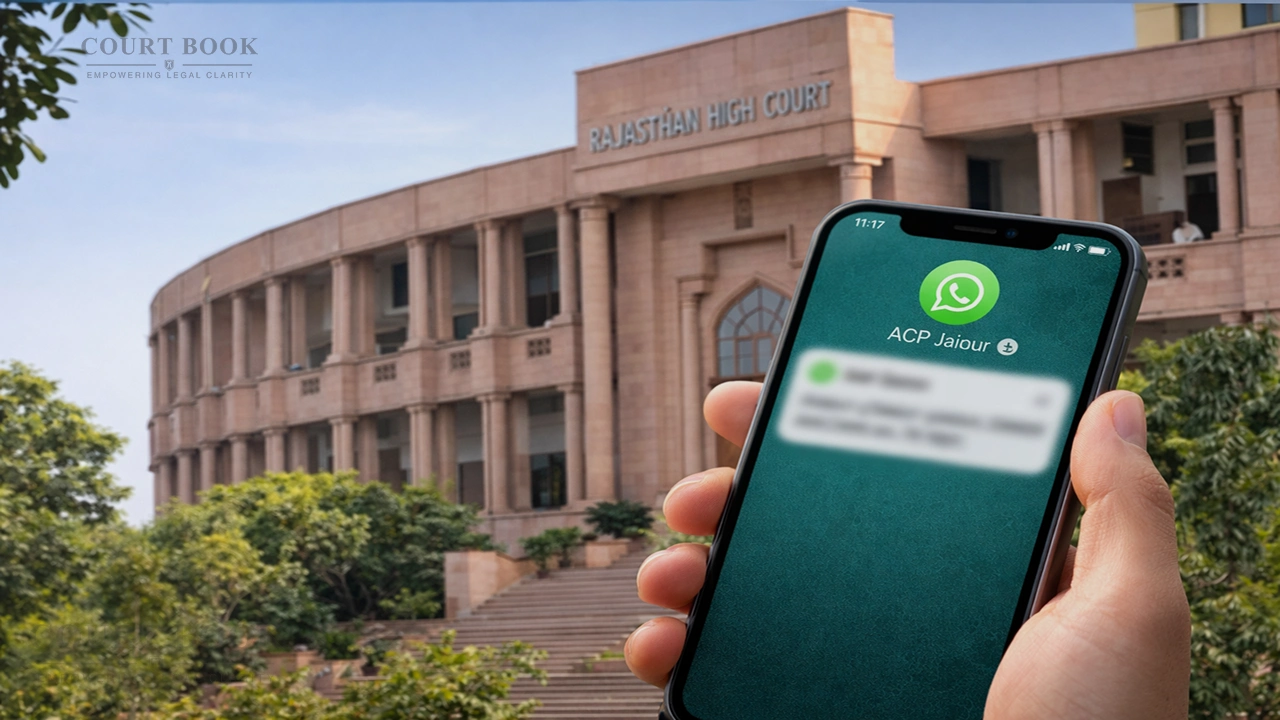
In a significant hearing before the Rajasthan High Court, the Jaipur Bench examined whether a police officer could rely on a WhatsApp message as a valid legal notice before arrest. The case arose from a contempt petition filed by a Jaipur resident who alleged violation of Supreme Court guidelines meant to protect personal liberty.
Background of the Case
The petition was filed by Ravi Meena, who challenged his arrest in connection with an Anti-Corruption Bureau (ACB) case. According to court records, the FIR was registered in September 2021 under provisions of the Prevention of Corruption Act and the Indian Penal Code.
The petitioner argued that he had received a notice dated January 25, 2023, through WhatsApp, asking him to appear before the investigating officer. He responded promptly, citing personal reasons and requesting time. Despite this, he was arrested on February 1, 2023.
Read also:- Mother Allowed to Sell Minor’s Property for Education: Allahabad HC Sets Aside Trial Court Order
His counsel told the court that the arrest was made without following the mandatory safeguards under Section 41-A of the Criminal Procedure Code (CrPC), which requires proper notice before arrest in certain cases.
The petitioner claimed that the WhatsApp message could not be treated as a legally valid notice. He relied on Supreme Court rulings that emphasize the need to avoid unnecessary arrests.
It was argued that:
• No proper notice under Section 41-A CrPC was served.
• The arrest lacked recorded reasons.
• The procedure laid down in key judgments was not followed.
“The action of the respondents is contrary to the statutory safeguards meant to protect personal liberty,” the petitioner’s counsel submitted.
Read also:- Habeas Corpus Not Appropriate Remedy For Deciding Minor’s Custody: Allahabad High Court
On the other hand, the State defended the arrest. Counsel for the respondents argued that the petitioner had not cooperated with the investigation and had shown evasive conduct.
They maintained that:
• A notice had been issued prior to arrest.
• The arrest was carried out under legal provisions with recorded reasons.
• The petitioner had earlier failed to secure relief from courts, including dismissal of his plea before the Supreme Court.
Justice Praveer Bhatnagar closely examined the legal framework governing arrests and notices. The court referred to Section 41-A CrPC, which mandates that a person should ordinarily be issued a notice to appear before being arrested, unless arrest is necessary.
Read also:- Passport Cannot Be Denied Solely Due to Pending Criminal Case; Telangana HC Directs Proper Legal Route
The court also relied on landmark Supreme Court rulings, especially those emphasizing that arrests should not be automatic.
Importantly, the bench noted that service of notice through WhatsApp does not meet the legal requirements.
“The so-called intimation through WhatsApp cannot be treated as a notice under Section 41-A CrPC,” the court observed, pointing out that proper modes of service must be followed.
The court further stressed that personal liberty is a fundamental right and cannot be curtailed without following due process.
The High Court discussed:
• Section 41 and 41-A of CrPC (procedure for arrest and notice)
• Supreme Court guidelines on arrest safeguards
• Requirements for recording reasons before arrest
It also referred to directions clarifying that electronic modes like WhatsApp cannot replace legally prescribed methods of serving notice.
Read also:- Gauhati HC Acquits Man in POCSO Case, Cites Weak Evidence and Contradictions
After examining the facts and legal position, the court framed two key issues: whether the arrest violated statutory safeguards and whether it amounted to willful disobedience attracting contempt jurisdiction.
The matter was decided after considering compliance with procedural safeguards and applicable legal standards, with the court addressing the allegations of contempt in light of the established law.
Case Details
Case Title: Ravi Meena v. Pushpendra Singh Rathod & Ors.
Case Number: S.B. Civil Contempt Petition No. 507/2023
Judge: Justice Praveer Bhatnagar
Decision Date: 23 March 2026
Counsels:
• Petitioner: Mohit Khandelwal & team
• Respondents: Ghanshyam Singh Rathore & Santosh Singh Shekhawat
Download Order

