

The Supreme Court has directed the Union government and its space agency to regularise long-serving daily wage workers, holding that a temporary engagement scheme failed to comply with earlier judicial directions. The Court underscored that fairness in public employment cannot be diluted through procedural shortcuts.
Background of the Case
The case, R. Iyyappan & Ors. vs Union of India & Ors., arose from a long-standing dispute involving daily-wage labourers working at the Mahendragiri unit of the Indian Space Research Organisation (ISRO).
These workers were engaged between 1991 and 1997 for tasks such as loading, unloading, and shifting materials. Over time, they sought regularisation under the Casual Labourers (Grant of Temporary Status and Regularisation) Scheme, 1993.
Read also:- Jharkhand High Court Upholds ‘Non-Duty’ Tag for Suspension Period, Dismisses Employee’s Appeal Against DVC
After multiple rounds of litigation, the Central Administrative Tribunal in 2010 directed the authorities to create posts and frame a scheme to engage such workers on a more permanent basis. This direction was upheld by the Madras High Court and later attained finality when the Supreme Court dismissed the challenge in 2011.
However, in 2012, the authorities introduced the “Gang Labourers Scheme”, which continued to treat these workers as temporary employees. This triggered fresh litigation.
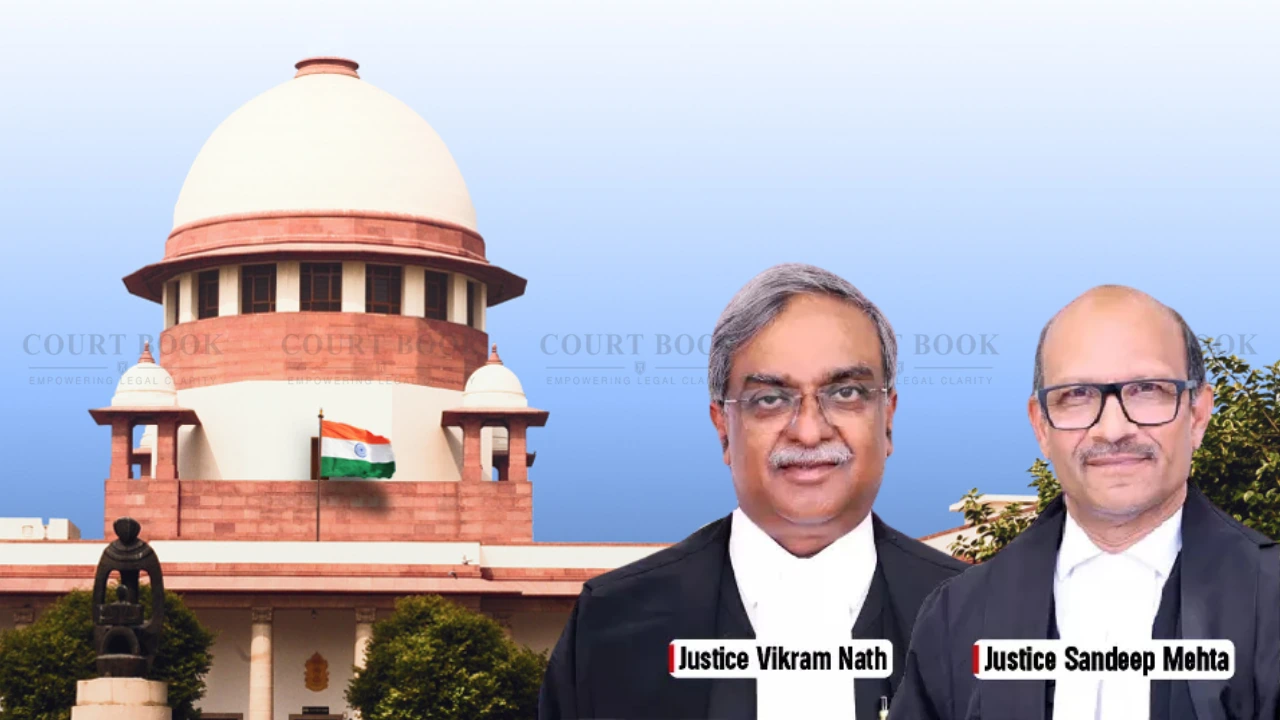
The bench of Justice Vikram Nath and Justice Sandeep Mehta closely examined whether the 2012 scheme complied with the Tribunal’s earlier directions.
The Court clarified that the original order did not merely call for a formal scheme, but required creation of posts and structured, permanent engagement.
“The essence of the earlier directions,” the bench noted, “was to transition from an ad hoc system to a structured regime based on sanctioned posts.”
The judges found that the 2012 scheme fell short, as it allowed only temporary employment without linking it to permanent posts. This, according to the Court, was inconsistent with both the letter and spirit of the Tribunal’s mandate.
Importantly, the Court also criticized the High Court for re-examining the merits of regularisation, stating that the issue had already attained finality.
“It was wholly impermissible for the High Court to reopen the issue on merits,” the bench observed.
The judgment carries a strong message on the role of the State as a model employer.
The Court expressed concern that workers who had served for decades were still kept in insecure, daily-wage arrangements. It emphasized that equality under Article 14 of the Constitution requires fairness and non-arbitrary action in public employment.
Read also:- Supreme Court Sets Aside CIRP Against Shrinathji Group, Rules Section 7 Plea Time-Barred
In a notable passage, the Court reflected on the broader ecosystem behind India’s space achievements, observing:
“The success of a rocket or satellite mission is not the sole outcome of high-level engineering... the last man in the chain plays an indispensable role.”
The bench stressed that ignoring such workers in service matters undermines dignity and fairness.
Allowing the appeal, the Supreme Court set aside the Madras High Court’s judgment dated July 8, 2024.
The Court held that:
• The Gang Labourers Scheme, 2012, to the extent it provided only temporary employment, is invalid.
• The respondents are directed to regularise the services of the appellants.
• Permanent status must be granted with effect from September 9, 2010, the deadline originally fixed by the Tribunal.
• The directions must be implemented within four weeks.
• The benefit of the judgment will also extend to similarly placed workers.
“The scheme, insofar as it is inconsistent with engagement on a permanent basis, is hereby set aside,” the bench ruled.
Case Details
Case Title: R. Iyyappan & Ors. vs Union of India & Ors.
Case Number: Civil Appeal arising out of SLP (C) No. 7138 of 2025
Judges: Justice Vikram Nath, Justice Sandeep Mehta
Decision Date: April 29, 2026
Download Judgment

