

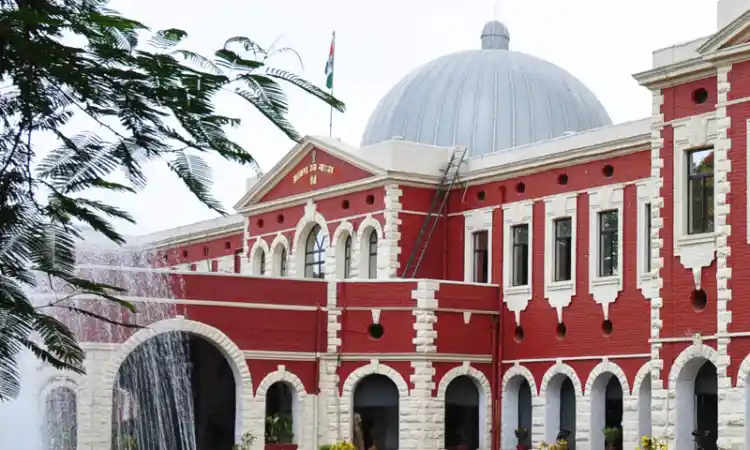
The Jharkhand High Court has dismissed an intra-court appeal filed by a Damodar Valley Corporation (DVC) employee, refusing to interfere with a minor penalty imposed on him and the decision to treat his long suspension period as “non-duty.” The Division Bench held that there was no illegality in the disciplinary authority’s actions.
Background of the Case
The case arose from a service dispute involving Gajendra Prasad, an Assistant Operator (Electrical) appointed in 1995. He was placed under suspension on October 25, 2002, following a criminal case linked to a matrimonial dispute.
Later, in 2004, the corporation initiated departmental proceedings against him on several charges. These included failure to disclose his marriage, allegations of dowry demand, desertion of his wife, and leaving headquarters during suspension without permission.
Read also:- Supreme Court Sets Aside CIRP Against Shrinathji Group, Rules Section 7 Plea Time-Barred
While some charges did not stand, the inquiry found him guilty of certain misconduct, particularly leaving headquarters without prior approval.
After completion of the inquiry, the disciplinary authority imposed a minor penalty-stoppage of one increment for one year without cumulative effect. His departmental appeal was also rejected.
The employee challenged the disciplinary action and related decisions before the High Court through a writ petition. The Single Judge partly interfered with some findings but upheld the penalty and also refused to disturb the order treating the suspension period (2002–2007) as “non-duty.”
Aggrieved by this, the employee filed a Letters Patent Appeal before the Division Bench.
The appellant argued that:
• The criminal case against him ended in compromise,ended in a compromise between the parties.
• His suspension was not due to misconduct related to official duties.
• Denial of full salary for over five years of suspension was unjustified.
He further contended that he had informed authorities before leaving headquarters and that the prolonged inquiry delay was not entirely his fault.
The corporation opposed the appeal, stating that:
• The appellant did not cooperate with the inquiry proceedings, causing delays.
• He was not fully exonerated in the departmental proceedings.
• Under applicable service regulations, full salary during suspension is not automatic unless the employee is completely cleared or the suspension is found unjustified.
The Division Bench closely examined the inquiry report and service regulations.
On the misconduct, the Court noted that although there were some deficiencies in how charges were framed, the essential allegation-leaving headquarters without prior permission-was established.
“The requirement of obtaining prior permission was not satisfied,”
the Court observed while upholding the finding of guilt on this charge.
Regarding the penalty, the Bench found it proportionate.
“It is not very harsh,” the Court said, agreeing with the Single Judge’s view.Read also:- Bombay High Court Rejects Contractor’s Plea Over Amravati Road Tender, Upholds Bid Evaluation Process
A major issue before the Court was whether the suspension period should be treated as duty, entitling the employee to full salary.
The Court referred to Regulation 100 of the DVC Service Regulations, which allows full pay only if:
• The employee is fully exonerated, or
• The suspension is held wholly unjustified.
In this case, neither condition was met.
“The appellant was not fully exonerated… nor was the suspension held wholly unjustified,” the Bench noted.
As a result, the competent authority had discretion to decide the extent of pay and had rightly treated the period as “non-duty.”
The Court concluded that there was no legal infirmity in either the minor penalty or the decision to treat the suspension period as non-duty.
Accordingly, the appeal was dismissed, with the Bench stating that it was “devoid of any merit.”
case details
Case Title: Gajendra Prasad vs. Damodar Valley Corporation & Ors.
Case Number: L.P.A. No. 650 of 2022
Judges: Hon’ble Mr. Justice Rongon Mukhopadhyay and Hon’ble Mr. Justice Deepak Roshan
Decision Date: 02 April 2026
Download Order

