

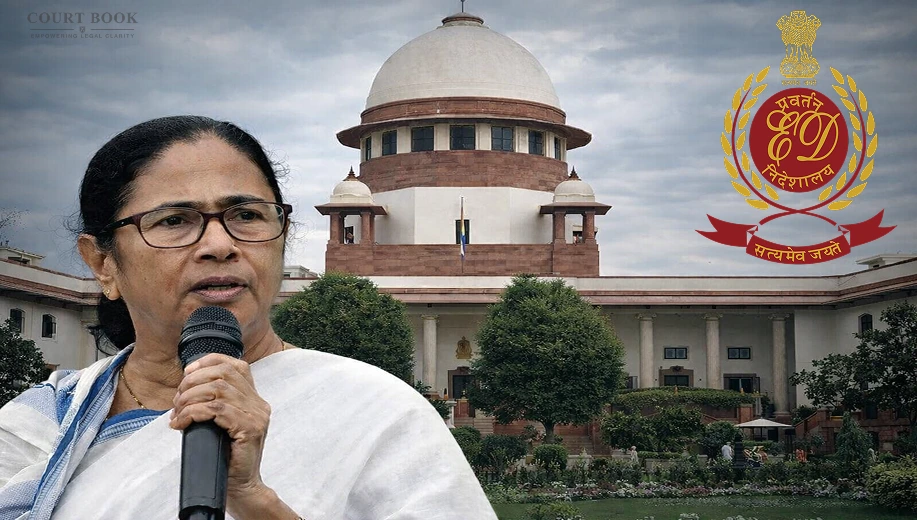
The Supreme Court on Wednesday (22 April 2026) as it examined allegations that West Bengal Chief Minister Mamata Banerjee interfered with an ongoing Enforcement Directorate (ED) investigation. The Court indicated that such actions, if established, raise serious constitutional concerns and cannot be treated as a routine Centre-State dispute.
Background of the Case
The matter arises from writ petitions filed by the Enforcement Directorate and its officers under Article 32 of the Constitution. The agency has sought, among other reliefs, a direction for a Central Bureau of Investigation (CBI) probe into the alleged obstruction of its search operations at the Kolkata office of political consultancy firm I-PAC.
According to the ED, during a search linked to a money laundering investigation, the Chief Minister entered the premises along with state officials and allegedly took away documents and electronic devices relevant to the probe. The State, however, has disputed this version, maintaining that the actions were lawful and did not obstruct the investigation.
A bench of Justices Prashant Kumar Mishra and N. V. Anjaria expressed concern over the nature of the allegations. The judges questioned whether such conduct could be framed as a federal dispute.
“This is not a dispute between the State and the Union,” the Bench observed. “A Chief Minister cannot walk into an ongoing investigation and then claim it is a Centre-State issue.”
The Court noted that the situation appeared unprecedented.
“We never thought a day would come when a sitting Chief Minister would walk into an office where an investigating agency is conducting a probe,” the Bench remarked.
It further indicated that interference by a constitutional functionary in an ongoing investigation could affect institutional integrity.
“Such actions, if true, put democracy in peril,” the Court said during the hearing.
Senior Advocate Menaka Guruswamy, appearing for the State, challenged the maintainability of the petitions. She argued that the dispute falls under Article 131, which governs Centre-State disputes, and not Article 32.
The Bench, however, appeared unconvinced. It questioned what fundamental right of the State was involved and emphasized that the issue concerns alleged actions of an individual holding constitutional office.
Senior Advocate Abhishek Manu Singhvi, representing a state police official, also argued that the ED, being a statutory body, cannot claim fundamental rights under Article 32. He submitted that there is no independent fundamental right to investigate.
The Court responded by probing whether ED officers, as individuals, lose their fundamental rights when acting in official capacity. It suggested that accepting the State’s argument could limit access to constitutional remedies.
During the hearing, Solicitor General Tushar Mehta, appearing for the CBI, supported the ED’s case. The Bench also noted earlier submissions and arguments regarding the alleged removal of material during the search.
The Court declined the request to refer the matter to a Constitution Bench, observing that not every legal question warrants such a reference.
“Every petition involves some question of law; that alone cannot justify sending it to a larger bench,” it stated.
The Supreme Court continued hearing the matter, indicating that the issues raised require careful judicial scrutiny, particularly in view of their potential impact on investigative processes and constitutional governance.
Case Details:
Case Title: Directorate of Enforcement v. State of West Bengal
Case Number: W.P.(Crl.) No. 16/2026
Bench: Justices Prashant Kumar Mishra and N. V. Anjaria
Decision Date: April 22, 2026


