

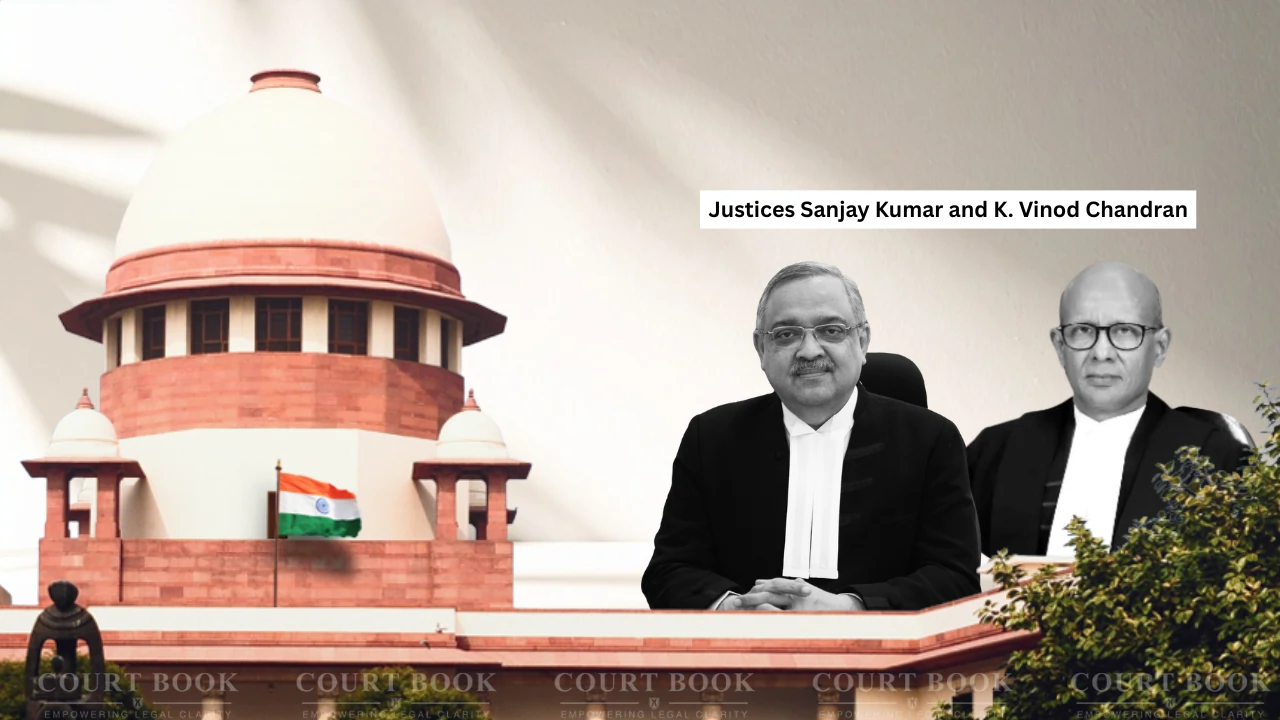
The Supreme Court of India has restored a 1975 revenue court decree that declared tenancy rights (“khatedari”) over agricultural land in favour of the appellant, setting aside orders that had reopened the case after a delay of 31 years. The Court held that such a prolonged delay, combined with the absence of proof of fraud, could not justify disturbing a long-settled judgment.
Background of the Case
The dispute dates back to a suit filed under Section 88 of the Rajasthan Tenancy Act, 1955, seeking declaration of tenancy rights over 158.3 bighas of land and recovery of possession from the defendants. The plaintiff claimed that the land had been inherited from his father, whose name was recorded in revenue records in 1961.
Read also:- Kerala High Court: Advocate Cannot Stall Execution Proceedings Over Fee Dispute, ₹50k Cost Imposed
The defendants relied on a disputed sale deed, allegedly executed in 1963, to justify their possession. However, the trial court in 1975 decreed the suit in favour of the plaintiff after the first defendant, despite earlier participation, failed to continue contesting the case. Decades later, in 2006, the defendant filed an appeal, citing fraud and lack of opportunity. The Board of Revenue allowed the matter to be reopened, a view upheld by the High Court.
A Bench of Justices Sanjay Kumar and K. Vinod Chandran closely examined the trial court records and rejected the claim that the original defendant had been denied a fair hearing.
The Bench noted:
“The proceedings clearly indicate that the defendant appeared through counsel, filed pleadings, and examined witnesses. The allegation that she was unaware of the case is not supported by the record.”
The Court pointed out that the defendant had never produced the sale deed that was the basis of her claim. It observed that withholding crucial evidence permitted the Court to draw an adverse inference.
Read also:- Rajasthan High Court Stays Consumer Proceedings Against Actor Salman Khan Over Pan Masala Advertisement Row
Regarding the long delay, the Bench remarked:
“Condonation of delay cannot be an act of generosity when it defeats substantial justice and prejudices the opposite party.”
The Court also highlighted that the sale deed allegedly executed on behalf of a minor would, in any case, be invalid without court permission, and no proof of a valid transfer was shown.
Finding the High Court’s decision to reopen the case unsustainable, the Supreme Court set aside the orders of the Board of Revenue and the High Court. It restored the original 1975 revenue court decree that had recognised the appellant’s tenancy rights over the disputed land.
All pending applications were disposed of accordingly.
Case Details
Case Title: Hari Ram v. State of Rajasthan & Ors.
Case Number: Civil Appeal arising out of SLP(C) No. 4664 of 2025
Judges: Justice Sanjay Kumar, Justice K. Vinod Chandran
Decision Date: 10 April 2026
Download Judgment

