

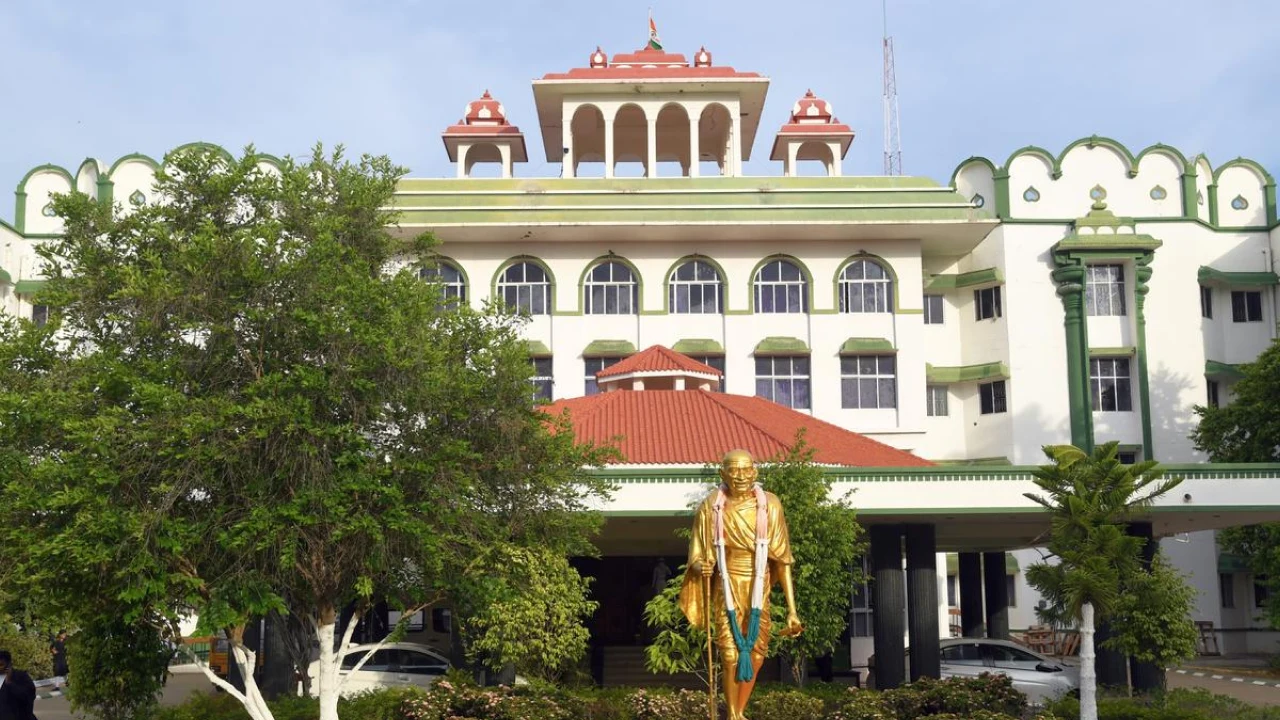
The Madras High Court has ruled that residents of one local body cannot claim, as a legal right, to use a cremation ground maintained by another local body merely because it is more convenient. The Court clarified that such a claim can succeed only if it is supported by a recognised customary right or protected under the fundamental right to freely practice religion under Article 25 of the Constitution.
Background of the Case
The case arose from a dispute between residents of Bommaiahgoundanpatti and Sukkuvadanpatti villages in Theni district. The petitioners, Anbalagan P., Thavaraja M., and Ragunathan R., approached the High Court seeking directions to the district authorities to take control of a cremation ground in Sukkuvadanpatti after local residents allegedly prevented them from performing cremations there.
According to the petitioners, they had traditionally used the Sukkuvadanpatti cremation ground because of its proximity. However, residents of Sukkuvadanpatti opposed their continued use, leading to a peace committee meeting that failed to resolve the dispute.
Court's Observations
The Division Bench of Justice G.R. Swaminathan and Justice K.K. Ramakrishnan began by emphasizing that every person is entitled to dignity even after death and that the right to perform last rites with respect forms part of the protection guaranteed under Article 21 of the Constitution. The Court referred to earlier Supreme Court decisions recognising the dignity of the deceased and the rights of family members to conduct funeral rites.
However, the Bench distinguished the right to perform last rites from the right to choose any cremation ground.
The Court examined the Tamil Nadu Panchayats Act, 1994, and held that village panchayats are responsible for maintaining cremation grounds primarily for the benefit of their own residents. It observed that the law does not confer an automatic right on non-residents to use facilities belonging to another local body.
The Bench observed:
"Those residing within the territorial limits of a local body cannot claim right of burial / cremation in the burial / cremation ground vested with another local body."
The judges also noted that a municipality or panchayat may regulate the use of its cremation grounds and that such regulation does not become unlawful merely because it restricts access to non-residents.
At the same time, the Court clarified that discrimination based on caste or birth in access to a public cremation ground would be unconstitutional. It also recognised that where an ancient and established custom exists, or where a place holds religious significance protected by Article 25, persons from outside the local body's limits may still have an enforceable right to perform cremation there.
Why the Petition Failed
The Bench found that the petitioners had relied only on the convenience of using the Sukkuvadanpatti cremation ground. They neither established an ancient customary right nor argued that the site enjoyed religious significance attracting constitutional protection under Article 25.
The Court further noted that Bommaiahgoundanpatti falls within Theni-Allinagaram Municipality, which already has its own cremation facilities, including a gasified crematorium. Therefore, the petitioners' legal remedy, if any, lay against their own local body rather than the neighbouring panchayat.
Decision
Dismissing the writ petition, the High Court held that residents of Bommaiahgoundanpatti were not entitled to insist upon using the Sukkuvadanpatti cremation ground as a matter of legal right.
The Court clarified that such a right can arise only when protected by an established custom or by the fundamental right to practice religion under Article 25, neither of which had been proved in the present case.
The connected miscellaneous petition was also closed without any order as to costs.
Case Details
Case Title: Anbalagan P. & Ors. v. The District Collector & Ors.
Case Number: WP(MD) No. 27734 of 2022
Judge: Justice G.R. Swaminathan and Justice K.K. Ramakrishnan
Decision Date: 29 June 2026


