

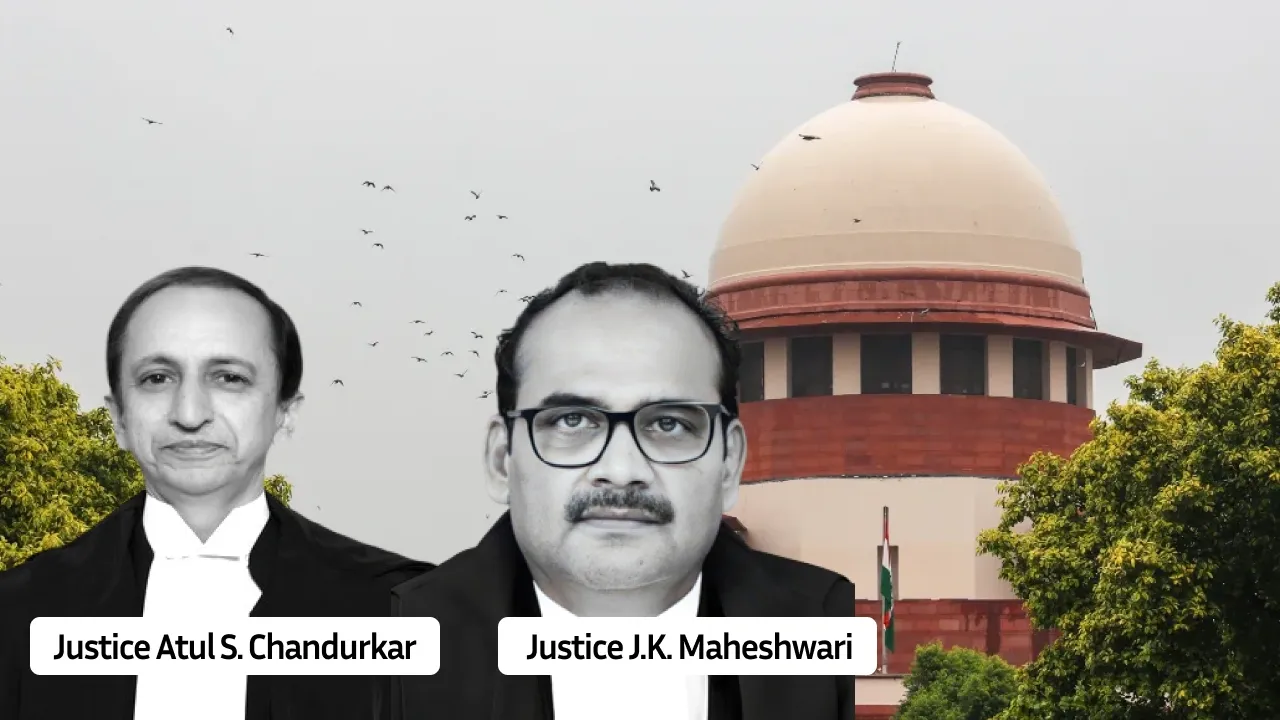
The Supreme Court has overturned the conviction of a man who had been sentenced under Section 498A of the Indian Penal Code (IPC) for allegedly subjecting his wife to cruelty. The Court held that merely not speaking to his wife over the phone for a brief period could not, by itself, be treated as cruelty capable of attracting criminal liability.
A Bench of Justice J.K. Maheshwari and Justice Atul S. Chandurkar delivered the judgment on May 7, 2026.
Background of the Case
The case arose after Sangeetha, who had married the appellant in November 2014, died by suicide at her parental home on January 31, 2015. The prosecution alleged that she was subjected to dowry-related harassment and mental cruelty by her husband and in-laws.
During the trial, all family members were acquitted of charges relating to dowry death and cruelty. The husband was also acquitted of the dowry death charge under Section 304B IPC. However, he was convicted under Section 498A IPC on the allegation that he had stopped communicating with his wife after she returned to her parental home without informing her in-laws.
Both the trial court and the Madras High Court held that this conduct amounted to mental cruelty.
Examining the scope of Section 498A IPC, the Supreme Court noted that cruelty must be established through convincing evidence and should be of such a nature that it is likely to drive a woman to commit suicide or seriously affect her mental or physical health.
The Bench observed,
“There cannot be a thumb rule with respect to determination of mental cruelty which can be applied uniformly to all cases.”
The Court emphasized that mental cruelty depends on the facts and circumstances of each case and that ordinary marital disagreements cannot automatically be treated as criminal cruelty.
A key factor that weighed with the Court was the absence of supporting evidence regarding the alleged non-communication.
According to the Bench, the prosecution relied mainly on oral statements made by the deceased's family members. The Court noted that call records or other material evidence could have been produced to substantiate the allegation that the husband had deliberately avoided speaking with his wife.
The judges also found that WhatsApp records showing no messages were exchanged did not conclusively establish a lack of communication, since conversations could have taken place through regular phone calls.
“The prosecution was duty bound to prove such allegation... with the call details,” the Court observed while finding that this burden had not been discharged.
Allowing the appeals, the Supreme Court held that the prosecution had failed to prove the essential ingredients of cruelty under Section 498A IPC.
The Bench concluded that
“mere non-communication with the deceased for thirteen days, without substantiating the same with cogent evidence, cannot, in any stretch of the imagination, fall within the ambit of cruelty.”
The Court set aside the judgments of the trial court and the Madras High Court, acquitted the appellant of the charge under Section 498A IPC, discharged his bail bonds, and directed that his passport be returned to him.
Case Details:
Case Title: Jayesh Kanna v. The Assistant Commissioner Law and Order (West) & Others
Case Number: Criminal Appeal Nos. 2382-2383 of 2026 (arising out of SLP (Crl.) Nos. 8581-8582 of 2026)
Bench: Justice J.K. Maheshwari and Justice Atul S. Chandurkar
Decision Date: May 7, 2026


