

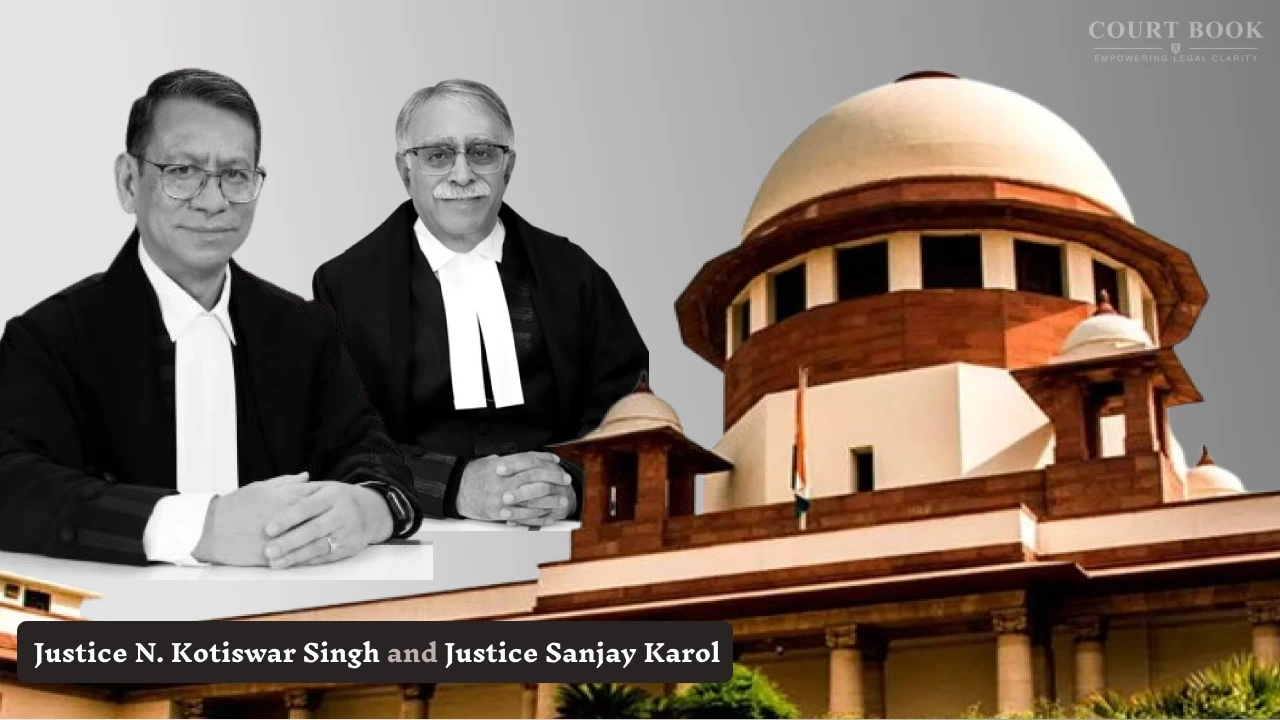
In a significant ruling on the protection of minors’ property rights, the Supreme Court has permitted a mother to proceed with a development agreement involving her minor son's share in inherited land, holding that courts must carefully assess whether a proposed transaction genuinely serves the child’s welfare rather than reject it on technical grounds.
The Court overturned orders of the District Judge, Darjeeling, and the Calcutta High Court, which had refused permission for the transaction under Section 8 of the Hindu Minority and Guardianship Act, 1956.
Background of the Case
The appeal was filed by Shephali Chakraborty on behalf of her minor son, Basab Chakraborty. The child inherited a share in family property following the death of his father, Basudeb Chakraborty, in 2018.
In 2022, members of the family decided to enter into a development agreement with a private developer for redevelopment of the property. Under the arrangement, the owners were to receive residential flats and monetary consideration in exchange for development rights.
Since a portion of the property belonged to a minor, court approval was required before the transaction could proceed.
The District Judge rejected the application, observing that the mother had failed to demonstrate how the proposed arrangement would specifically benefit the child. The High Court later affirmed that decision.
The division bench of Justice Sanjay Karol and Justice N Kotiswar Singh undertook an extensive examination of Section 8 of the Hindu Minority and Guardianship Act.
The Court explained that while a natural guardian has authority to manage a minor's property, any transfer or disposal of immovable property requires prior court permission. Such approval can be granted only when the transaction is necessary or provides an evident advantage to the minor.
The Bench observed that the provision reflects the doctrine of parens patriae, under which courts act as protectors of those who cannot safeguard their own interests.
“The welfare of the minor remains paramount,” the Court emphasized while discussing the statutory scheme.
The Court noted that judges considering such requests must independently evaluate whether a transaction benefits the child and should not merely rely on the guardian’s consent.
At the same time, the Bench cautioned that the presence of a minor co-owner should not unnecessarily prevent adult co-owners from deriving reasonable benefits from property.
“The best interest of the child is not passive consideration but a vigorous principle that requires foresight, caution, and meticulous scrutiny in every matter affecting the minor’s property,” the judgment stated.
According to the Court, the real question was whether the minor would be better served by retaining an undivided share in undeveloped land or by receiving a share in a completed residential unit along with monetary consideration.
The Bench found that an undivided share in vacant land often remains a largely notional asset that may not provide immediate utility or financial benefit.
By contrast, the development agreement would provide a concrete residential asset and cash consideration. The Court observed that such a combination of immovable and liquid assets could better serve the child’s future needs, including education, healthcare and overall welfare.
“The conversion of an interest in land into tangible, enforceable assets can be considered a step towards enhancing the minor’s welfare,” the Court observed.
The judges also disagreed with the lower court’s finding that the identity of other co-owners was unclear, noting that the development agreement itself adequately recorded the ownership history.
Allowing the appeal, the Supreme Court granted permission to Shephali Chakraborty to proceed with the development agreement.
However, the Court imposed safeguards to protect the minor’s interests. It directed that the monetary consideration received under the agreement be deposited in a nationalised bank with automatic renewal until the child attains majority, subject to future modification by the competent court if circumstances require.
The Court further directed that any alteration to the development agreement must receive prior court approval. It also ordered that if co-owners seek to sell their interests before the minor becomes an adult, they must first obtain permission from the concerned court.
With these directions, the appeal was allowed and the orders of the District Judge and the High Court were set aside.
Case Details
Case Title: Shephali Chakraborty v. State of West Bengal
Case Number: Civil Appeal arising out of SLP (Civil) No. 25053 of 2025
Judges: Justice Sanjay Karol and Justice Nongmeikapam Kotiswar Singh
Decision Date: June 3, 2026


