

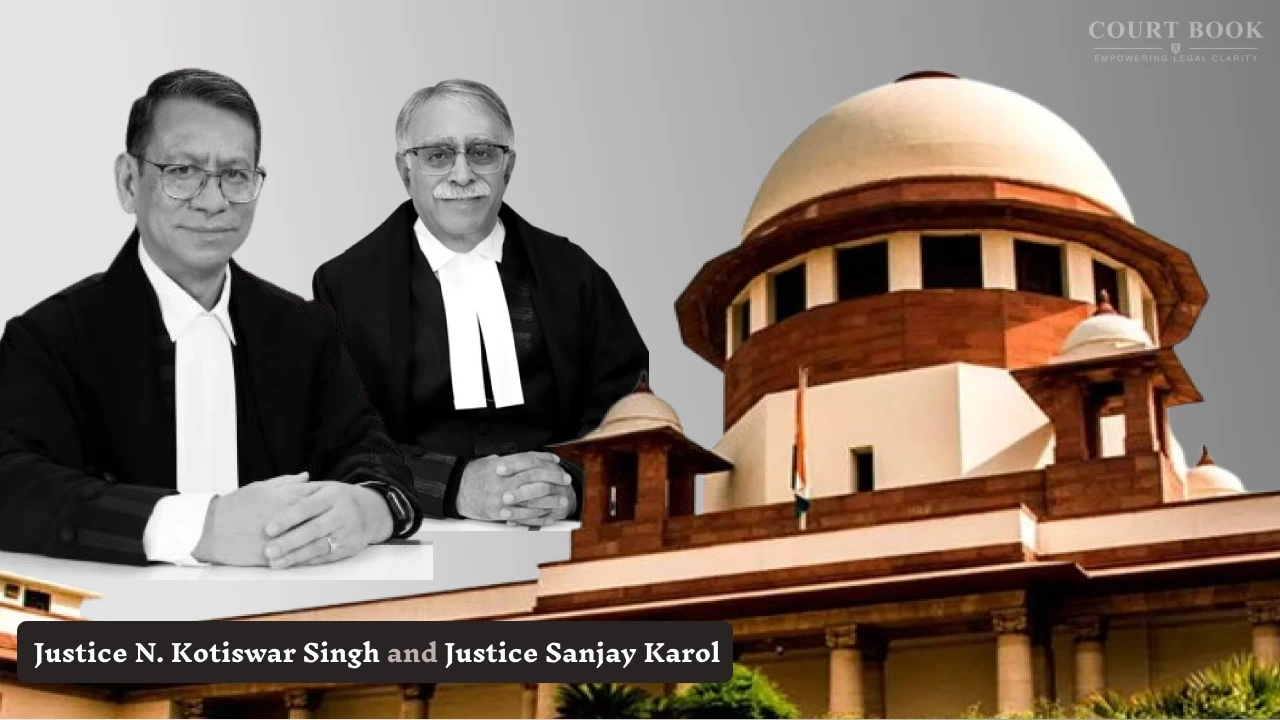
In a significant ruling on compensation for the death of homemakers, the Supreme Court has substantially increased the compensation payable to the family of a woman who died in a road accident more than two decades ago. The Court held that the contribution of a homemaker cannot be treated as economically insignificant merely because it does not generate a conventional salary.
The bench of Justice Sanjay Karol and Justice N. Kotiswar Singh described homemakers as “nation builders” and emphasized that their unpaid domestic work forms an essential pillar of the economy and family life.
Background of the Case
The dispute arose from a motor vehicle accident that occurred on 25 November 2001. The deceased woman was travelling from Sirsa to Fatehabad when the accident took place. Her legal heirs approached the Motor Accident Claims Tribunal (MACT), which awarded compensation of ₹2.42 lakh in 2003.
Unsatisfied with the amount, the family appealed before the Punjab and Haryana High Court. After nearly two decades of pendency, the High Court enhanced the compensation to ₹8.43 lakh in December 2024. However, the claimants continued to seek a higher amount and approached the Supreme Court.
The Supreme Court expressed concern over the extraordinary delay in motor accident compensation matters. The Court noted that the appeal remained pending for nearly twenty years in the High Court, partly due to the destruction of records in a fire and the prolonged process of reconstruction.
The bench observed that compensation under a welfare-oriented law loses much of its value when claimants are forced to wait for decades.
“The idea of ‘just and fair’ compensation requires that an amount of money be paid to the claimants that would, as far as possible, place them in a position as if the unfortunate incident had not taken place,” the Court observed.
A major part of the judgment focused on the contribution of homemakers. The Court rejected the notion that a homemaker is dependent on earning family members and instead noted that households often function because of the unpaid labour performed by women.
The judgment referred to domestic responsibilities such as cooking, cleaning, caregiving and household management, observing that these activities support the productivity of earning members while remaining largely unrecognized in economic calculations.
“The earning members are in fact solely dependent on the homemaker,” the Court remarked while discussing the importance of unpaid domestic work.
The Supreme Court introduced an important principle for future compensation cases involving homemakers.
The Court held that where a homemaker does not have proven monetary income, tribunals and courts should account for her contribution under a separate head called “loss of domestic care.” It fixed a benchmark amount of ₹30,000 per month as the basic minimum value of such contribution, with a 10% cumulative revision every three years.
The Court clarified that where a homemaker is also earning independently, the amount under “loss of domestic care” can be awarded in addition to the proven income.
Applying these principles to the present case, the Court found that the claimed monthly income of ₹3,000 from knitting and stitching had not been established through evidence. It therefore treated the matter as one involving a homemaker without proven monetary income and assessed compensation using the “loss of domestic care” framework.
The Court calculated compensation by taking ₹30,000 per month as the notional contribution, adding future prospects, applying the relevant multiplier, and granting amounts under consortium, loss of estate and funeral expenses. The total compensation was determined at ₹62,77,900.
Allowing the appeal, the Supreme Court enhanced the compensation payable to the claimants from the amount awarded by the High Court to ₹62.77 lakh. The Court directed that the award would be payable by the insurance company and retained the interest conditions already imposed by the High Court.
The judgment also directed that in future cases involving the death of a homemaker, compensation under the head of “loss of domestic care” should be added and observed that homemakers should be recognized as “Nation Builders.”
Case Details
Case Title: Shishu Pal @ Shish Ram & Ors. v. Surjeet & Ors.
Case Number: Civil Appeal arising out of SLP (Civil) No. 33915 of 2025
Judge: Justice Sanjay Karol
Decision Date: 2026 (reported as 2026 INSC 634)


