

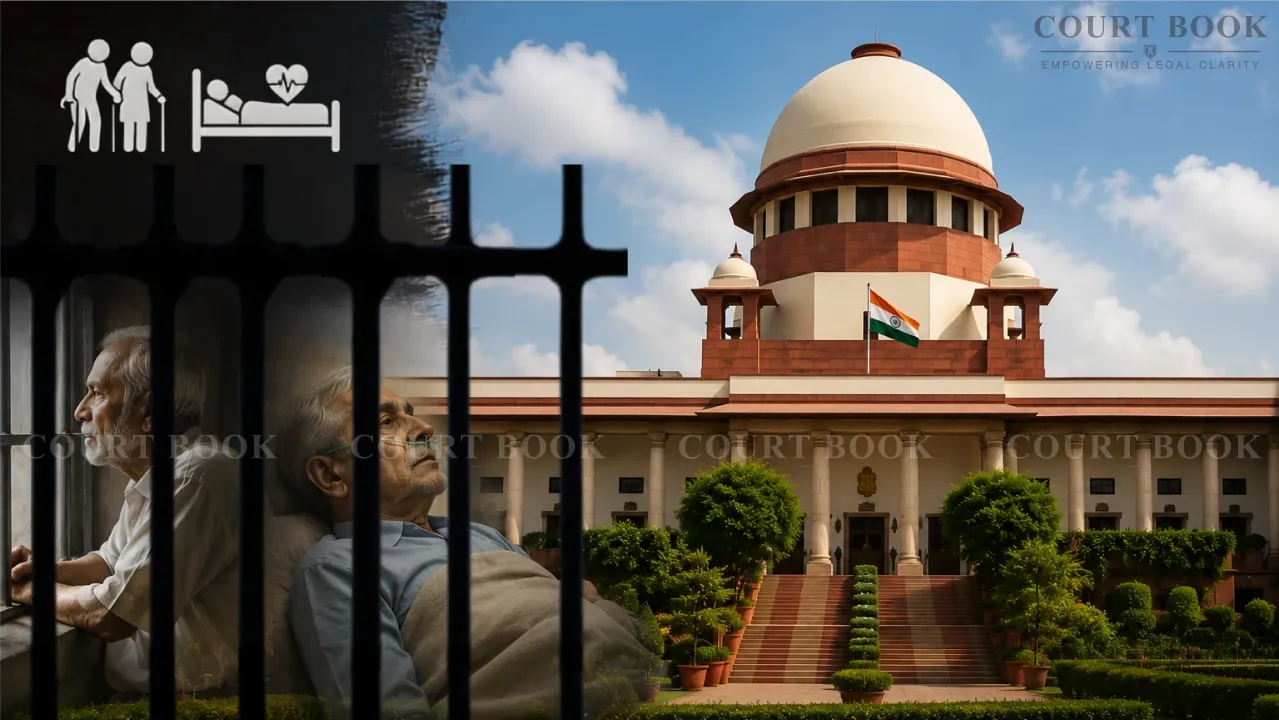
In a significant judgment reinforcing the constitutional right to live with dignity, the Supreme Court has directed every State and Union Territory to formulate a comprehensive policy for the early or compassionate release of elderly and terminally ill prisoners within three months. The Court held that imprisonment cannot result in unnecessary suffering merely because a prisoner has grown old or is battling a terminal illness.
The ruling came in a writ petition filed by the National Legal Services Authority (NALSA), which highlighted the continued incarceration of prisoners above 70 years of age and those suffering from terminal illnesses despite their fragile health conditions.
Background of the Case
National Legal Services Authority (NALSA) approached the Supreme Court under Article 32 of the Constitution after conducting a nationwide Special Campaign for Old Prisoners and Terminally Ill Prisoners between December 2024 and March 2025.
The campaign identified 5,393 vulnerable prisoners, including 3,507 convicts and 1,886 undertrial prisoners. Among them, NALSA specifically pointed out 11 terminally ill convicts and 84 convicts above the age of 70 whose cases required urgent constitutional scrutiny. The petition argued that many prisons lack adequate medical and caregiving facilities, making prolonged incarceration incompatible with the right to dignity guaranteed under Article 21 of the Constitution.
Court's Observations
A Bench of Justice Vikram Nath and Justice Sandeep Mehta observed that constitutional protections do not end once a person is sent to prison.
The Bench said:
“Prisons, though instruments of lawful confinement, are not spaces where constitutional values are suspended.”
The Court further noted that the issue was not confined to individual cases but reflected a systemic concern requiring institutional reforms.
It observed:
“The continued incarceration of elderly and terminally ill prisoners… raises fundamental questions about proportionality, dignity and the moral legitimacy of punishment itself.”
The judgment also referred to previous decisions where elderly or seriously ill prisoners were granted relief on humanitarian grounds, reiterating that punishment should never become avoidable physical suffering.
Directions Issued by the Supreme Court
Invoking its powers under Articles 32 and 142 of the Constitution, the Supreme Court issued a series of binding directions.
Among the key directions are:
1. Every State and Union Territory must notify a policy for early or premature release of elderly and terminally ill prisoners within three months.
2. The policy must clearly define "terminal illness" and establish objective eligibility criteria.
3. Independent Medical Boards must be constituted at Divisional and State levels to assess prisoners' medical conditions.
4. Applications for compassionate release must follow a transparent and time-bound process.
5. Under Trial Review Committees (UTRCs) must periodically examine cases involving elderly, terminally ill or physically incapacitated prisoners.
6. The entire process must be integrated with the National e-Prisons Portal to ensure digital tracking, transparency and accountability.
7. The Union of India, along with the National Informatics Centre (NIC), has been directed to provide the required technical infrastructure.
8. States, Union Territories and the Union Government must file compliance affidavits before the Supreme Court within six months.
Decision
Disposing of the matter with extensive directions, the Supreme Court held that while prison administration falls within the legislative domain of the States, constitutional courts cannot remain silent where failure to implement humane policies results in violations of fundamental rights.
The Bench concluded that these directions are intended to ensure that the constitutional guarantee of life with dignity remains meaningful even for prisoners whose age or irreversible medical condition makes continued incarceration unduly harsh.
The matter has been listed for monitoring compliance on 19 January 2027.
Case Details
Case Title: National Legal Services Authority v. Union of India & Ors.
Case Number: Writ Petition (Criminal) No. 162 of 2025
Judges: Justice Vikram Nath and Justice Sandeep Mehta
Decision Date: 16 July 2026


