

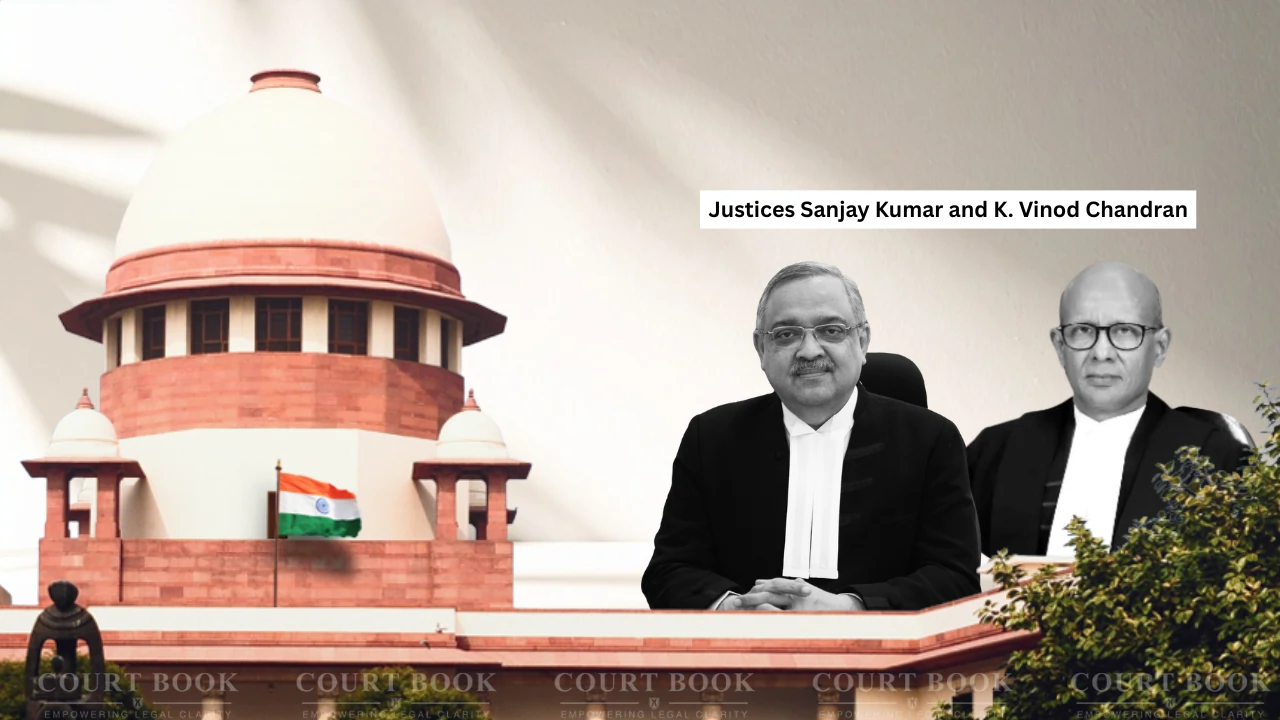
In a significant ruling, the Supreme Court of India has set aside a High Court acquittal in a corruption case, holding that demand for bribe can still be established even when the complainant turns partially hostile during trial.
Background of the Case
The case titled State of Kerala vs K.A. Abdul Rasheed (Criminal Appeal arising out of SLP (Crl.) No. 1808 of 2026) was decided on April 15, 2026, by a bench led by Justice K. Vinod Chandran.
The respondent, a Taluk Supply Officer (TSO), was accused of demanding ₹500 from a ration dealer to countersign official records known as the ‘Abstract’. A trap was laid by vigilance officials, during which the money was recovered from the accused.
Read also:- Delhi HC Takes Kejriwal’s Bias Affidavit on Record, Refuses to Reopen Recusal Hearing in Excise Case
The trial court convicted the officer under the Prevention of Corruption Act, awarding two years’ imprisonment. However, the High Court later acquitted him, citing lack of clear proof of demand.
The Supreme Court closely examined the testimony of the complainant (PW1), who had given inconsistent statements during trial.
“The evidence of a hostile witness cannot be discarded entirely,” the bench noted, adding that courts must identify and rely on credible portions of such testimony.
The Court observed that:
• The complainant had initially confirmed the demand in his complaint before vigilance officers.
• Independent witnesses and the trap officer corroborated key events, including the recovery of money.
• The accused admitted receiving the ₹500, though he gave conflicting explanations.
Read also:- Husband’s Low Income Claim Not Fully Trusted, Yet ₹13K Maintenance Upheld by Delhi HC
Importantly, the Court emphasised:
“The earlier demand stands established despite inconsistencies in deposition.”
The Court reiterated that proving demand and acceptance is essential for conviction under corruption law.
While the High Court found demand unproven due to inconsistencies and a missing witness, the Supreme Court disagreed. It held that:
• Demand can be inferred from the overall evidence, not just direct testimony.
• The complainant’s confirmed complaint and corroboration by officials were sufficient.
• A false explanation by the accused regarding money recovery strengthens the prosecution’s case.
Read also:- False Marriage Promise Row : Delhi High Court Refuses Relief to Accused, Notes Prima Facie Deception
“The acceptance of the amount is established beyond doubt,” the bench observed.
Setting aside the High Court’s acquittal, the Supreme Court restored the trial court’s conviction and sentence.
“We allow the appeal… restoring the order of the trial court,” the Court ruled, adding that the punishment awarded was already the statutory minimum and required no modification.
Case Details
Case Title: State of Kerala vs K.A. Abdul Rasheed
Case Number: Criminal Appeal (arising from SLP (Crl.) No. 1808 of 2026)
Judge: Justice K. Vinod Chandran with Justice Sanjay Kumar
Decision Date: April 15, 2026
Download Judgment

