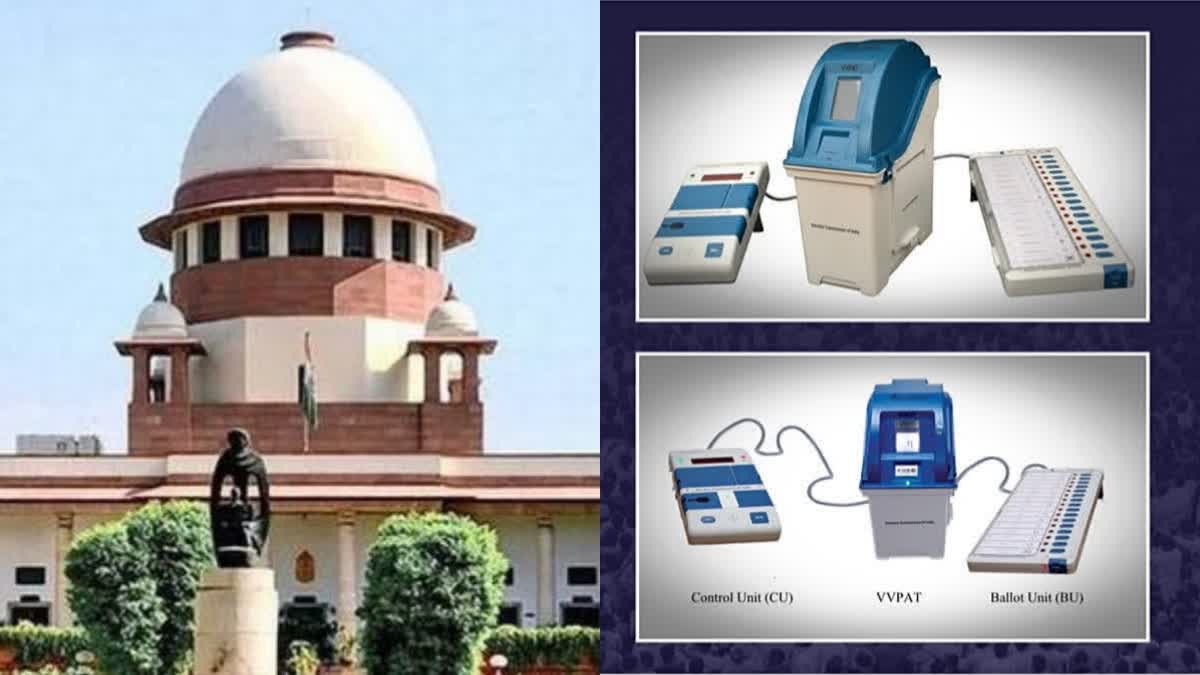
The Supreme Court has asked the Union government to examine whether a totaliser system can be introduced for counting votes recorded in Electronic Voting Machines (EVMs), with the aim of preventing the voting pattern of individual polling booths from being identified.
A Bench comprising Chief Justice of India Surya Kant, Justice Joymalya Bagchi and Justice V. Mohana was hearing petitions concerning the disclosure of booth-wise voting results.
A totaliser would combine votes from several EVMs before individual machine results are revealed. This would make it difficult to determine how a particular polling booth voted.
Background of the Case
The petitioners argued that revealing booth-wise voting patterns could expose voters to intimidation or victimisation after elections. Advocate Ashwini Kumar Upadhyay submitted that a totaliser could, for example, combine the results of 14 EVMs, preventing candidates from identifying the exact support received from a particular booth.
He referred to the Election Commission of India’s earlier stand supporting the introduction of totalisers and relied on a January 2018 Supreme Court order concerning the issue.
The ECI, however, pointed to several practical and legal difficulties. Senior Advocate Dama Seshadri Naidu submitted that there was no specific statutory provision presently authorising the use of a totaliser for EVM counting.
Court’s Observations
Justice Bagchi observed that the totaliser was, in principle, a mechanism for anonymising voter choice. He also questioned why an exception similar to Rule 59A of the Conduct of Elections Rules, 1961 could not potentially apply to EVM counting.
The provision permits aggregated counting of ballot-paper votes in specified circumstances where there is a concern that voters may be identified and subjected to intimidation or victimisation.
Justice Bagchi observed:
“On principle, totalizer is a good tool to ensure anonymization of voter choice. But the difficulty is - let's say we pass an order. They will have to have statutory backing.”
Chief Justice Surya Kant also noted that the ECI had identified roadblocks rather than necessarily rejecting the idea on principle.
The ECI pointed to the existing verification system involving Form 17C, which records votes polled at each polling station. It submitted that aggregating EVM results could affect booth-wise verification and create difficulties in maintaining the existing audit trail.
The Commission also raised concerns regarding the Supreme Court’s directions concerning verification of Voter Verifiable Paper Audit Trail (VVPAT) records.
Supreme Court Seeks Centre’s Decision
After considering the submissions, the Bench directed the Union government to examine the issue and determine whether the Conduct of Elections Rules could be amended to provide for totalisers in EVM counting.
The Court also asked the government to consider Rule 59A and the Law Commission’s recommendation on totalisation contained in its 255th Report.
Chief Justice Surya Kant directed:
“We would like to know what are the impediments, if any, and whether there would be any negative impact because of introduction of such a mechanism. The Election Commission may make a suitable proposal/representation to the Union of India. The Union of India shall take a call on the proposal.”
The petitions were accordingly taken up with the Union government being asked to examine the legal and practical aspects of introducing the mechanism.







-300x169.webp)