

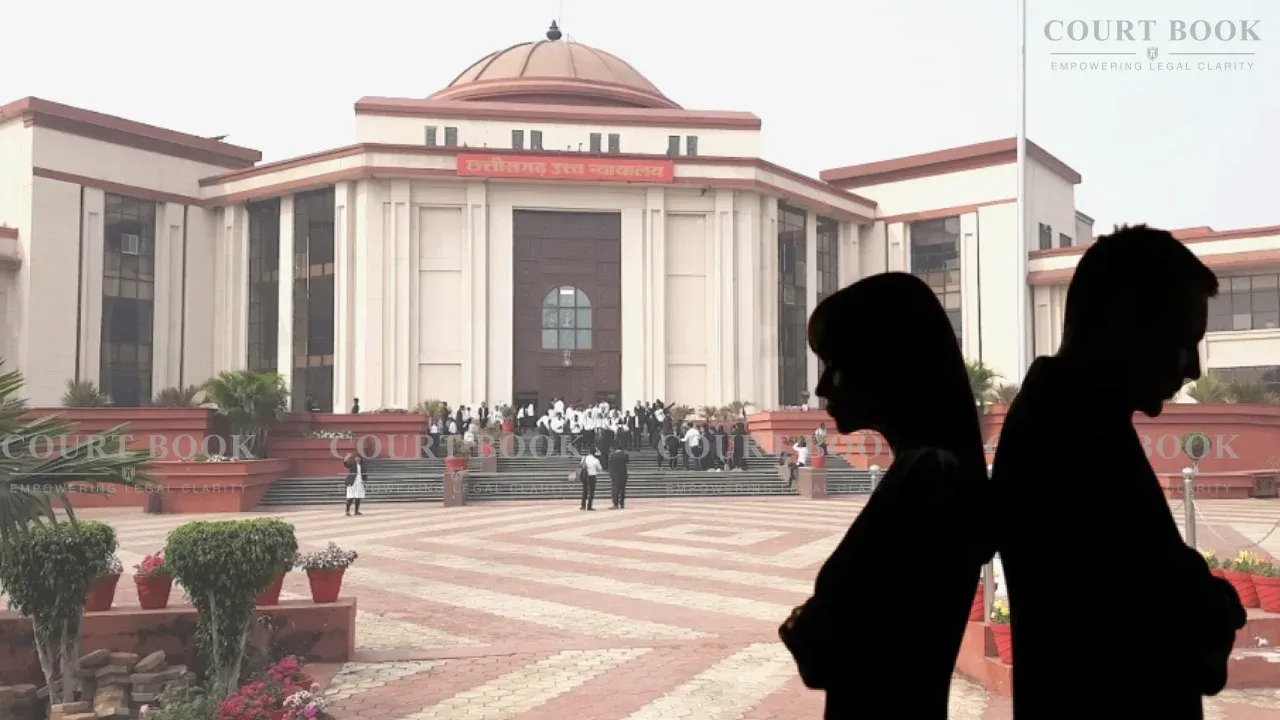
The Chhattisgarh High Court at Bilaspur has allowed a wife’s appeal seeking divorce on the ground of cruelty, holding that the material placed on record, particularly the unchallenged WhatsApp chats, disclosed conduct amounting to mental cruelty. The Division Bench of Justice Parth Prateem Sahu and Justice Sushma Sawant delivered the judgment on September 23, 2026.
The appeal arose from a Family Court judgment dated April 2, 2024, which had rejected the wife’s plea for divorce. The High Court set aside that decision and dissolved the marriage.
The appellant-wife had approached the Family Court seeking dissolution of her marriage with the respondent-husband on the ground of cruelty. According to her case, the marriage was solemnised on December 5, 2021, and the parties resided together for about one month after the marriage. During this period, she alleged that her husband abused and assaulted her, following which matrimonial disputes arose between them.
She alleged that her husband subjected her to physical and verbal abuse, threatened her, and demanded an air-conditioner as dowry. She also stated that after her family members intervened, abusive messages were sent to her and her sisters. The husband did not appear before the Family Court despite service of summons and was proceeded against ex parte.
The Family Court nevertheless held that cruelty had not been proved and dismissed the divorce petition. During the appeal, the wife also sought to introduce a police complaint lodged in August 2026 concerning alleged harassment during the pendency of the proceedings.
The High Court first rejected the application to introduce the later police complaint as additional evidence. The Bench noted that the complaint had not yet resulted in any established finding and that the allegations contained in it had neither been proved nor disproved.
The Court therefore examined the evidence that had already been placed before the Family Court, particularly the WhatsApp conversations produced by the wife.
The Bench noted that the WhatsApp chats marked as Exhibits P-2 and P-3 had been discarded by the Family Court partly because the identity of the mobile-phone holder had not been established and the conversations were incomplete. The High Court, however, found that the husband had not specifically denied or challenged the contents.
Referring to Section 14 of the Family Courts Act, 1984, the Bench observed that Family Courts have wider discretion to receive material that may assist them in effectively deciding matrimonial disputes.
The Court stated:
“Since the documents marked as Exs.P-2 & P-3 produced by the appellant, have remained unchallenged, there is no reason to disbelieve them. A perusal of these documents reflects the mindset of the respondent, indicating that he did not hold a respectful or appropriate view even towards his sisters-in-law. Such conduct, particularly when directed towards the family members of the wife, would undoubtedly cause deep mental anguish and constitute grave mental cruelty to any wife.”
The Bench also referred to the Supreme Court’s principles on mental cruelty, including the requirement to assess matrimonial conduct in its overall context rather than treating isolated incidents separately.
The High Court concluded that the Family Court had erred in appreciating the material available on record. It held that the conduct reflected in the WhatsApp conversations amounted to mental cruelty and warranted interference with the Family Court’s judgment.
Accordingly, the Division Bench allowed the appeal and set aside the Family Court’s judgment and decree dated April 2, 2024. The Court granted the wife a decree of divorce and dissolved the marriage solemnised between the parties on December 5, 2021. The Court also reserved liberty for the wife to seek permanent alimony separately under Section 25 of the Hindu Marriage Act, 1955.
Case Title: Archana Singh v. Anand Kumar Gupta
Case Number: FA(MAT) No. 189 of 2024


