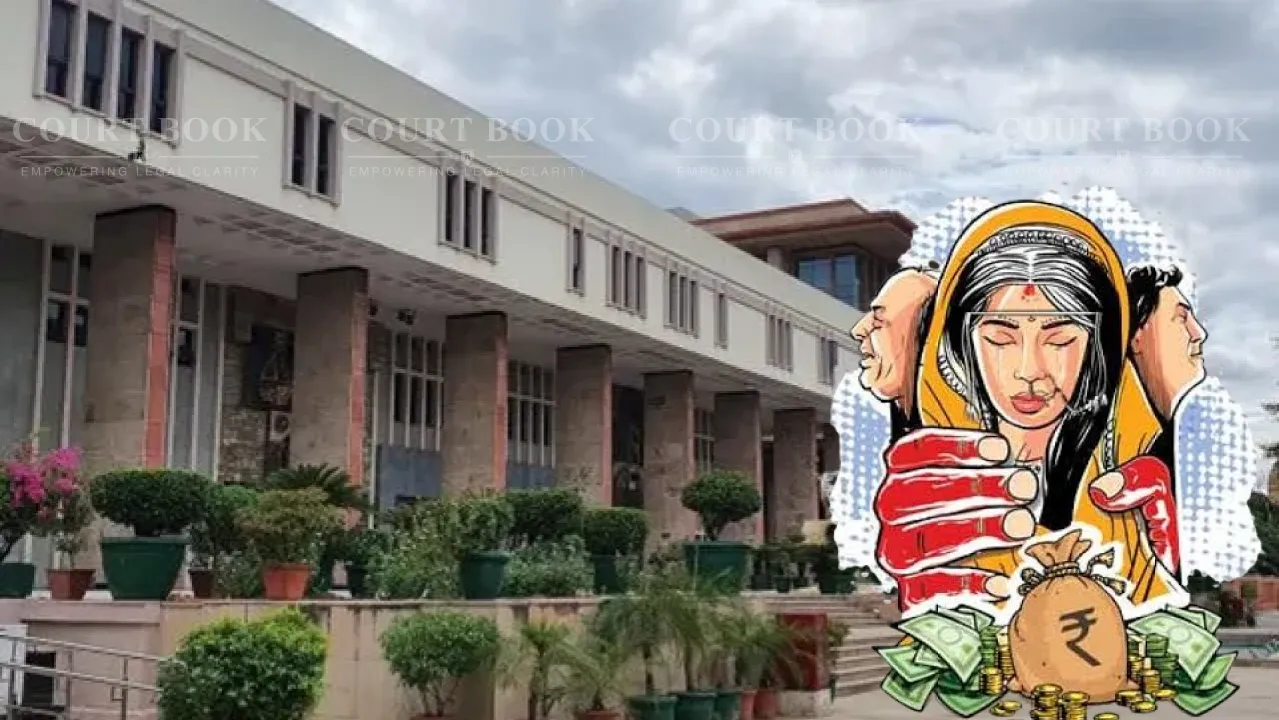
The Delhi High Court has dismissed an appeal filed by Naveen Kumar Verma and Ajay Kumar Verma against their conviction under Sections 304-B and 498-A of the Indian Penal Code (IPC) in connection with the death of Naveen's wife, Vinita @ Kamlesh.
Justice Vimal Kumar Yadav, in a judgment dated September 15, 2026, upheld the conviction and sentence imposed by the trial court, finding that the prosecution had established consistent evidence regarding a ₹50,000 dowry demand and harassment before the woman's death.
Background
Vinita married Naveen Kumar Verma on November 29, 2002. On April 10, 2003, she was found hanging from a ceiling fan at a residence in Railway Colony, Tughlakabad, New Delhi.
The prosecution alleged that after the marriage, Vinita was subjected to beatings and harassment by her husband and brother-in-law in connection with a demand for ₹50,000. Her father, mother, brother, uncle and sister were examined during the trial.
The trial court convicted Naveen and Ajay under Sections 304-B and 498-A IPC. They were sentenced to 10 years' rigorous imprisonment under Section 304-B and three years' rigorous imprisonment along with a fine of ₹5,000 under Section 498-A. Their mother, Kaushalya Devi, was acquitted by the trial court and that acquittal was not challenged by the State.
Before the High Court, the appellants argued that the prosecution witnesses were relatives of the deceased and that their evidence contained inconsistencies. They also relied upon the absence of physical injuries and argued that there was no independent witness supporting the allegations.
The High Court examined the statements made before the police, the Sub-Divisional Magistrate and the trial court. It found that although there were variations concerning certain details, the central allegation of a ₹50,000 demand remained consistent across the evidence.
The Court observed:
“The demand was specific both in quantum (₹50,000) and in kind (cash), as deposed to by PW-1, PW-2, PW-3, PW-4, and PW-5.”
The Court also held that the fact that the witnesses were related to the deceased did not, by itself, make their testimony unreliable.
A significant part of the judgment appears in Paragraph 28, where the Court considered the argument concerning the purpose of the ₹50,000 demand.
The Court noted that one witness had explained the demand as being connected with setting up a business. It held that this circumstance did not take the demand outside the definition of dowry.
The Court stated:
“The circumstance that PW-2, in the course of her testimony, explained the demand as being connected with setting up a business does not take it outside the definition of dowry, since a demand connected with the marital relationship does not cease to be a dowry demand merely because the purpose disclosed for it is ‘business’ rather than ‘personal use’.”
The High Court further agreed with the trial court that Section 304-B IPC does not require proof of a concluded agreement to give dowry; the specific demand was sufficient when considered with the other requirements of the provision.
The Court then examined whether the alleged harassment occurred “soon before” Vinita's death. It explained that the expression does not mean immediately before death and has to be assessed according to the facts of each case.
The Court noted that the marriage lasted only about four and a half months and that the evidence indicated the alleged demand and harassment had continued during this period. Even if the harassment was taken to have begun in January 2003, the Court found the interval before the April 10 death sufficiently proximate.
The High Court held that the prosecution had established the foundational facts required for the statutory presumption under Section 113-B of the Indian Evidence Act. It found that the defence had failed to rebut that presumption through reliable evidence.
The Delhi High Court maintained the conviction dated August 16, 2004 and the sentence dated August 17, 2004 under Sections 304-B and 498-A IPC.
The appeal was dismissed. Naveen Kumar Verma and Ajay Kumar Verma were directed to surrender forthwith to undergo the remaining sentence, subject to the benefit of set-off under Section 428 Cr.P.C.
Case Details
Case Title: Naveen Kumar Verma & Anr. v. State
Case Number: CRL.A. 677/2004
Judge: Justice Vimal Kumar Yadav
Decision Date: September 15, 2026





-300x169.webp)
 Act (UAPA)-300x169.webp)