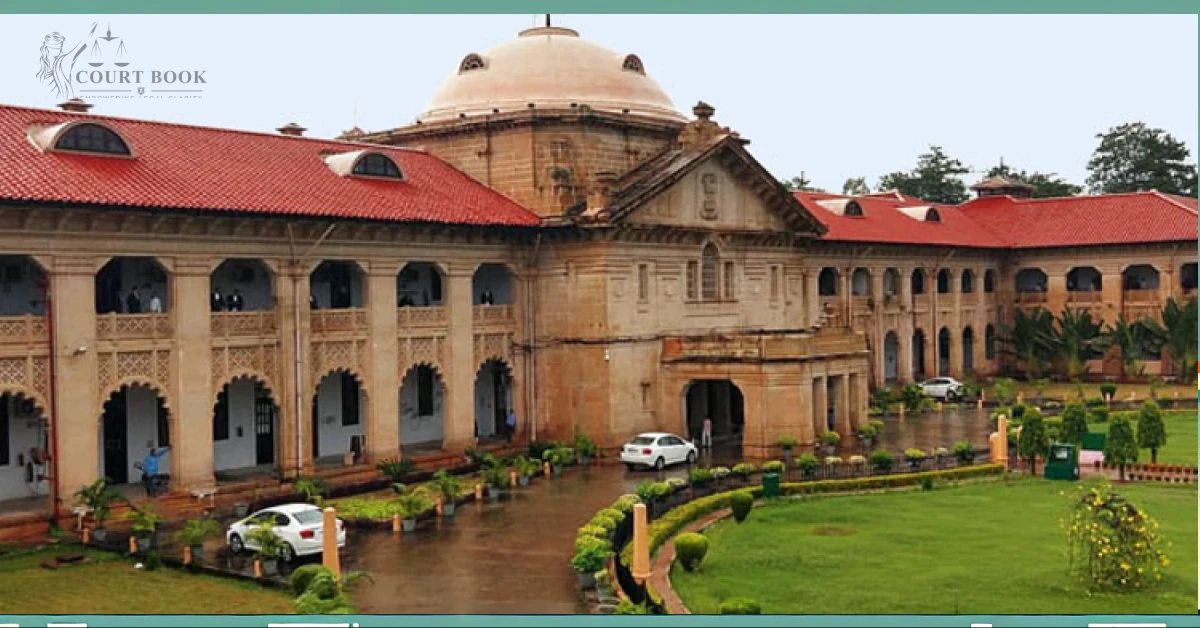
The Allahabad High Court has directed the Railway Claims Tribunal (RCT) to release the entire compensation awarded to adult claimants in railway accident and untoward incident cases, holding that the amount cannot be restricted merely on the basis of literacy or financial condition.
Justice Rohit Ranjan Agarwal passed the order on September 10, 2026, while deciding a batch of writ petitions led by Ram Naresh Singh and 5 Others v. Union of India. The petitions challenged Rule 5 of the Railway Accidents and Untoward Incidents (Compensation) Rules, 1990, particularly the provisions governing how compensation awarded by the RCT is to be disbursed.
Background of the Case
The petitioners were either dependants of passengers who died in railway incidents or passengers who themselves suffered injuries. After the RCT awarded compensation, only 10 percent of the amount was released in the cases, while the remaining amount was directed to be kept in fixed deposits or interest-bearing accounts.
The challenge was primarily directed against Rule 5.1 and Rule 5.4.1(i) and (ii). The petitioners argued that these provisions created an impermissible distinction between literate and illiterate claimants and between financially stronger and weaker persons, contrary to the equality guarantee under Article 14 of the Constitution.
Rule 5 was introduced following directions issued by the Delhi High Court in Geeta Devi v. Union of India, with the stated objective of protecting compensation from possible exploitation by middlemen and others.
Court's Observation
Justice Agarwal examined the statutory framework governing railway compensation and noted that the maximum compensation prescribed under Rule 3 was Rs. 8 lakh. The Court specifically considered the practice of releasing only 10 percent while keeping the balance in fixed deposits.
"Need of a claimant cannot be gauged by RCT," the Court observed, holding that the restrictions under Rule 5.1 and Rule 5.4.1 could not justify withholding the awarded amount on the basis of literacy or financial circumstances.
The Court further noted that there was no material before it to establish that an illiterate or financially weaker claimant was incapable of managing the compensation awarded by the Tribunal. It also considered the widespread availability of bank accounts and banking facilities.
The Court held that subordinate rules framed to facilitate an Act cannot curtail the benefit that the parent legislation provides to claimants. It found that withholding 90 percent of the awarded compensation created a barrier between claimants based on literacy and financial position.
Decision
The High Court did not strike down the entire Rule 5. Instead, it read down Rule 5.1 and Rule 5.4.1(i) and (ii), meaning that the provisions were given a narrower interpretation to bring their operation in line with the law.
The Court directed that the Tribunal shall release the awarded amount to claimants, except in cases covered by Rule 5.2, which concerns minors or persons of unsound mind. Where a claimant does not have an individual savings account in a nationalised bank near their permanent residence, the RCT may direct that such an account be opened.
The writ petitions were partly allowed. The Tribunal was directed to release the entire awarded amount to the petitioners who are major and are not covered by Rule 5.2.
Amounts already kept in fixed deposits were also directed to be released immediately, and the RCT orders were modified to that extent.
Case Details:
Case Title: Ram Naresh Singh and 5 Others v. Union of India
Case Number: Writ-C No. 27617 of 2026, along with connected petitions
Judge: Justice Rohit Ranjan Agarwal
Decision Date: September 10, 2026