

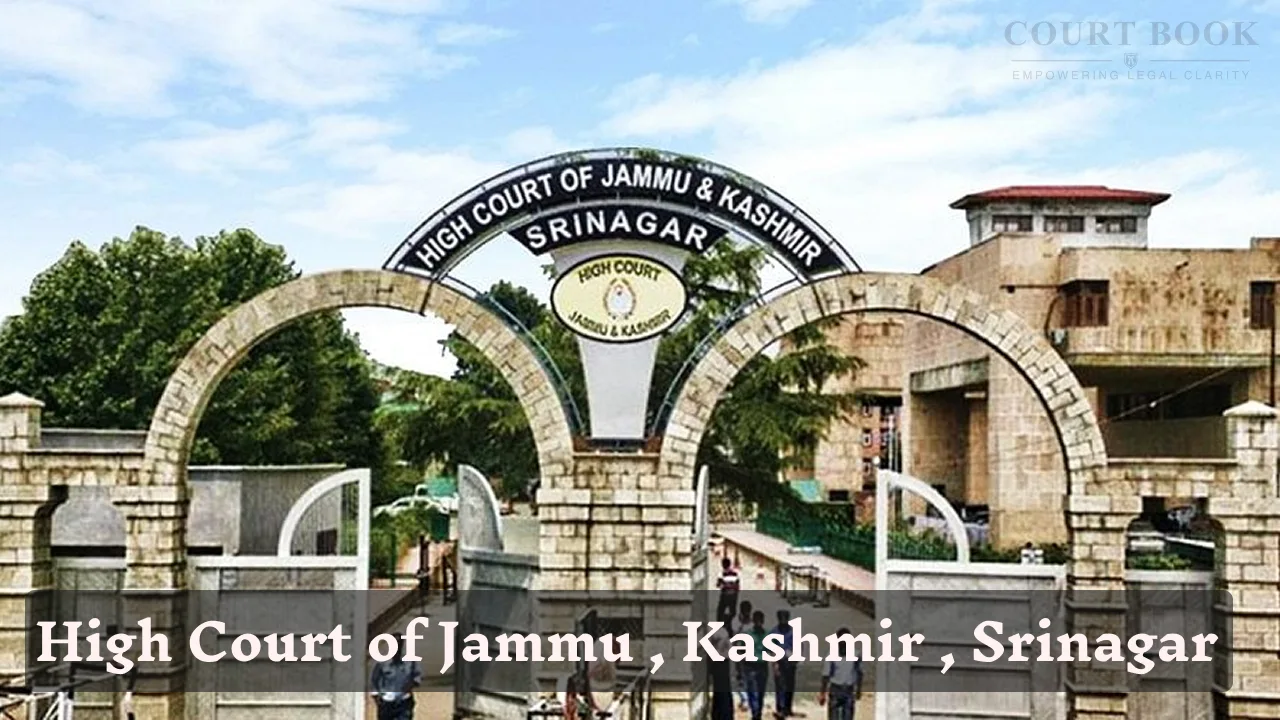
The Jammu & Kashmir and Ladakh High Court has refused to quash criminal proceedings in a cheque bounce case, holding that allegations of cheque alteration must be tested during trial. The court made it clear that such disputes cannot be settled at the preliminary stage when facts remain disputed.
Justice Sanjay Dhar passed the order while dismissing a petition filed by Abdul Hamid Wani, who had challenged the criminal complaint pending against him under Section 138 of the Negotiable Instruments Act.
Read also:-No Evidence, Yet Organised Crime Tag: MP High Court Calls It Misuse of Power, Grants Bail
Background of the Case
The dispute arose from a cheque allegedly issued by Abdul Hamid Wani in favour of Abdul Hamid Lone. According to the complaint, the accused had issued a cheque worth ₹14 lakh towards repayment of a liability.
When the cheque was presented before the bank, it was returned unpaid with the remark “alterations require drawer’s authentication.”
Following this, a legal notice was sent to the accused demanding payment within the statutory period. As no payment was made, the complainant approached the trial court in Shopian, which took cognizance of the offence and issued summons.
The accused then moved the High Court, claiming that the cheque had been tampered with and that he had only issued it for ₹14,000 - not ₹14 lakh. He alleged that the complainant had altered the figures to inflate the amount.
Key Legal Issue Before the Court
The central question before the High Court was:
Does dishonour of a cheque due to unauthenticated alterations amount to an offence under Section 138 of the Negotiable Instruments Act?
The petitioner argued that since the cheque was allegedly forged, no offence could be made out against him. He also claimed that sufficient funds were available in his account at the time of presentation.
Court’s Observations
The High Court referred to several Supreme Court judgments, including M/s Lakshmi Dyechem v. State of Gujarat and Veera Exports v. T. Kalavathy, to clarify the legal position.
The bench observed that dishonour of a cheque is not limited to cases of insufficient funds alone. Any deliberate act by the drawer that results in dishonour-such as signature mismatch or unauthenticated alterations-can attract liability under Section 138.
“If a drawer intentionally makes alterations in the cheque to prevent its encashment, such conduct would fall within the mischief of Section 138,” the court observed.
The judge further explained that alteration of the cheque amount is a material alteration under Section 87 of the Negotiable Instruments Act. However, the crucial question is who made the alteration-the drawer or the payee.
Why the Case Was Not Quashed
The court noted that determining who altered the cheque requires examination of evidence, which can only be done during trial.
Importantly, the court pointed out that:
• The accused did not reply to the statutory legal notice.
• The issue of alteration is a question of fact, not law.
• Such factual disputes cannot be decided in proceedings seeking quashing of a complaint.
“Whether the alteration was made by the drawer or the payee can only be decided after evidence is led before the trial court,” the bench said.
The court also emphasized that even if a cheque is altered, the drawer cannot escape liability automatically unless it is proven that the alteration was done without his consent.
Read also:-Environmental Lapse Exposed: MP High Court Flags Thousands of Units Operating Without Consent
Final Decision
Rejecting the plea for interference, the High Court dismissed the petition and allowed the criminal proceedings to continue.
“The petitioner is free to raise all his defences before the trial court at the appropriate stage,” the court concluded.
The trial court has been directed to proceed in accordance with law.
Case Title: Abdul Hamid Wani vs Abdul Hamid Lone
Case No.: CRM(M) No. 264/2022
Decision Date: 21 November 2025
Download Judgment

