

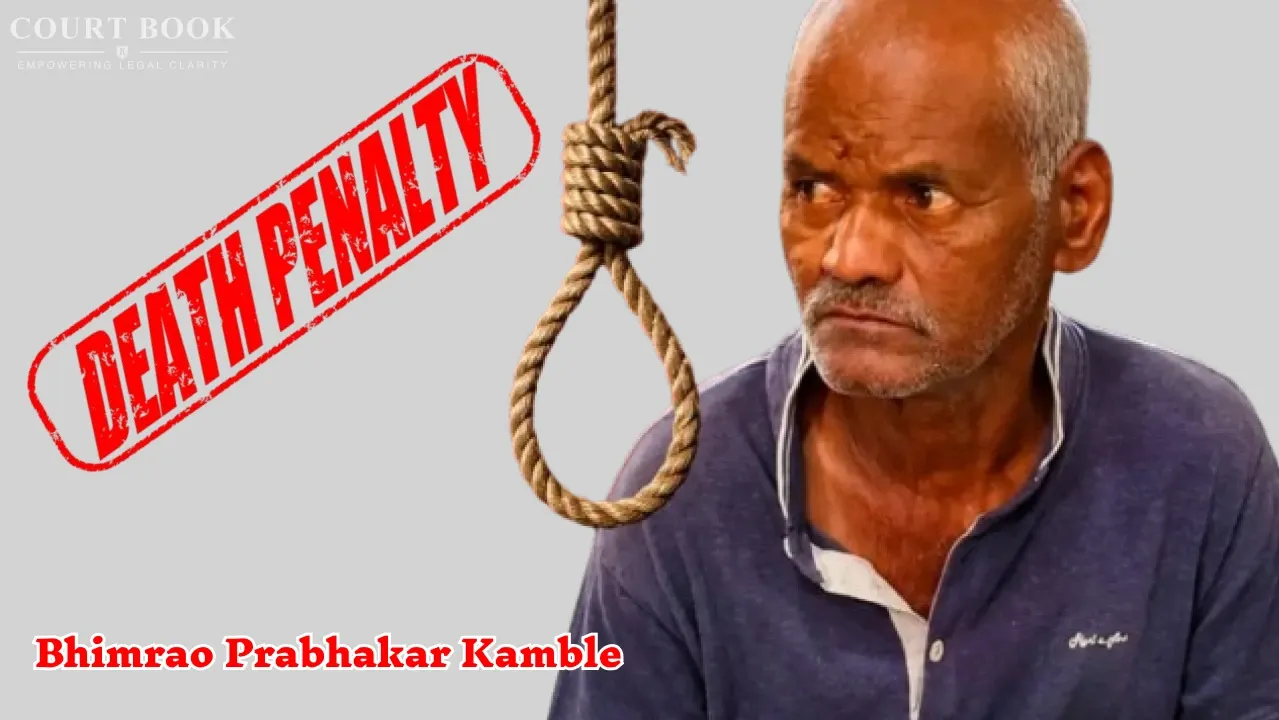
A Special POCSO Court in Pune has awarded the death penalty to Bhimrao Prabhakar Kamble after convicting him for the kidnapping, sexual assault and murder of a three-year-old girl. The court held that the prosecution established an unbroken chain of circumstantial evidence, supported by CCTV footage, forensic findings and medical evidence, leaving no reasonable doubt about the accused's involvement.
Background of the Case
According to the prosecution, the incident took place on 1 May 2026 in Nasarapur village of Pune district. The child had been playing near a temple when she went missing. During the search, villagers reviewed CCTV footage and allegedly saw the accused walking with the child towards a tin shed near a cowshed before returning alone a short while later.
The child was later found inside the shed in an injured condition and was declared dead. The investigation relied on CCTV footage, forensic examination, DNA analysis, medical reports and other scientific evidence. The accused was subsequently prosecuted under multiple provisions of the Bharatiya Nyaya Sanhita (BNS) and the Protection of Children from Sexual Offences (POCSO) Act.
Court's Observations
Special Judge S.R. Salunkhe noted that although there was no eyewitness to the incident, the case rested on a complete chain of circumstantial evidence that consistently pointed towards the accused.
Referring to the prosecution's evidence, the court observed that,
"the prosecution has proved the guilt of the accused beyond reasonable doubt by establishing the continuous and complete chain of circumstances."
The court also examined the legal principles governing circumstantial evidence and the "last seen together" theory before concluding that the prosecution had successfully proved every material circumstance forming the chain of guilt.
During the hearing on sentence, the prosecution argued that the brutality of the crime, coupled with the surrounding circumstances, justified the maximum punishment available under law. It submitted that the case fell within the category of the "rarest of rare" cases.
The defence opposed the death sentence, arguing that the prosecution case was based on circumstantial evidence and that life imprisonment would be an appropriate punishment considering the accused's age and personal circumstances. The accused was also personally heard by the court before sentencing.
The court extensively discussed Supreme Court precedents on capital punishment, including the principles laid down in Bachan Singh v. State of Punjab, observing that life imprisonment remains the normal rule and death sentence can be awarded only after recording special reasons in exceptionally grave cases.
Decision
After evaluating the evidence and the sentencing principles, the Special POCSO Court convicted the accused under Sections 137(2), 140(1), 74, 64, 65(2), 103(1) and 238 of the Bharatiya Nyaya Sanhita, along with Sections 4, 6, 8 and 12 of the POCSO Act.
The court ultimately imposed the death penalty, holding that the case warranted capital punishment.
Case Details
Case Title: The State of Maharashtra v. Bhimrao Prabhakar Kamble
Case Number: Special POCSO Case No. 467/2026
Judge: Special Judge S.R. Salunkhe
Decision Date: 29 June 2026


