

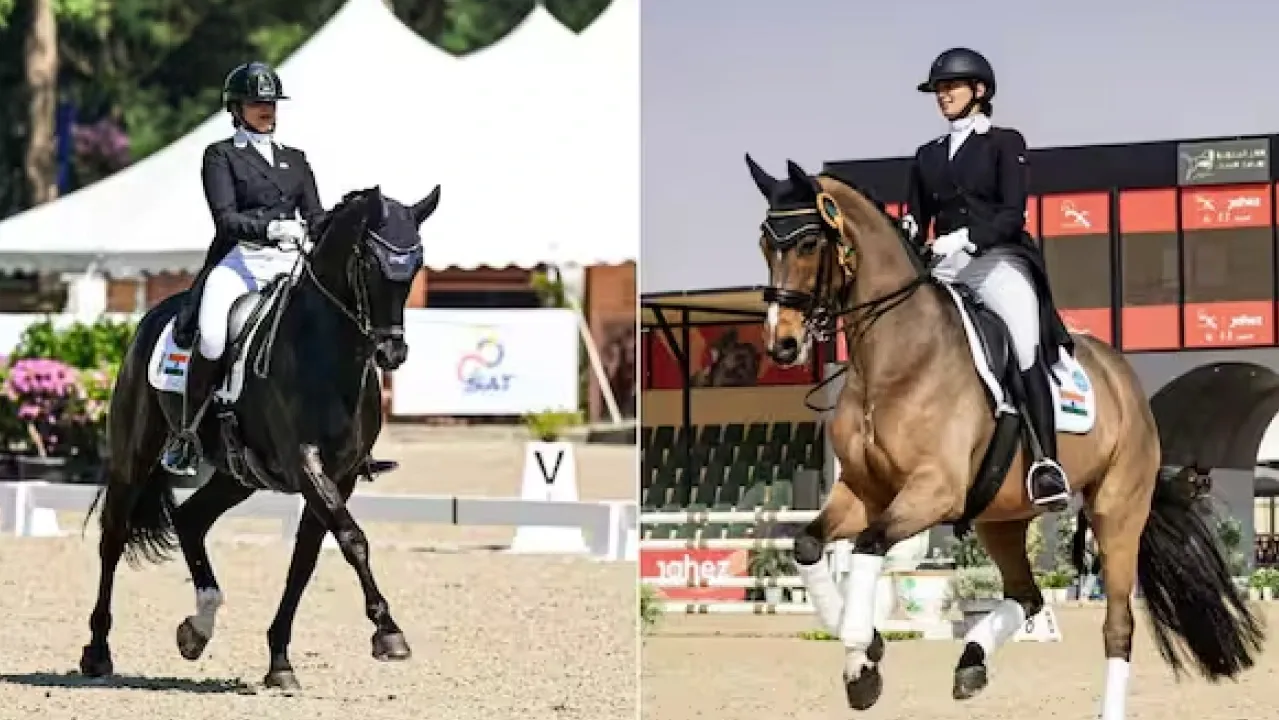
The Delhi High Court has dismissed two petitions challenging the selection of India's Dressage team for the 20th Asian Games, holding that courts cannot interfere with decisions of expert sports bodies unless the process is shown to be arbitrary, irrational or contrary to the governing rules. The Court found that the Equestrian Federation of India (EFI) had followed its notified selection criteria while preparing the final merit list.
Background of the Case
The petitions were filed by Sudipti Hajela and Anush Agarwalla after the EFI released its selection list on 16 June 2026 for the Dressage discipline of the Asian Games scheduled to be held in Japan from 19 September to 4 October 2026.
Both horse-rider combinations were placed on the reserve list. Anush Agarwalla's horse-rider combination was placed as Reserve No. 1, while Sudipti Hajela's horse-rider combination was placed as Reserve No. 2. They sought cancellation of the selection list and requested inclusion among the four horse-rider combinations selected to represent India in the Dressage event.
Agarwalla argued that one of his competition scores from Hagen, Germany should have been considered while calculating his Minimum Eligibility Requirement (MER), which, according to him, would have improved his ranking. He also alleged bias because a member of the Selection Committee was involved in separate litigation with him.
Hajela, on the other hand, contended that EFI had incorrectly ranked participants by relying on individual MER calculations instead of first considering Team MERs before determining comparative merit.
Court's Observations
Justice Mini Pushkarna examined the EFI Selection Criteria and noted that horse-rider combinations were to be ranked based on the highest cumulative percentage obtained from their best two valid MER results.
Rejecting Agarwalla's challenge, the Court held that he could not selectively replace one score from a completed competition with another score from a different event because the competition in Belgium had already included all the mandatory Dressage tests.
The Court observed:
"Such interpretation as sought to be given by the petitioner, is not in line with the intent and purport of the Selection Criteria."
The Court also found no merit in the argument that other selected riders had been allowed to combine scores from different events. It explained that those instances involved competitions where certain mandatory tests were unavailable, allowing the horse-rider combinations to complete the remaining tests at subsequent events in accordance with the notified Selection Criteria.
No Grounds for Judicial Interference
The High Court reiterated the settled principle that judicial review in sports selection disputes is limited. It emphasized that courts cannot replace the opinion of expert selection committees merely because another interpretation is possible.
The bench observed:
"The Court cannot substitute its decision over a decision of the Expert Committee, except where the decision is shown to have been exercised in an arbitrary or capricious or perverse manner."
After examining the record, the Court concluded that the EFI's method of calculating MERs achieved by each horse-rider combination and preparing the merit list was fully consistent with the published Selection Criteria.
It also rejected Hajela's argument that Team MERs should have been given priority over Individual MERs, noting that the rules required ranking based on cumulative scores from valid MER results while giving preference to horse-rider combinations achieving Individual MERs over those having only Team MERs.
Bias Allegation Rejected
The Court also dismissed Agarwalla's allegation of bias against a member of the Selection Committee.
It noted that although the petitioner had earlier raised an objection through a WhatsApp message, he participated in the selection process without seeking reconstitution of the committee or pursuing any legal remedy before the results were declared.
According to the Court, a candidate who knowingly participates in the process cannot later challenge the committee's composition after receiving an unfavourable result.
Court's Decision
Holding that the selection process was neither arbitrary nor contrary to the notified rules, Justice Mini Pushkarna declined to interfere with the EFI's decision.
The Court observed that the Selection Committee and the Ad-hoc Executive Committee had evaluated the eligible horse-rider combinations on the basis of objective performance, MER achievements and the prescribed Selection Criteria before finalising the team and reserve list.
Finding no legal infirmity in the process, the Delhi High Court dismissed both writ petitions along with the pending applications.


